India curbs ‘grocery under 10 minutes’. But riders must still fatally race | Business and Economy
New Delhi, India — Just moments before, they were both navigating the busiest traffic hours at an intersection in Noida, a satellite city of Delhi, delivering groceries at the doorstep. The next thing he knew, Himanshu Pal, 21, stood there, helpless, looking over the body of his colleague, rammed by a car.
His friend, Ankush, was “just 18, and just out of high school,” Pal told Al Jazeera. It was Ankush’s first day in a metropolitan city, after he came from his village in eastern Bihar, more than 1,000km (600 miles) away; he rented a cheap electric bike and signed up with Swiggy, one of India’s quick commerce giants.
Ankush packed his first order and tried to figure out how to reach the location – mandatorily within 10 minutes – when Pal held his hand and showed him the way around the app. “He was trying his best: looking at the phone, then on the road, a customer calling back; then on the phone, a traffic light, and then on the road again,” Pal recalled, from October last year.
“That was all. A car hit and left him dead at the signal.” Pal and his colleagues crowdfunded for an ambulance to take the body back to his village.
Quick delivery, quick death
India’s rapid delivery services are a marvel to the rest of the world, competing to deliver everything from food to groceries and medicines to cigarettes to the country’s 430 million-strong middle class. Swiggy, where Ankush worked, and Zomato have been the dominant quick commerce platforms for more than a decade. But others have joined, too, including Zepto and Flipkart Minutes. In December 2024, Amazon entered the market with a 15-minute delivery service called Tez — which means “fast” in Hindi and Urdu.
As competition tightened, some, like Zomato’s Blinkit service, explicitly promised 10-minute deliveries, while others like Swiggy’s Instamart tried to get riders to deliver in most cases in about 10 minutes.

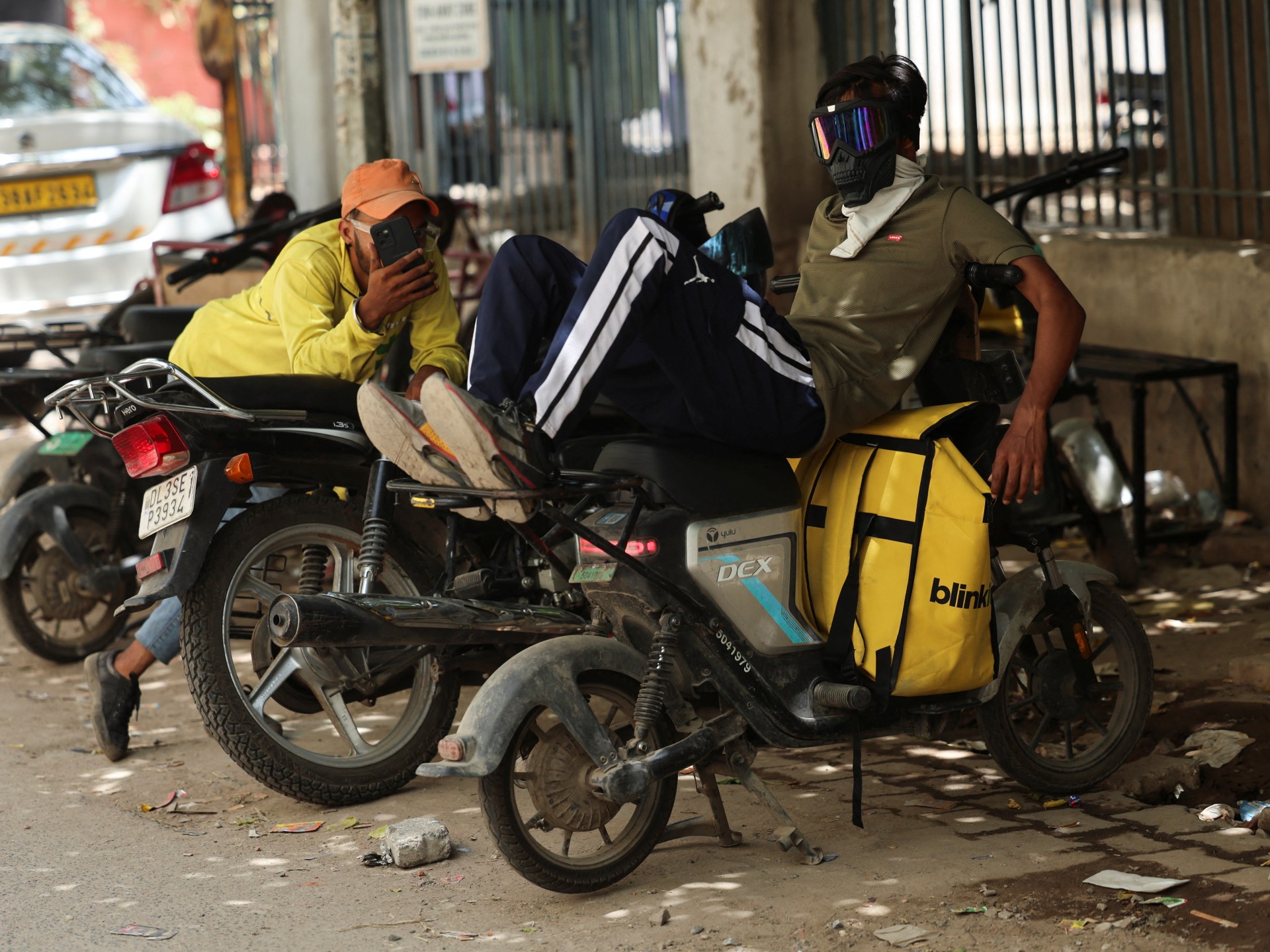
But for riders trying to beat traffic-congested and potholed roads in India’s metropolises, these top-down delivery deadlines have often served as a death trap. Riders and unions have repeatedly pointed out road accidents that often lead to deaths but are not reported as workplace fatalities. And the dangers extend well beyond crashes. Workers ride long hours outdoors in extreme heat, alongside deadly exposure to toxic air in cities like Delhi and Bengaluru. Payouts are influenced by a star-based rating system, which means that riders can’t push back against misbehaving customers.
In early January, the Indian government intervened and asked all quick commerce platforms to stop promising “10-minute deliveries” after a nationwide strike by the gig workers over dangerous working conditions.
But experts and workers toiling within India’s mammoth quick commerce engine say that the reality remains largely unchanged — the intense competition for speedy deliveries means that with or without a formal 10-minute promise, riders are under pressure to do whatever it takes to get packages to customers as fast as possible.
“The Indian middle class is literally riding on the back of the poor,” said Vandana Vasudevan, the author of OTP Please!, a 2025 book on the lives of gig workers. “They sit at home, and are extremely pampered by this rather innovative tech model,” she told Al Jazeera, “but all these privileges are coming at the cost of workers.”

Rise of 10-minute delivery
After the COVID-19 pandemic, which paved the path for digitising grocery services in India, quick commerce platforms have leveraged small “dark stores” — a warehouse exclusively meant to store goods for online shopping — in neighbourhoods to deliver thousands of products, from groceries and skincare to the latest iPhone.
As companies like Walmart’s Flipkart, Swiggy, or IPO-bound Zepto raced for even faster deliveries, they also redefined how urban India bought into the psychological appeal of instant gratification. Where many Indians previously planned and purchased, a study last year found that quick commerce had turned several of them into more impulsive buyers.
India’s gig economy, a $11.5bn market, has been ballooning: gig workers are projected to rise from 7.7 million in 2021 to 23.5 million by 2030, according to Niti Aayog, a government think tank.
In the last financial year, quick commerce platforms had a record-high year, with gross orders worth $7bn, more than double the previous year. The sector has been an investment darling, recording a staggering 142 percent compound annual growth rate from 2022.
But driving this apparent success story are two darker demographic factors, say experts. Middle-class neighbourhoods in Indian cities, while crammed together, are often segregated communities, making it easier for companies to rent a cheap warehouse near a posh locality. Meanwhile, the gap between the rich and the poor has reached a historic high, visible in everything from stagnant wages to the concentration of vast wealth. This allows companies to keep hundreds of riders idle, at every single store, waiting in line to pick the next order and race to deliver, without providing social security or minimum wages.
After the direction from officials of India’s labour ministry, quick commerce companies appear to have replaced the marketing promise of instant delivery within 10 minutes with other features like the availability of products.
But experts say that won’t change much – for the companies, or their workers.
The removal of the 10-minute delivery catchline is largely “optics-driven rather than business-altering,” Karan Taurani, executive vice president at securities firm Elara Capital, told Al Jazeera, adding that the proposition of quick commerce continues to be anchored in speed and convenience that remains structurally superior to horizontal e-commerce timelines.
A week after the government direction, platforms were often still showing a delivery time of less than 10 minutes, when Al Jazeera checked in three different cities in the national capital region, which also includes New Delhi.

‘The inherent design problem’
Quick commerce companies maintain that the new direction would have no material impact on their business model.
Delivery riders agree.
“We deliver groceries to doorsteps, keeping our lives on [the] line every single time,” said Pal, waiting outside a dark store near a wealthy neighbourhood in Noida, just outside New Delhi, for his next order. “This instant delivery idea is so rubbish; what could one possibly need within 10 minutes?”
The riders say the problem is inherent in the design. “The system works on simple maths for us: the more orders you deliver, the more you earn,” added Pankaj Kumar, another delivery rider, hovering over Pal’s shoulder.
“If we want to earn money on these platforms, we need to ride faster – all the while, flying my bike on the wrong side [of the road] and jumping signals,” Kumar said.
However, Vasudevan, the author, said that “the government’s intervention is a welcome step that has come as a relief to some workers.”
“The 10-minute problem comes with customer expectations; once you do away with the promise, the act of speed becomes at least voluntary,” she said.
“The architecture of a faster delivery is not a wrong thing in itself,” argued Vasudevan. “But a tight deadline is an architectural imposition on the riders that became the norm, unfortunately.”
And India’s quick commerce model has little regard for its workers’ welfare, Vasudevan added.
The Indian government is also introducing new labour laws that formally recognise gig workers for the first time, propose social security benefits, including pensions and accident insurance, and plans to establish a social security fund, partly funded by companies.
But for now, those plans exist just on paper – and workers say that they learned that there’s only one way for them to be heard: through collective action.

You snooze, you lose
In the face of worsening working conditions and fluctuating wages, several workers’ groups coordinated a strike on New Year’s Eve.
Shaik Salauddin, national general secretary of the Indian Federation of App-Based Transport Workers (IFAT) that led the stoppage, told Al Jazeera that their demands from the platform companies were met with “corporate flexing power muscles, from PR games to intimidating riders”.
Salauddin, who is also part of a committee interacting with the Indian government on regulations, said that the demands included making companies’ algorithms, which dictate payouts, transparent and reliable. The workers are also asking for an end to “arbitrary blocking of workers’ IDs” and the right to organise protests.
Delivery riders say platforms use automated algorithms to deactivate a worker’s account, essentially firing them without notice, for a range of reasons, including lower ratings, frequent order cancellations, or customer complaints. The riders involved in protests have also faced police investigations in some cases.
In a statement on the strike, which sparked a fierce debate in the country on workers’ working conditions, one of the quick commerce leaders, Deepinder Goyal, who until recently headed Eternal, Zomato’s parent company, called the complaining workers “miscreants” who caused law and order problems.
The government appeared to disagree.
Welcoming the government’s intervention, Salauddin said, “Our collective voice reached the CEOs and the government; it is a win for those unionising.
“Thousands of riders logged off during peak hours in a protest for the right to life and dignity at the workplace,” said Salauddin.
But, “if the companies cheat us, then we will not sit silently,” he said, referring to the issue that the platforms are still delivering orders within 10 minutes after the government’s intervention.
Kumar, the delivery rider in Noida, said none of the riders were informed of any change by the platforms.
After the government intervention, Kumar said, the onus of riding quickly lies with them, now.
He fractured his right shoulder while delivering an order last year. Kumar said he was not provided with financial assistance in his treatment. Three days later, with a plaster on, he returned to the store, willing to ride with one hand. The manager had no problem, he said.
“If we lose a streak – of say hours in a day, days in a week – then we lose incentives,” said Kumar, standing dejected outside the dark store.
“What are we for the company? Just robots on bikes, delivering orders,” he added. “What’s for them to lose if one bike goes off the street?”




Post Comment