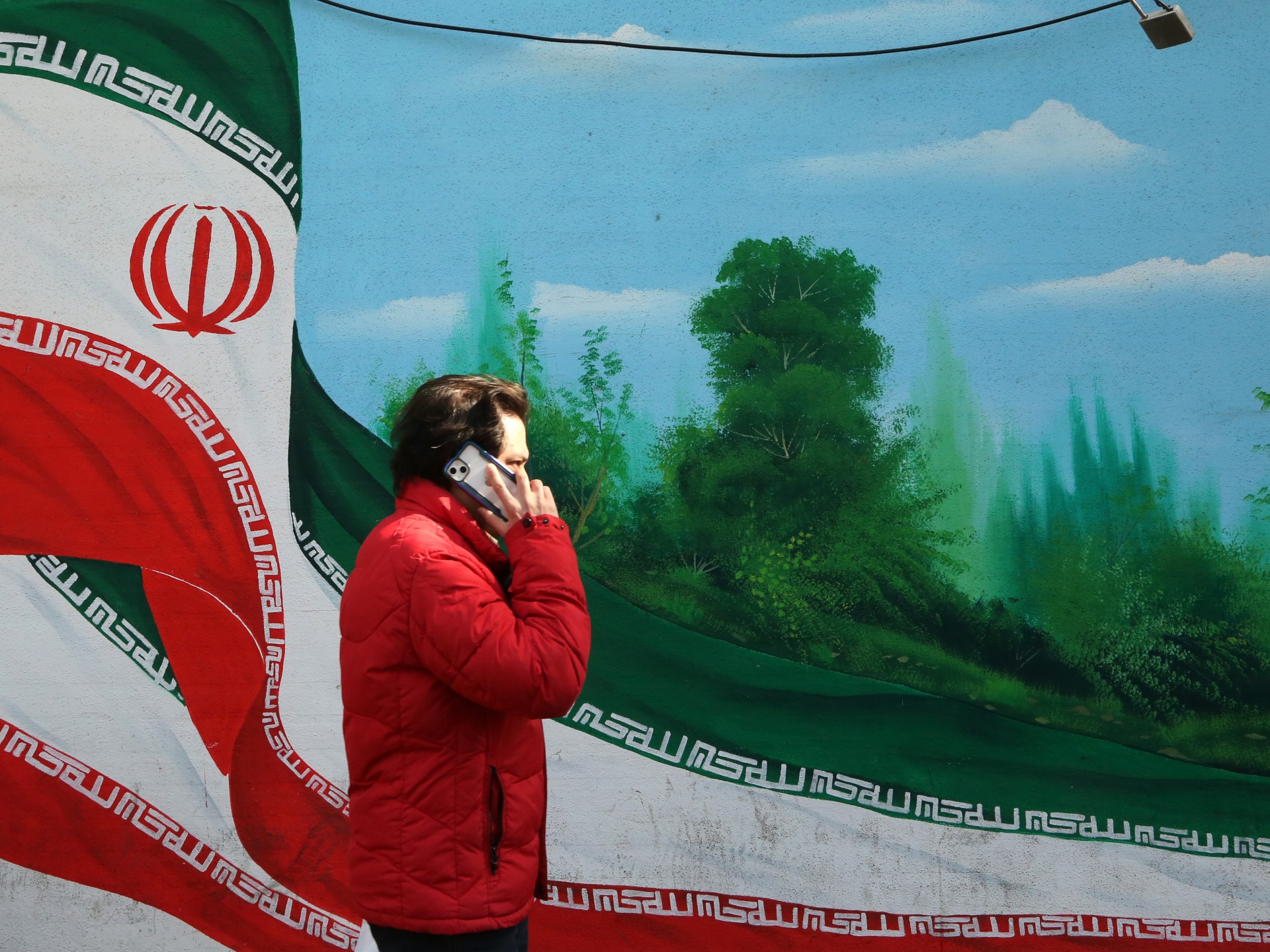
Iran prepares for war as US military ‘armada’ approaches | Conflict News
Tehran, Iran – Iranian authorities have signalled that they are ready to defend their country as the United States continues to threaten a military attack, amid regional diplomatic efforts to avoid a new conflict.
Iran’s Foreign Minister Abbas Araghchi will hold high-level talks in Turkiye on Friday, according to Esmaeil Baghaei, the Foreign Ministry’s spokesperson.
Recommended Stories
list of 3 itemsend of list
Baghaei added that Tehran is looking to “constantly strengthen ties with neighbours based on shared interests”.
The visit comes amid a flurry of high-level talks, as regional leaders hope to convince the US not to attack, and the two sides to find some kind of compromise.
But a US “armada” – as President Donald Trump called it on Wednesday – continues to position itself near Iran’s waters, led by the USS Abraham Lincoln aircraft carrier.
And in Iran, top political, military and judicial authorities continue to send messages of defiance, indicating that Iran’s focus is on defence, and not talks.
“Tehran’s priority is currently not to negotiate with the US, but to have 200 percent readiness to defend our country,” Kazem Gharibabadi, a senior member of the Iranian negotiating team, was quoted as saying by state media on Wednesday.
Gharibabadi said that messages have recently been exchanged with the US through intermediaries. But he added that even if conditions were suitable for talks, Iran would remain fully prepared to defend itself, noting that it was previously attacked – first by Israel and then the US – last June, just as negotiations were about to get under way.
Army prepared
Iran has emphasised its military strength in recent days, following on from numerous military exercises held since June’s 12-day war, when a number of its senior military officials were killed, and nuclear sites were attacked.
The Iranian army announced on Thursday that 1,000 new “strategic” drones joined its forces. They include one-way suicide drones, as well as combat, reconnaissance and cyberwarfare-capable aircraft that can hit fixed or mobile targets on land, air and sea, according to the army.
“Proportionate to the threats facing us, the agenda of the army includes maintaining and improving strategic advantages for fast combat and a decisive response to any aggression,” army commander Amir Hamati said in a short statement.
The Islamic Revolutionary Guard Corps (IRGC) has also previously touted its ability to endure attacks and keep launching ballistic and cruise missiles at Israel, as well as US assets across the region if necessary.
‘Our people will die’
In Tehran and across the country, Iranians have closely followed Trump’s often contradictory rhetoric – renewing threats while also expressing his willingness to talk.
The Islamic Republic’s most fervent supporters appear steadfast in their support for the government, even as Washington says that the Iranian state is at its weakest since coming to power nearly half a century ago, following protests that rocked the country this month and led to the deaths of thousands.
“America can’t do a damn thing,” a young woman told Al Jazeera in Tehran, repeating a refrain favoured by Supreme Leader Ayatollah Ali Khamenei and his top officials.
“Even if, God forbid, they launch some kind of missile towards us, it is the Islamic Republic that will give a decisive response and level their bases to the ground,” she said.
But even as the government and its supporters remain focused on how much damage Iran may potentially be able to inflict on Israel and the US if it is attacked, many Iranians are fearful of what the second conflict in the space of a year will mean for them.
“I think another war would be totally terrible for both countries [Iran and Israel], and it’s the people of our country who will die in it,” another young woman, a student, said from Tehran on Thursday.
“If war breaks out, we will face destruction and devastation. I hope this doesn’t happen,” a man in his 50s said. All of those interviewed asked to remain anonymous for security reasons.
Preparedness
Authorities have been working to increase civilian preparedness in the event of a war.
Iranian President Masoud Pezeshkian delegated some authorities to governors of Iran’s border provinces, allowing them to import essential goods, especially food, in case of war.
Attention has also turned towards the dire need for public shelters to protect Iranians during aerial attacks.
Alireza Zakani, the hardline lawmaker-turned-mayor of Tehran, said in a statement on Thursday that the city municipality will build “underground parking shelters” as a “priority project”.
But Zakani added that the project would only be completed “over the coming years”, meaning that Iranians will once again have few locations to protect themselves during bombing raids if a conflict does break out imminently.
A new conflict will also likely mean the return of a communications blackout, a scenario that occurred during the June war and during the most-recent protests.
All internet and mobile access were cut off by the state across Iran on the night of January 8, during the height of the nationwide protests, during one of the bloodiest chapters of the Islamic Republic since the 1979 revolution.
After imposing nearly three weeks of total blackout affecting more than 90 million people, one of the longest and most widespread in its history, Iranian authorities have restored some internet bandwidth over recent days, but communication for most people remains disconnected or heavily disrupted.
But those who have been able to get online are now seeing images of the bloodshed of the past few weeks and are worried about the potential for yet more if fighting does break out.
“I’m afraid that soon again we will be woken up by the sounds of loud explosions at night because of a war,” a young woman in Tehran said, adding that she had been inundated with heartbreaking images and videos of protesters killed across the country. “But even without a war, death is already all around us.”

Post Comment