In Zimbabwe, millions choose funeral insurance over pricey medical cover | Health News
Harare, Zimbabwe – Ngoni Mutambararo’s uncle, Steward Ganda, 60, spent the last months of his life at home, trying to recover from a severe ailment on his own.
Ganda suffered from severe pain in his legs that left him confined to bed and unable to tend the small tuck shop he ran in Kambuzuma, a low-income suburb in Harare.
Recommended Stories
list of 3 itemsend of list
Like millions of Zimbabweans without health insurance and unable to cover hospital expenses, he had hoped to soldier through and get well without medical attention. But as the weeks and months passed, his condition deteriorated.
Eventually, family members convinced him to consult a physician, and he was first admitted to Sally Mugabe Central Hospital. Doctors initially suspected he’d suffered a stroke. But on further inspection, they told the family he may have a kidney-related issue and needed to see a specialist, a nephrologist whose consultation fee was $600.
With no savings, Ganda’s family spent a month late last year trying to gather the money, hoping it would save his life. But it was too late.
“We couldn’t raise that amount,” Mutambararo, 39, told Al Jazeera. “He died barely a month after the admission.”
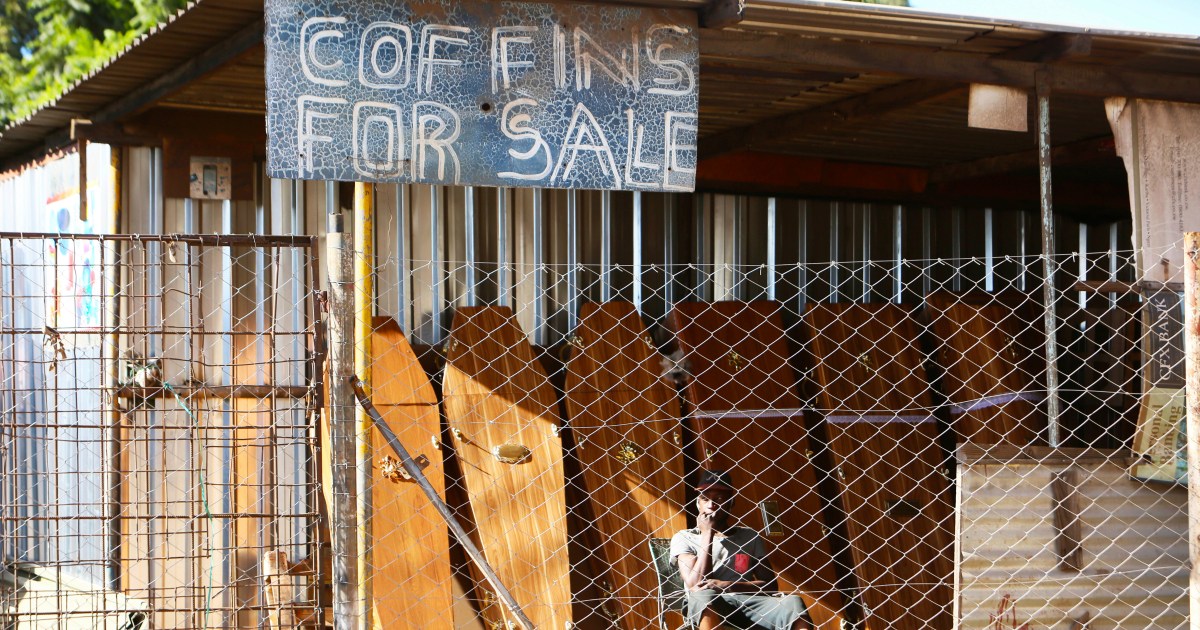
Soon after, the funeral was held. And while Ganda had spent his last months in pain and relative poverty, the service that bid him farewell was enviable: a casket, a hearse, burial equipment and a 65-seat bus to carry mourners on the 135km (85-mile) journey from Harare to his hometown of Wedza.
While Ganda could not afford health insurance, which averages about $200 per month and would have covered his diagnosis and treatment, he never missed his $11 monthly payment to a funeral services company, Nyaradzo Group, which paid his post-death costs.
Ganda is no exception. In Zimbabwe, data show more people are preparing for death than for survival as funeral insurance has eclipsed medical cover to become the most widely held financial product in the country.

Although health insurance is accessible through employers and monthly premiums are deducted automatically from salaries, fewer than 900,000 Zimbabweans are formally employed.
About 16 million people, or roughly 90 percent of the population, have no health insurance and must fund medical care out of their own pockets, according to 2023-2024 data from Zimbabwe’s National Statistics Agency.
At the same time, experts said funeral policies offer a cheaper, culturally resonant form of support, especially in a society in which dignity in death often takes precedence over safeguarding life itself.
Of all insured Zimbabweans, 72 percent hold funeral insurance policies while 30 percent have health insurance, according to a 2022 report from the financial inclusion nonprofit FinMark Trust.
‘Life after death is important’
For most Zimbabweans, medical cover is a luxury they cannot afford, so they forgo private healthcare for government services. Public health fees can start at about $5 per month, but government-run facilities suffer from poor infrastructure, limited drug supplies and staff shortages caused by the migration of healthcare professionals, which many said lead to low-quality care.
Although some private insurance premiums start at about $10 per month, others run into tens and even a few hundred dollars, putting plans beyond the reach of many households in a country where 60 percent of the population lives on less than $3.65 a day.
In comparison, funeral insurance plans are widely accessible and relatively low cost. The funeral cover provider Ecosure, for instance, offers plans starting at $0.75 while Zimnat’s policies begin at $1.
“Funerals are immediate, unavoidable events that come with significant financial and communal expectations,” said Innocent Tshuma, the public relations manager at Doves Holdings Group, a funeral services provider.
“In contrast, access to comprehensive medical aid remains limited due to affordability challenges, exclusions and unpredictable out-of-pocket costs.”
He argued that Zimbabweans place deep importance on dignity, respect and collective responsibility at times of death and funeral insurance offers certainty in cost and service delivery, “which explains its strong appeal in an environment of constrained household incomes”.

Vivek Solanki, a physician and member of the Zimbabwe Medical Association, agreed.
“In Zimbabwean culture, the aspect of life after death is very much important, and it’s actually not a financial one,” he told Al Jazeera.
On the other hand, he added, “it’s almost a taboo to think about how and when [someone is] going to get sick … because it’s like you are attracting bad things to happen.”
Solanki also attributed the low numbers of people with health insurance to a legacy of post-independence policies when citizens relied on government-funded healthcare and rarely worried about costs. But things have been deteriorating since the public system began collapsing in the 2000s after Western sanctions were imposed.
“But today, even to receive proper healthcare in public hospitals, private funds are required,” Solanki said. “For many people in Zimbabwe, covering the financial burden of emergencies, chronic illnesses and noncommunicable diseases has become extremely challenging.”
Low prioritisation of medical insurance remains a significant hurdle in Zimbabwe, where 25 percent lack access to basics like food, healthcare and education. To address this, the country plans to launch a national health insurance scheme in June as it aims to expand access to quality healthcare for all.
Itai Rusike – the director of the Community Working Group on Health, a network of civic organisations, and a public health activist – said the initiative “affirms the government’s commitment to ensure universal health coverage”.
However, he expressed concerns about the government’s capacity to sustain the programme, given the current challenges of high public debt, currency fragility and persistent inflation facing Zimbabwe.
“To fully achieve the full potential of a National Health Insurance scheme, actions to address the social determinants of health must be implemented,” he said. “These include economic stability, community and physical environment, education and social context, and the healthcare system.”

Death insurance: A ‘commercialisation of life’?
The public health system currently is in a state of collapse after years of chronic underfunding. With just 1.7 hospital beds per 1,000 people and a maternal mortality rate of 462 per 100,000 live births compared with a global rate of 197 deaths per 100,000 live births, thousands are locked out of essential care.
Funeral insurance, on the other hand, is accessible and booming with 66 percent of all life assurance revenue in 2024 coming from funeral policies.
According to EcoSure, funerals typically cost $800 to $3,000 in Zimbabwe depending on the city, number of attendees and type of service. For many, this makes funeral insurance a worthwhile investment.
However, African spiritualist and traditionalist Pearson Takaingei Marinda calls the trend a “commercialisation of life”.
“Culturally, we appreciate and celebrate life and transition [death], but in the modern day, we are forced to prepare for death more than life,” Marinda told Al Jazeera. “Traditionally, funerals and burials are facilitated by the society and the deceased would be buried covered in animal skin, but due to commercialisation, people are forced to pay for coffins.”
In line with newer traditions, those who cannot afford formal funeral policies are turning to informal, community-based burial schemes, joining grassroots efforts to ensure their families can preserve dignity in death.
Ellie Mlambo, whose father died last year after a long battle with a heart condition, spent nearly a year consulting traditional healers and prophets because their services were far cheaper than medical insurance and hospital bills.
When he passed, two burial savings groups – Chirongwa Chemadzimai Chekuviga and Tashinga Burial – attended Mlambo’s father’s funeral in Machavangu, 100km (62 miles) southeast of Harare, supporting her bereaved mother. The former collects $1 per member per month and helps contribute to eventual funeral costs while the latter collects $2 per member monthly and contributes $120 towards a coffin.
“My mother paid up for two burial savings, but since my father was on my funeral policy, the money was given to my mother for other uses,” Mlambo told Al Jazeera.

Some informal burial groups often go beyond covering funeral costs and provide mealie-meal, a traditional corn-based dish, vegetables and cooking utensils to support the bereaved.
In Jegede village, a rural area in Zaka, community members established the Jegede Burial Society last year after an elderly woman died without the means to afford a coffin, a proper burial or food for those attending her funeral. Traditionally, the bereaved family would provide for the funeral, and neighbours would simply gather to offer moral support, but the community now helps ensure basic needs are met.
The chairperson of the Jegede Burial Society, Chomudisa Jegede, said the incident reminded the community of the importance of having a contingency plan for funerals.
“Our community responded well, and we are now made up of 44 members and each is obliged to contribute $10 when a member dies,” he told Al Jazeera. “It is working very well because so far we have managed to assist some five members during funerals of their immediate families.”
However, Jegede noted that the community needs to go beyond death and also focus on the need for health insurance.
His sentiments were echoed by Solanki from the Zimbabwe Medical Association.
“Education and public awareness on the importance of medical insurance and providing funds towards healthcare is the way to go in an era where health is no longer free,” he said.
He also urged Zimbabweans in the diaspora to contribute to the initiative, noting that their experience with health insurance in the countries where they work gives them a clearer understanding of its benefits.
“Perhaps the diasporians could fund or pay towards health insurance of their families in Zimbabwe,” he said, “I think that’ll be one of the ways to encourage people, educate them and create awareness of the essential need for health funding in case of any emergency or health ailments.”
This article is published in collaboration with Egab.


Post Comment