‘Regavim’: Israel’s new Rafah border site carries coded annexation message | Israel-Palestine conflict
Name of Israeli military facility at Gaza crossing with Egypt linked to Zionist anthem and pro-settler NGO, signalling a shift, analysts say, from security control to West Bank-style land grab and dehumanisation of Palestinians.
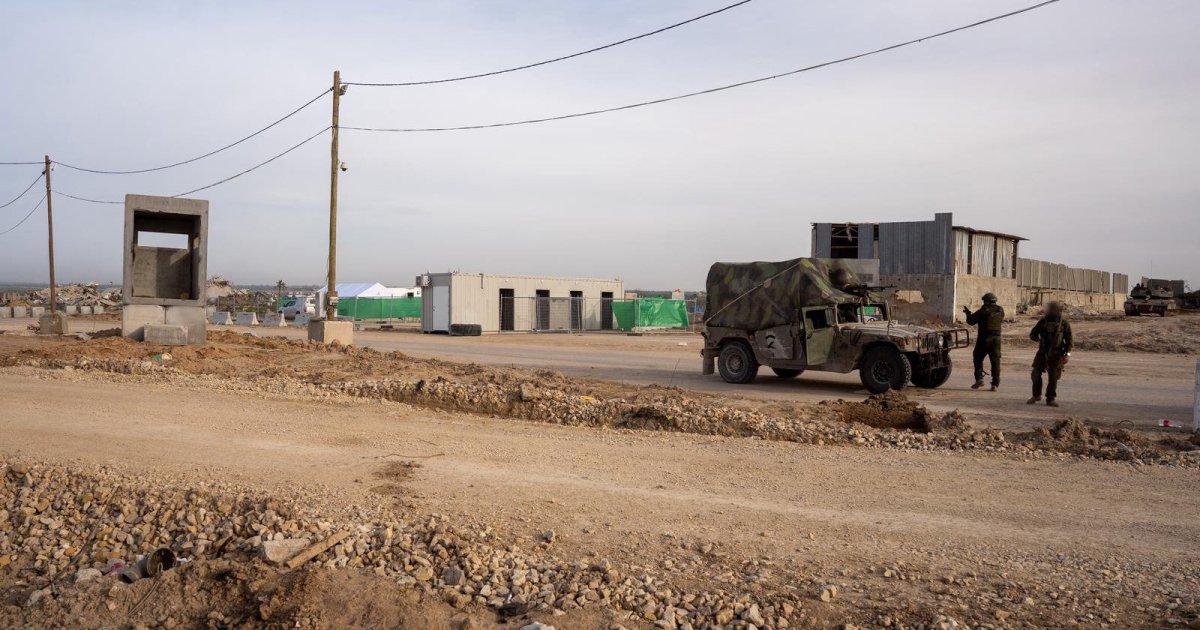
The Rafah border crossing between Gaza and Egypt has reopened partially for a few Palestinians after an 18-month closure in tandem with an added restriction to control the movement of returnees. The Israeli army has set up a checkpoint called Regavim in an area under its control outside the crossing for those entering Gaza from Egypt.
As the first trickle of humanity passed through the gates on Monday, official Israeli military documents gave it a name that indicates the facility is no longer being treated as a border crossing but as an operation for population control.
In an official statement published on its website on Sunday, the Israeli army announced the completion of what it called the “Regavim Inspection Nekez”.
While the Israeli military frames this technical language as routine, analysts told Al Jazeera that the choice of the words “Regavim” and “Nekez” indicates Israel’s long-term intentions.
Al Jazeera spoke to Israeli affairs experts who argued that these terms reveal a dual strategy: invoking Zionist nostalgia to claim the land while using engineering terms to dehumanise the Palestinian people.
Historical code: ‘Clod after clod’
For analyst Mohannad Mustafa, the name Regavim is not random; it is a deliberate ideological trigger intended to resonate with the Israeli government’s far-right base.
“In Hebrew, Regavim means ‘clods of earth’ or patches of arable land,” Mustafa explained. “But it is not just a word. It is a trigger for the Zionist collective memory of land redemption.”
The term is inextricably linked to the Zionist children’s song and poem Dunam Po Ve Dunam Sham (A Dunam Here, a Dunam There) by Joshua Friedman, which was an anthem for the early settlement movement. The lyrics celebrate the acquisition of land: “Dunam here and dunam there/Clod after clod (Regev ahar regev)/Thus we shall redeem the land of the people.”
“By officially naming the Rafah corridor Regavim, the army is sending a subliminal message,” Mustafa said. “They are framing their presence in Gaza not as a temporary security mission but as a form of ‘redeeming the land’ identical to the ideology of the early pioneers.”
Political code: The ‘West Bank model’
Beyond the historical nostalgia, the name has a direct line to the present-day architects of Israel’s annexation policies: the Regavim Movement.
This far-right NGO, cofounded in 2006 by Finance Minister Bezalel Smotrich, has been the primary force behind the expansion of Israeli control in the occupied West Bank. A 2023 investigation by the Israeli newspaper Haaretz detailed how the organisation essentially became the “intelligence officer” for the state, using drones and field data to map and demolish Palestinian structures in Area C, the 61 percent of the occupied West Bank under full Israeli control.
Mustafa argued that applying this name to the Rafah crossing signals the transfer of the “civil administration” model from the West Bank to Gaza.
“It suggests that Gaza is no longer a separate entity but a territory to be managed with the same tools used to prevent Palestinian statehood in Judea and Samaria,” Mustafa said, using the Israeli terms for the West Bank.
Operational code: A ‘political brand’ and a ‘drain’
Analyst Ihab Jabareen takes the name Regavim a step further. He argued it has evolved beyond its linguistic meaning into a modern “political brand” for the settlement right and is being used to normalise a long-term Israeli presence.
However, Jabareen said the use of the term Nekez in the Israeli military statement portends even more danger.
“While Regavim operates as a political brand, Nekez reveals the cold, engineering mindset of the military,” Jabareen told Al Jazeera. “A Nekez is a drainage point. It is a hydraulic term used for managing sewage, floodwaters or irrigation – not for processing human beings.”
Jabareen argued that describing a human border crossing as a “drain” reflects three chilling assumptions now formalised in military doctrine:
- Dehumanisation: “The Palestinian is no longer a citizen. They are a ‘fluid mass’ or a ‘flow’ that must be regulated to prevent overflow,” Jabareen said.
- The end of negotiations: “You do not negotiate with a drain. Rafah is no longer a political border subject to sovereignty. It is an engineering problem to be managed.
- Infrastructure, not a border: “Security is now being managed like a sewage system – purely technical, devoid of rights.”
“This is colder and more dangerous than standard settlement rhetoric,” Jabareen warned. “It converts the political issue of Gaza into a permanent technical function.”
A formula for ‘quiet control’
Both analysts agreed that the official adoption of these two terms points to a reality that is neither a full withdrawal nor declared annexation.
“It is a formula for ‘quiet control’,” Jabareen explained. “Israel doesn’t need to declare immediate settlement to control the territory. By treating the land as ‘Regavim’ (soil to be held) and the people as a ‘Nekez’ (a flow to be filtered), they are establishing a long-term reality where Gaza is an administered space, never an independent entity.”
Mustafa concurred: “The name ‘Regavim’ tells the settlers: ‘We have returned to the land.’ And the official designation ‘Nekez’ tells the security establishment: ‘We have the valve to turn the human flow on or off at will.’”




Post Comment