Relief for patients leaving Gaza as Rafah opens, but thousands still wait | Israel-Palestine conflict News
Khan Younis, Gaza – The headlines read that Israel has finally reopened the Rafah crossing between Gaza and Egypt, allowing injured Palestinians desperate for medical aid to leave.
However, the reality is that on the first day of the opening, on Monday, Israel only allowed five patients to exit Gaza via the crossing, forcing hundreds, if not thousands, of others to wait.
Recommended Stories
list of 3 itemsend of list
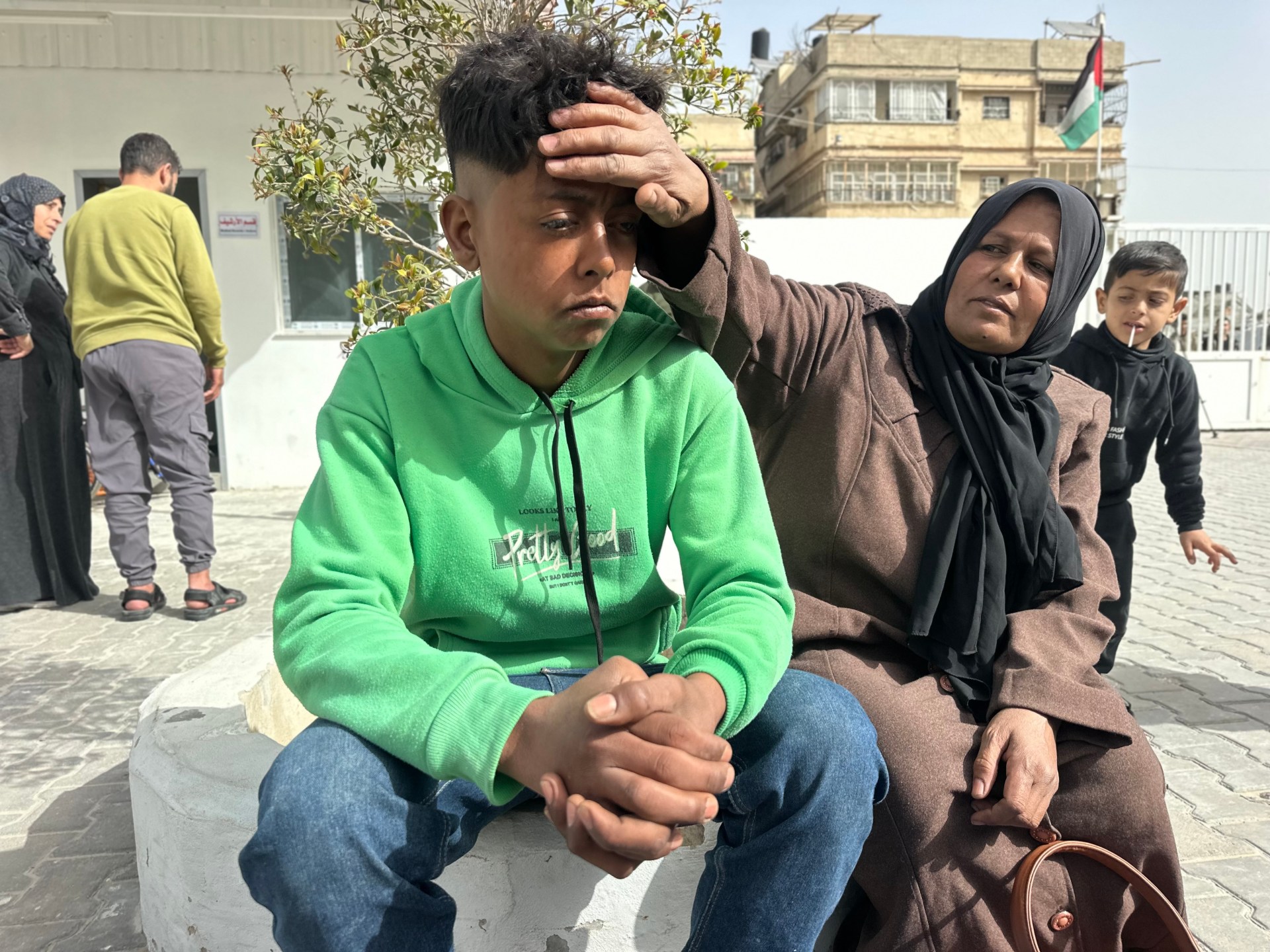
Mohammed Abu Mostafa is one of the lucky five. The 17-year-old travelled on Monday with his mother, Randa, to southern Gaza’s Khan Younis, and then on to Rafah, which has been closed by Israel for two years as it waged its genocidal war on Gaza, killing more than 70,000 Palestinians.
Randa told Al Jazeera that she had received a phone call on Monday morning informing her that Mohammed had been included in the first list of wounded patients scheduled to travel, and that they were instructed to head immediately to the Red Crescent Hospital in Khan Younis.
The reopening of Rafah, Gaza’s only land crossing that does not go through Israel, has been much touted as evidence of the progress of the second phase of the United States-backed Gaza “ceasefire” deal.
But events on Monday revealed a different reality, marked by strict security restrictions, complex procedures, and limited numbers being allowed to cross, falling far short of expectations and the scale of Gaza’s accumulated humanitarian needs.
Each of the five patients being allowed to leave was accompanied by two people as per Israeli orders, bringing the total number of travellers to 15, according to information provided to Gaza’s health authorities.
Mohammad Abu Salmiya, the director of Gaza’s al-Shifa Medical Complex, told Al Jazeera that this was the only group that departed, despite prior plans with the World Health Organization (WHO) – the body overseeing coordination between Egypt and Israel – for the departure of 50 patients daily.
Egyptian official sources have told Al Jazeera that 50 Palestinians were also permitted to return to Gaza via the Rafah crossing, though no information is yet available on whether they have actually reached the Palestinian side.
Ismail al-Thawabta, the director of Gaza’s Government Media Office, highlighted just how low these numbers are compared with the approximately 22,000 people needing to leave Gaza for treatment abroad. Meanwhile, about 80,000 Palestinians who left Gaza during the war want to return, he said.
Eye injury
Mohammed was injured in an Israeli air attack a year and a half ago, near where his family had been displaced in al-Mawasi, Khan Younis, Randa said. He sustained a direct injury to his eye, severely affecting his optic nerve and ability to see.
“My son has been suffering immensely since his injury. Day after day, his condition kept worsening, and there is no treatment available for him in Gaza,” Randa said, while waiting in the hospital courtyard alongside other patients and their relatives.
Despite her joy at finally being able to accompany her son on his journey, Randa feels a sense of anguish at having to leave four of her six children behind, as she was only permitted to take one child as a second companion.
“What matters to me now is that my son regains his sight and can see again with his own eyes. That is my only concern at the moment,” Randa said.
“I also hope to return to Gaza soon after my son recovers, that the blockade will be lifted, and that all patients will be able to travel, just like my son.”
Israeli restrictions
In the Red Crescent Hospital courtyard, dozens of patients on travel waiting lists expressed frustration over the first-day restrictions at Rafah.
Several patients, including those with amputations, gathered at the hospital, hoping to be permitted to travel to Egypt for treatment.
Despite patients and their families arriving early in the morning with high hopes, Israeli authorities refused to permit more than five patients to leave, leading to widespread dissatisfaction with the complex mechanisms accompanying the crossing’s partial reopening.
The multi-stage security procedure of Palestinians moving through the Rafah crossing begins with the preparation of daily lists of candidates for travel, which are then referred to the Israeli side for pre-travel security screening.
No one is allowed to pass through the crossing or enter it without explicit Israeli approval. The European Union Border Assistance Mission deployed to Rafah is limited to monitoring the process and verifying identities.
Arrivals in Gaza, after initial identity verification at the crossing under European supervision, are subject to additional inspection procedures at checkpoints located in areas under Israeli military control.
Raed al-Nims, the Gaza Red Crescent’s head of media, told Al Jazeera that the organisation was still waiting for updates regarding the transfer of more patients for treatment through the crossing.
He added that a group of patients was successfully transferred to Israel on Monday through the Kerem Abu Salem crossing, in coordination with the WHO.
Desperate need
Ibrahim Abu Thuraya was also one of the five patients allowed to leave Gaza on Monday.
Ibrahim was injured in the early months of the war, sustaining wounds that led to the amputation of his left hand and an injury to his left eye, where shrapnel is still embedded.
“Day after day, my eye condition is deteriorating, and I feel severe pain, especially since the shrapnel is lodged behind it and there are no medical capabilities in Gaza to deal with it,” he said from Khan Younis, before he travelled to Rafah. “Doctors told me that I need to travel abroad.”
Ibrahim was informed on Monday morning by the WHO and Gaza’s Ministry of Health that he had been approved for travel. He will be accompanied by his wife, Samar, and their son.
“I have suffered greatly for two full years just to be able to leave for treatment, and there are thousands of wounded like me,” he said. “I hope the crossing will be opened permanently.”

Post Comment