Gold and silver prices soared, then plummeted. What’s going on? | Business and Economy News
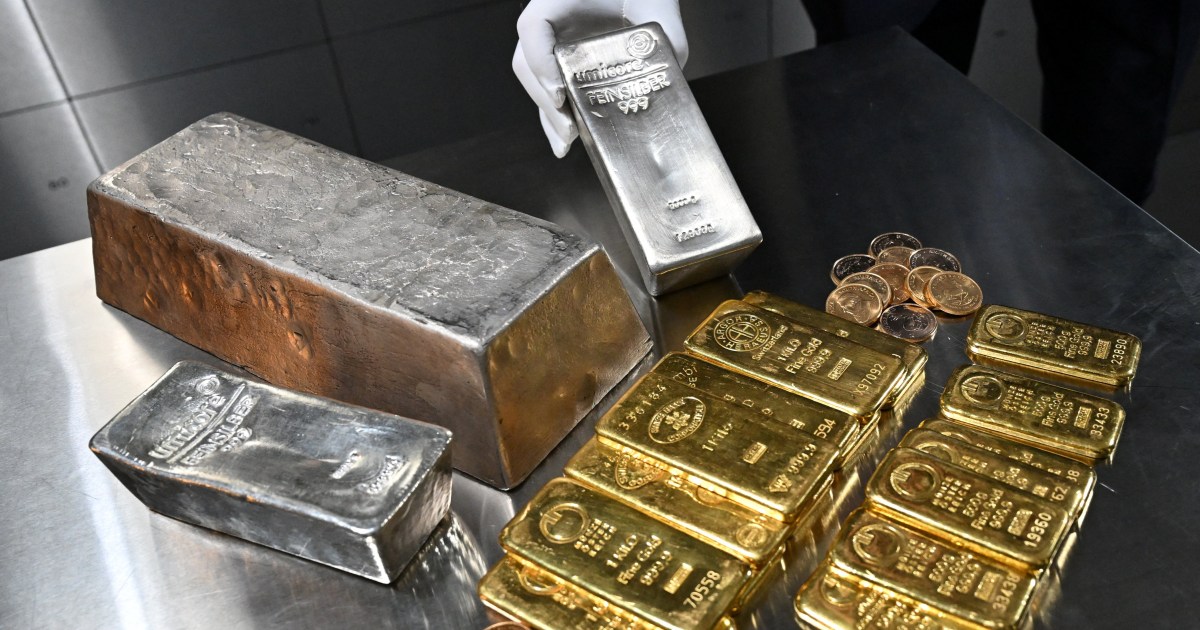
Gold and silver prices have been on a rollercoaster ride in the past few days.
After racking up huge gains over the past year to hit record highs, prices of the precious metals fell sharply on Friday and Monday.
Recommended Stories
list of 4 itemsend of list
Prices recovered some ground on Tuesday, though remaining well below their peaks.
Here’s all you need to know about the recent price moves:
Why have gold and silver prices risen so much over the past year?
Precious metals are prized by investors for their tendency to hold their value.
Historically, they have attracted buyers during times of economic uncertainty and geopolitical turmoil.
The return of Donald Trump, a leader famed for his unpredictability, to the White House has been one factor driving volatility over the past year.
From his tariffs to his pressure on the independence of the Federal Reserve, the country’s central bank, and threats to take over the Danish autonomous territory of Greenland, Trump has repeatedly taken a sledgehammer to orthodoxy, stirring unease in markets.
Trump’s convention-busting governance has also driven a weakening of the United States dollar, further encouraging investors to seek out “safe haven” assets that will hold their value.
Between Trump’s inauguration last year and the end of January 2026, gold prices nearly doubled, while silver prices rose nearly four-fold.
Some analysts argue that the rising prices of precious metals reflect a deeper crisis of confidence in economic systems worldwide after years of high inflation and rising national debts.
The US national debt has grown to $38 trillion, the highest in the world. This is the amount of money the US government owes to its lenders, both domestic and foreign.
“In a world where almost every financial activity incorporates credit risk – that of a state, a central bank, an intermediary – gold remains the only asset without a counterparty. It makes no promises, pays no interest, and is not dependent on political decisions. It simply exists. And that is precisely why it provides security,” Diego Franzin, head of portfolio strategies at Plenisfer Investments, told Al Jazeera.
“In a system based on record levels of public and private debt, this characteristic takes on unprecedented value.”
Another factor driving demand has been purchases by central banks in emerging economies, including China and Turkiye, which have been seeking to lessen their dependence on the dollar.
On Thursday, gold hit a record peak of almost $5,595 an ounce, while silver hit an all-time high of nearly $122.
The blistering rally came to a sudden halt on Friday when gold and silver prices plunged about 10 percent and 28 percent, respectively.
The slide continued into Monday, with gold ending the day about 4.5 percent lower and silver down about 6.5 percent.
On Tuesday, the precious metals clawed back some of their gains, with gold up about 3.5 percent and silver up about 4.5 percent as of 06:00 GMT.
Why did gold and silver prices crash?
Analysts are not united on the cause of the fall.
Some have suggested that Trump was responsible for bringing prices back to earth just as he was for driving the surge.
On Friday, Trump announced he would nominate Kevin Warsh to lead the Federal Reserve, a pick that was widely seen as relatively conventional compared with other names on his shortlist.
The choice of Warsh, a former member of the Fed’s seven-member board of governors, was welcomed by investors who had feared that Trump would tap an ally who would slash interest rates without paying heed to inflation risks. The US president has been pressuring the outgoing Fed chief, Jerome Powell, to cut rates.
Trump on Friday also expressed hopes that he would reach a deal with Iran, following weeks of threats of military action against the Middle Eastern country.
Some analysis has suggested that the prospect of more stable economic conditions and a rising dollar led investors to sell off precious metals.
Many analysts, however, have cast doubt on that explanation, arguing that the drop simply reflected the fact that prices had become overvalued.
“The more likely explanation is that precious metals prices collapsed simply because they had already gone parabolic in the previous week. Once profit-taking started, it just snowballed,” Mark Matthews, head of research for Asia at Bank Julius Baer, told Al Jazeera.
What will happen to gold and silver prices next?
Predicting the market is famously a fool’s errand, but some analysts see precious metals continuing to gain over the medium-to-long term.
In a note on Sunday, JP Morgan analysts said they expected gold to reach $6,300 an ounce – a 30 percent gain from current prices – by the end of 2026.
“Gold remains a dynamic, multi-faceted portfolio hedge and investor demand has continued to come in stronger than our previous expectations,” Gregory Shearer, Jason Hunter, Ali Ibrahim and Ananyashree Gupta said in the note.
Bank Julius Baer’s Matthews said investors are likely to pick up their purchases of gold and silver once they believe the market has stabilised.
“Their two fundamental drivers remain unchanged – namely, the US dollar should continue to depreciate, and central banks should increase their holdings in gold,” Matthews said.
“The price ascent probably won’t be as steep as it was before, but that’s a good thing.”



Post Comment