Bangladesh election reaches Britain, but some voters feel excluded | Bangladesh Election 2026
London, United Kingdom — Behind the fluorescent-lit glass counters, silver trays of singhara — also known as samosa — biryani and hash browns sit side by side. Two men in forest-green polo shirts, the cafe’s standard uniform, move briskly between the grill and the till, taking orders as the lunchtime crowd thickens, then thins again.
Inside Casablanca Cafe, the scrape of faux-leather chairs mixed with low conversation competes with traffic and the occasional siren on Whitechapel Road.
Some customers hurry through plates of chicken curry and rice during short breaks from nearby offices; others linger over fried eggs, beans and toast, chatting before heading next door for prayers at East London Mosque.
At a worn wooden table in the centre of the room, Khaled Noor cradles a tall glass of ginger and honey tea. For months now, he says, Bangladesh’s upcoming election has been a constant topic of conversation.
“Since the elections were announced,” Noor, a barrister and political scientist, said, “people haven’t stopped talking about it.”
![Jahanara Begum (L) and Romina Khatun, Bangladeshi women in London who have voted remotely ahead of the February 12 Bangladesh elections [Indlieb Farazi Saber]](https://www.aljazeera.com/wp-content/uploads/2026/02/Jahanara-Begum-L-Romina-Khatun-R-1770358054.jpg?w=770&resize=770%2C580&quality=80)
A long-awaited vote
The vote, scheduled for February 12, will be Bangladesh’s first national election since the removal of former prime minister Sheikh Hasina, and the first in nearly two decades expected to feature genuine competition. It follows years of tightly managed polls, opposition boycotts and allegations of repression under Hasina that left many voters at home disillusioned and deepened frustration among Bangladeshis overseas who had long been excluded from the ballot.
Bangladesh’s politics has long been shaped by rivalry between the Awami League, led for years by Hasina, and the Bangladesh Nationalist Party (BNP), founded by former military ruler Ziaur Rahman and later led by his widow, Khaleda Zia. Under Hasina, Bangladesh saw rapid economic growth alongside deepening accusations of authoritarianism and repression.
The BNP, sidelined for much of the past decade, is seeking to reassert itself under the leadership of Khaleda Zia’s son, Tarique Rahman. Supporters portray Rahman, who spent 17 years in exile in London, as a symbol of resistance to one-party dominance; critics point to past convictions and accusations of corruption. The election will be the first since Khaleda Zia’s death in December, lending additional emotional and symbolic weight to the contest.
Meanwhile, the interim administration under Nobel laureate Muhammad Yunus, which took charge after Hasina’s ouster, has banned her Awami League from electoral politics.
Amid all of that flux, Bangladeshis living abroad have, for the first time, won the right to vote. “For years we’ve been campaigning for this moment,” Noor said. “People wanted recognition.”
But at neighbouring tables in the cafe, several people decline to speak, wary of sharing political views publicly. Noor, a former local councillor, said some Bangladeshi citizens in the UK who are technically eligible to vote but lack secure immigration status are among the most cautious.
“They’re watching the elections very closely,” he said, “but they don’t want to draw attention to themselves.”
For decades, overseas Bangladeshis, despite sending billions of dollars home in remittances, had no formal say in national elections. Campaigners argued that excluding the diaspora was both undemocratic and politically expedient, particularly as many Bangladeshis abroad had left amid political violence or repression.
Following sustained pressure, electoral authorities expanded overseas voter registration, allowing expatriates to participate remotely for the first time. According to Bangladeshi election authorities, more than seven million expatriates worldwide have registered since overseas voting was introduced — making them a substantial 5 percent of the total electorate of about 127 million. Bangladesh’s election authorities estimate there are roughly 15 million Bangladeshis living abroad in all.
In the United Kingdom, however, just over 32,000 Bangladeshi citizens are registered to vote, a modest figure given the size of the wider community. According to the 2021 census, about 645,000 people in England and Wales identify as Bangladeshi or British Bangladeshi, with the largest concentration in East London. In Tower Hamlets alone, Bangladeshis make up nearly 35 percent of residents, with significant communities also in Newham, and Barking and Dagenham.
The disparity highlights a central tension running through the diaspora: cultural identity does not always align with citizenship or eligibility. These demographics help explain why events in Bangladesh ripple so strongly through everyday life in East London, but they do not guarantee political engagement.
Some analysts point out that expatriate Bangladeshis could still be significant in close contests. Bangladesh’s election authorities estimate that in some constituencies overseas voters may represent nearly a fifth of registered voters, a share that could influence outcomes in a first-past-the-post system.
In practice, however, eligibility to vote is limited to Bangladeshi citizens holding a national identity card (NID). Many British Bangladeshis, particularly those born in the UK, identify strongly with Bangladesh but do not hold citizenship documents and are therefore excluded from the ballot.
Bangladeshis have lived in Britain for more than a century, but large-scale migration began only in the mid-20th century. In the 1950s and 1960s, economic hardship in what was then East Pakistan, combined with labour shortages in the UK, drew Bengali men, many from Sylhet, to London and Birmingham.
The 1971 Liberation War prompted another wave, as people fled political instability and sought work abroad. Family reunification followed, reshaping neighbourhoods like Tower Hamlets in the decades that followed.
These layered histories help explain why events in Bangladesh continue to ripple so strongly through everyday life here, but they do not guarantee political engagement.
![Casablanca Cafe in East London, a popular haunt among the Bangladeshi diaspora, where chatter about the upcoming election is hard to miss [Indlieb Farazi Saber/ Al Jazeera]](https://www.aljazeera.com/wp-content/uploads/2026/02/Casablanca-Cafe-interior-1770358169.jpg?w=770&resize=770%2C580&quality=80)
Between paperwork and disengagement
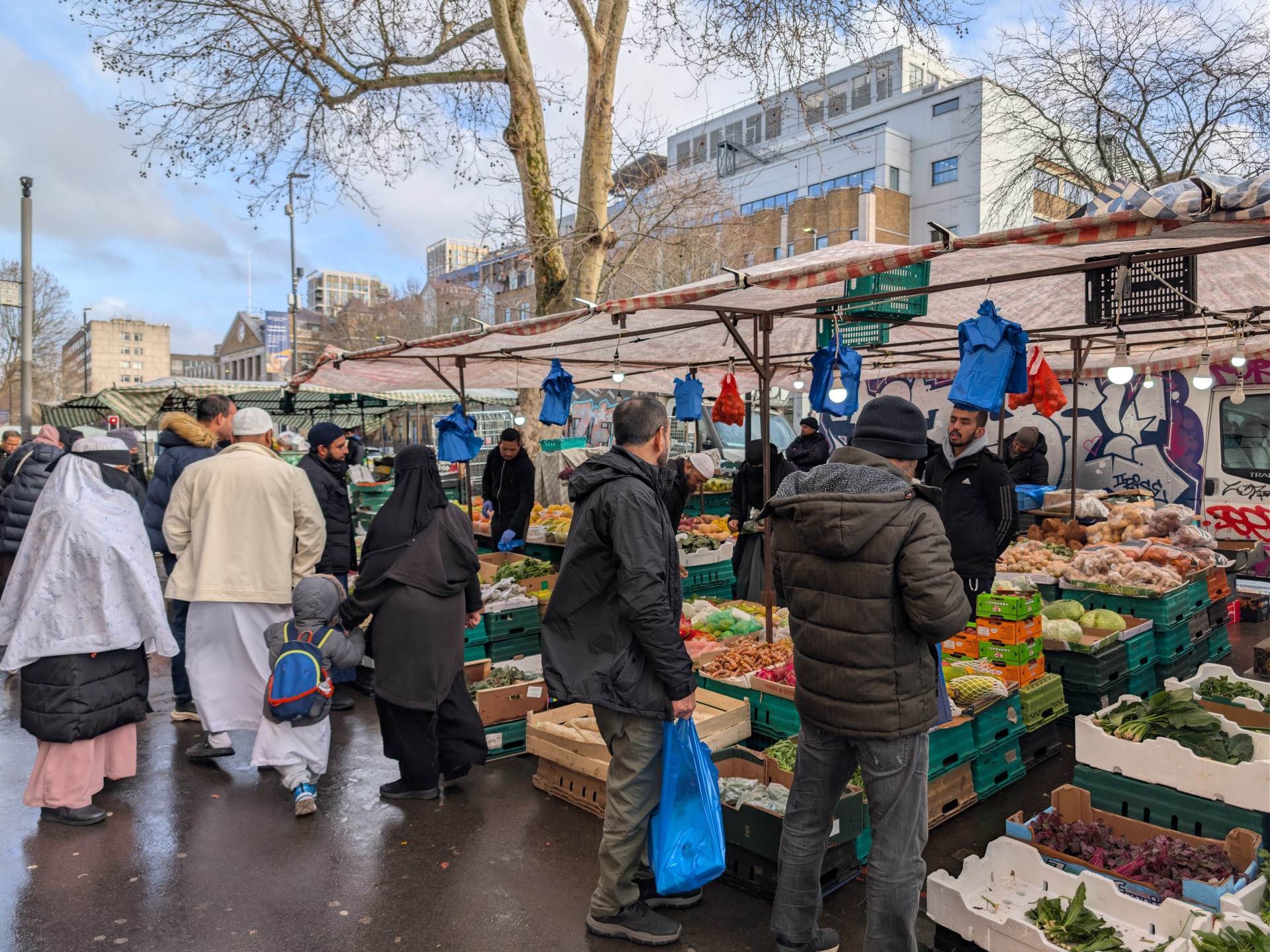
Earlier in the day, in Whitechapel Road Market, two young women browse a rack of brightly coloured jalabiyas, pausing to check the stitching. Asked about the election, they shrug. They had heard older relatives talking about it, one said, but it felt distant.
“It doesn’t affect us, does it?” she asked. “We live here.” Politics in Britain, she added, felt more pressing, mentioning Labour’s struggles and the rise of Reform.
Noor explained that such apathy was common among younger British Bangladeshis. Years of disputed polls had left many hopeful but cautious, he said, while practical barriers had discouraged wider participation.
“To vote, you need a national identity card, biometrics, and then another digital process through a mobile app,” he said. “For many people, especially older voters, it’s simply too complicated.”
Patterns elsewhere underscore the contrast. Election commission figures show far higher participation in Gulf states, with more than 239,000 registered voters in Saudi Arabia and about 76,000 in Qatar.
Back at his office in Tower Hamlets, Noor said the difference reflected lived realities. Migrants in the Gulf are often single men with families back home and limited political or social rights in their host countries, keeping their ties to Bangladesh immediate and practical. In the UK and United States, by contrast, many Bangladeshis are settled with families, careers and children, their daily concerns anchored firmly where they live.
That divide, between older migrants invested in events back home and younger British Bangladeshis rooted firmly in the UK, runs through conversations across East London.
Several said they had registered to vote. Many arrived in Britain decades ago and still hold Bangladeshi passports. For them, the election carries the weight of memory: of the Liberation War, of years of military rule, of elections that once felt either dangerous or meaningless.
Above a convenience store on a side street close to the mosque, a narrow, worn staircase leads to the small office of Bangla Sanglap, a bilingual weekly newspaper. Its editor, Moshahid Ali, scrolls through messages from readers debating the election, correcting rumours and sharing registration information.
“People are excited about having the right to vote,” he said. “But it hasn’t been clear or straightforward.”
Many complained of limited outreach by authorities, he added. The process itself put others off: the need for an NID card, biometric registration at the High Commission with long waiting lines, followed by a further digital application through a mobile app, a series of bureaucratic thickets that sap enthusiasm.
Some learned about postal voting too late. One man said he rushed to apply for his NID card days before the deadline, only for it to arrive after registration closed.
Others said the technology itself proved daunting, particularly for older voters. “Everything is on apps now,” one older would-be voter said. “If something goes wrong, who do you ask?”
Mizanur Khan, 44, a community volunteer and hijama (cupping therapy) practitioner, said he wanted to vote but missed the registration deadline. He is now considering travelling to Bangladesh to vote in person.
“There wasn’t enough awareness,” he said. “But the main thing is free and fair elections. If they can even manage that, Bangladesh has a chance.”
The Bangladesh High Commission in London was contacted for comment, but did not respond.
Not everyone who could vote chose to. At an electrical goods stall in Whitechapel Market, as February rain began to fall, Radwan Ahmed, 23, a student in London, said he holds an NID card but decided to boycott the election. He described his decision as a protest against what he sees as a compromised political process, saying the ban on the Awami League had undermined the vote’s legitimacy.
Across the borough, the mood remains unsettled.
A man in his forties said the election felt overdue. Bangladesh, he said, had been run by the same two parties, and the same families, for too long. He did not want his name in print, but his eyes lit up when he spoke of change. “If change doesn’t happen now, then when will it happen?” For the first time in Bangladesh’s electoral history, the Jamaat-e-Islami — the country’s largest religious party — is a serious contender to win the vote. It is in an alliance with the National Citizen Party (NCP), a group formed by leaders of the student-led uprising against Hasina.
Britain’s political significance is underscored by the presence of influential figures on both sides of Bangladesh’s political divide. Tarique Rahman’s long exile in London remains a sore point among some who were interviewed in East London. His UK presence did not necessarily translate into trust or recognition. Several people described him as distant from everyday community life, saying he rarely engaged beyond party circles.
“He’s just one man,” said one voter who declined to be named. “Part of the same system.” Another said Rahman’s long stay in the UK passed without meaningful contact with working-class Bangladeshis. “He met elites otherwise; he remained hidden,” he said. “There was no connection with people like us.”
Britain is also home to prominent figures linked to the Awami League. Among them is Tulip Siddiq, a Labour MP and Hasina’s niece. Siddiq was recently sentenced in absentia to two years’ imprisonment and a 100,000 Bangladeshi taka ($818) fine by a Bangladeshi court, a move criticised by UK-based lawyers and rights groups as politically motivated, a claim Bangladeshi authorities reject.
Several UK-based local politicians of Bangladeshi origin, including Tower Hamlets councillors Sabina Khan and Ohid Ahmed, are also standing in the Bangladesh elections, drawing criticism both in Britain and in Bangladesh over questions of accountability and dual political loyalties.
The issue is further complicated by Bangladesh’s approach to dual nationality. While dual citizenship is permitted in practice, constitutional provisions restrict those who acquire foreign citizenship or pledge allegiance to another country from standing for parliament, a distinction that is often poorly understood.
Legal experts note that under UK law, for instance, a declaration of renunciation must be formally registered with the Home Office before it takes effect; until then, the applicant remains a British citizen.
“How much do they really know about politics back in Bangladesh if they’ve been living over here?” one woman asked.
For most of those Al Jazeera spoke to, however, daily concerns, jobs, family, security and life in Britain loomed far larger than the intricacies of elite politics in Bangladesh.
![Romina Khatun (R) with her daughter Nargis Akhtar. Unlike her mother, Akhtar isn't enthused about the elections [Indlieb Farazi Saber/Al Jazeera]](https://www.aljazeera.com/wp-content/uploads/2026/02/Nargis-Akhtar-L-Romina-Khatun-R-1770358252.jpg?w=770&resize=770%2C347&quality=80)
Mixed sentiments
Those priorities become clearer a few miles away, in another part of the borough.
On a quiet, tree-lined street minutes from the glass towers of Canary Wharf, the Isle of Dogs Bangladeshi Association and Cultural Centre sits almost hidden beside the local library. Once a stronghold of far-right politics, the area now reflects a different chapter in East London’s migrant history.
Inside, a small group has gathered for tea and butter biscuits. Conversation drifts between translating documents, navigating an increasingly digital world and plans for afternoon prayers.
Here, too, the election is on people’s minds.
Muhammad Saiful Miah, 44, who works in the emergency services, said he had not voted — because he doesn’t have an NID card. But he is following the election closely.
“The elections matter because that’s where my family comes from,” he said. “I’m British and Bangladeshi, so of course I care.”
Across the room, Jahanara Begum, 58, from Cumilla near Dhaka, speaking in Bangla through a translator, said she was “very happy” to have voted and had already sent her postal ballot.
“I waited years for this,” she says, hands wrapped around her teacup. “This is the first time in a long time it feels like it matters,” said Begum, who arrived in Britain just three years ago.
As a former primary school teacher and election monitor, she recalled travelling long distances, sometimes 30km by rickshaw, to count votes, often missing the chance to cast her own. The last time she voted, she said, was in 1991.
She spoke vividly of the 2008 general election when the Awami League came to power. She claimed the results recorded locally were later altered. “We saw BNP winning in many areas, but the figures announced were different.”
Now living in Britain, she still cares deeply about the outcome. “I have four children there,” she said. “It’s my country. I want peace. I want them to be safe.”
Her friend, Romina Khatun, 69, who has lived in the UK since 1985 and has also voted, nodded in agreement. For her too, the election represents a tentative hope after years of violence and uncertainty.
But Romina’s daughter, Nargis Akhtar, 45, who volunteers as the centre’s manager, remains unconvinced. Born in Sylhet but raised in London, she did not vote and does not have an NID card.
Akhtar grew up in a politically engaged household. She remembers hearing the names Khaleda Zia, Sheikh Hasina and Hussain Muhammad Ershad — a military ruler who led Bangladesh for most of the 1980s — spoken with intensity. “I must have been seven or eight,” she said, laughing, recalling a political cartoon that once enraged her father. “I didn’t even know who Ershad was; I just knew it mattered to my parents.”
But, she said, she does not “have much faith that elections alone will change things”.
“There’s no proper welfare system, no employment rights [in Bangladesh],” Akhtar said. “People talk about creating jobs, but without protections, what difference does that make?”

Post Comment