‘We have a voice’: Latinos celebrate Bad Bunny’s Super Bowl halftime show | Entertainment
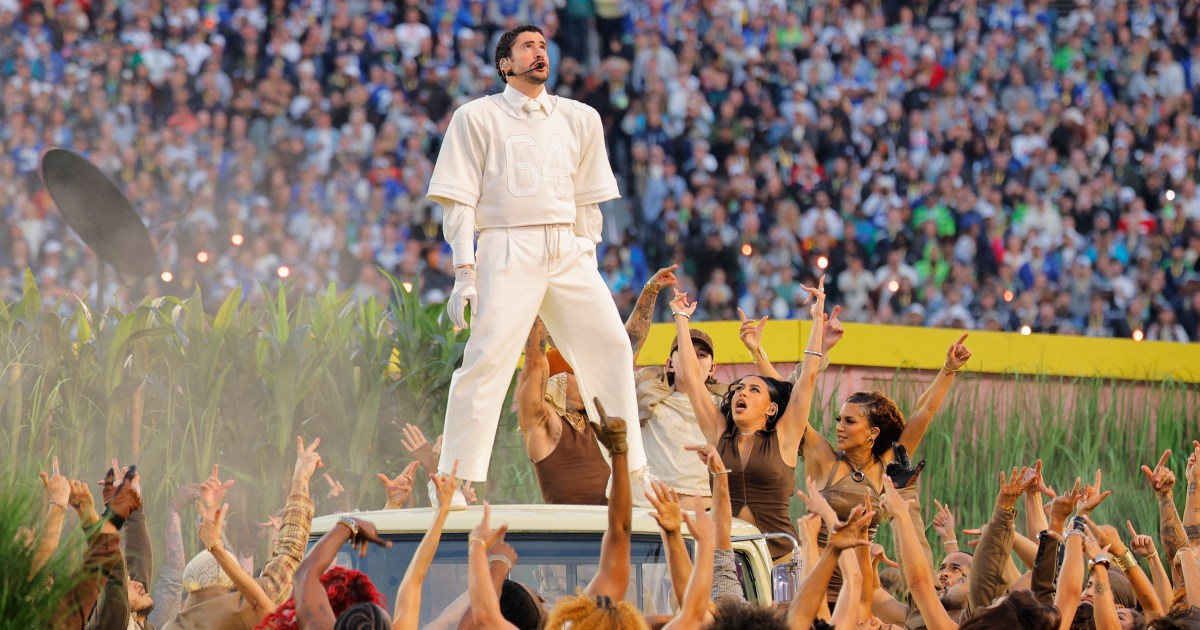
As a sprawling sugar cane field parted to reveal dancers in traditional pava hats, Puerto Rican megastar Bad Bunny emerged to deliver a boundary-breaking Super Bowl LX halftime show that was as political as it was spectacular.
The flamboyant show on Sunday night at the annual championship game of the National Football League (NFL) in California – performed almost entirely in Spanish – drew thunderous acclaim from Latinos across the United States and audiences throughout Latin America.
Recommended Stories
list of 4 itemsend of list
The performance included appearances by celebrities Pedro Pascal, Cardi B, and Jessica Alba, all dancing in a house party setting in the middle of the field. The set even featured a live wedding ceremony during the song Titi Me Pregunto – a track about having many girlfriends and a wedding.
However, the celebration was underscored by tension; many viewed the performance as an act of defiance amidst ongoing deadly raids by US Immigration and Customs Enforcement (ICE) targeting immigrant communities across the country.
And US President Donald Trump contributed to the political atmosphere of the event, blasting Bad Bunny’s act as “the worst performance ever” and “a slap in the face to our country”, skipping the live show and watching the game instead from an event in Florida.
“Nobody understands a word this guy is saying, and the dancing is disgusting, especially for young children that are watching from throughout the USA, and all over the World,” Trump railed in a Truth Social post.
His “Make America Great Agains” (MAGA) supporters followed suit, also questioning why it was in a “foreign” language and decrying it as “anti-American”. Many conservatives instead tuned in to the “All-American Halftime Show”, a live entertainment event featuring country artists presented as an alternative, and organised by the right-wing non-profit Turning Point USA, which was founded by the late Charlie Kirk.
The divisive political climate in the US is why those with Latin American heritage felt pride in Bad Bunny’s cultural performance, in which he strutted and swayed to his most famous songs, from Titi Me Pregunto to Baile Inolvidable.
“Bad Bunny symbolises hope for the Latino community in a deeply divided time, when Latinos are often reduced to harmful stereotypes,” Claudia Ruiz, a Cuban-American who lives in Modesto, California, told Al Jazeera.
“He represents unity in a rich, cultural, family- centred, and joyful way that restores pride.”
‘We’re not savages … we’re not aliens’
Last week, the singer and rapper, whose real name is Benito Antonio Martinez Ocasio, and who is one of the most listened-to artists worldwide, made history at the Grammy Awards, with his album, Debi Tirar Mas Fotos, scooping up the Best Album award, the first Spanish-language one to ever do so.
During his acceptance speech, Bad Bunny spoke against ICE and stated, “We’re not savage, we’re not animals, we’re not aliens. We are humans, and we are Americans”, a stance that was amplified by his Super Bowl performance.
Ruiz said that Bad Bunny is a reminder that she should not be made to feel apologetic for celebrating her identity, which is very much a part of the American fabric.
“As a Latina, I want to be reminded of my roots positively and feel grounded in who I am, without needing to shrink myself to make others comfortable,” she said. “Seeing our culture celebrated without apology feels powerful.”
“Our music can [take] a stand in the most ‘US’ event in existence to say we’re more than just land you can take militarily or recreationally. We also matter; we have a voice.”
In one climactic moment, after crooning cameos by Lady Gaga and another Puerto Rican star of a past generation, Ricky Martin, Bad Bunny belted out the words “God Bless America!”
The only English phrase of the performance was followed by a roll call of the countries of North, South and Central America, from Cuba to Canada, and a parade of their flags.
For Bernardo Garcia Espinosa, who watched the Super Bowl from Mexico, the roll call was the “most powerful moment” of the whole show.
“Benito took this well-known US-ism of ‘God bless America’ and then flips it on its head by reciting the names of the countries in the Americas,” Espinosa told Al Jazeera from Mexico City.
“Since I’ve been young, there’s this sense that people from the US claim the whole continent by reserving the ‘American’ demonym exclusively for themselves, and this was Bad Bunny saying, ‘Screw that, we are all Americans because we all live in the Americas’,” said Espinosa, who used to live in Canada.
Espinosa referenced Trump’s recent actions in the region, including the abduction of Venezuelan President Nicolas Maduro. The US leader had justified his action by invoking the Monroe Doctrine, a 19th-century policy that urged the division of the world into spheres of influence overseen by different powers.
“When the US is renewing its Monroe Doctrine approach, it feels very empowering that our music can [take] a stand in the most ‘US’ event in existence to say we’re more than just land you can take militarily or recreationally. We also matter; we have a voice.”

Trump’s ‘supporters forget that we are all Americans’
For Mariana Limon Rugerio, a Mexican from the city of Monterrey, the performance was necessary considering the US’s “delicate political landscape” amidst ICE raids. But beyond overt political statements, Rugerio enjoyed the simple, everyday nods to Latino culture in Bad Bunny’s performance.
“There were so many hints to Latin American culture that we all share, like a kid sleeping in a chair while the adults are still partying,” Rugerio told Al Jazeera.
She said she could never have dreamed of a Super Bowl performance entirely in Spanish.
“I think it was well deserved for all the Latino immigrants to see this,” Rugerio said.
Bad Bunny’s show also featured roving dancers dressed as mechanics, shopkeepers, and hairdressers – jobs taken up by many Latino immigrants in the US. Those scenes moved Natalia Bustamante, a Chilean-Ecuadorean living in Montreal, Canada.
“Our immigrant brothers and sisters go through hell in order to get to the States,” she told Al Jazeera, adding that it felt good to be celebrated “for once”.
“It was so overwhelming, [by] the end, I was crying.”
Abril Boniche Porras, a Costa Rican-American from Richmond, Virginia, meanwhile, said it was disheartening to witness the alternative halftime show organised by Turning Point USA. She was also dismayed to see people post photos to social media using headphones to block out Bad Bunny’s performance during the live event.
“[All] because they didn’t want to hear someone speak in a language they could not understand,” Porras told Al Jazeera.
“The show was all about love, and community, and music … [Trump] supporters forget that we are all Americans.”


Post Comment