In Munich, Rubio urges transatlantic unity but lashes Europe on migration | Donald Trump News
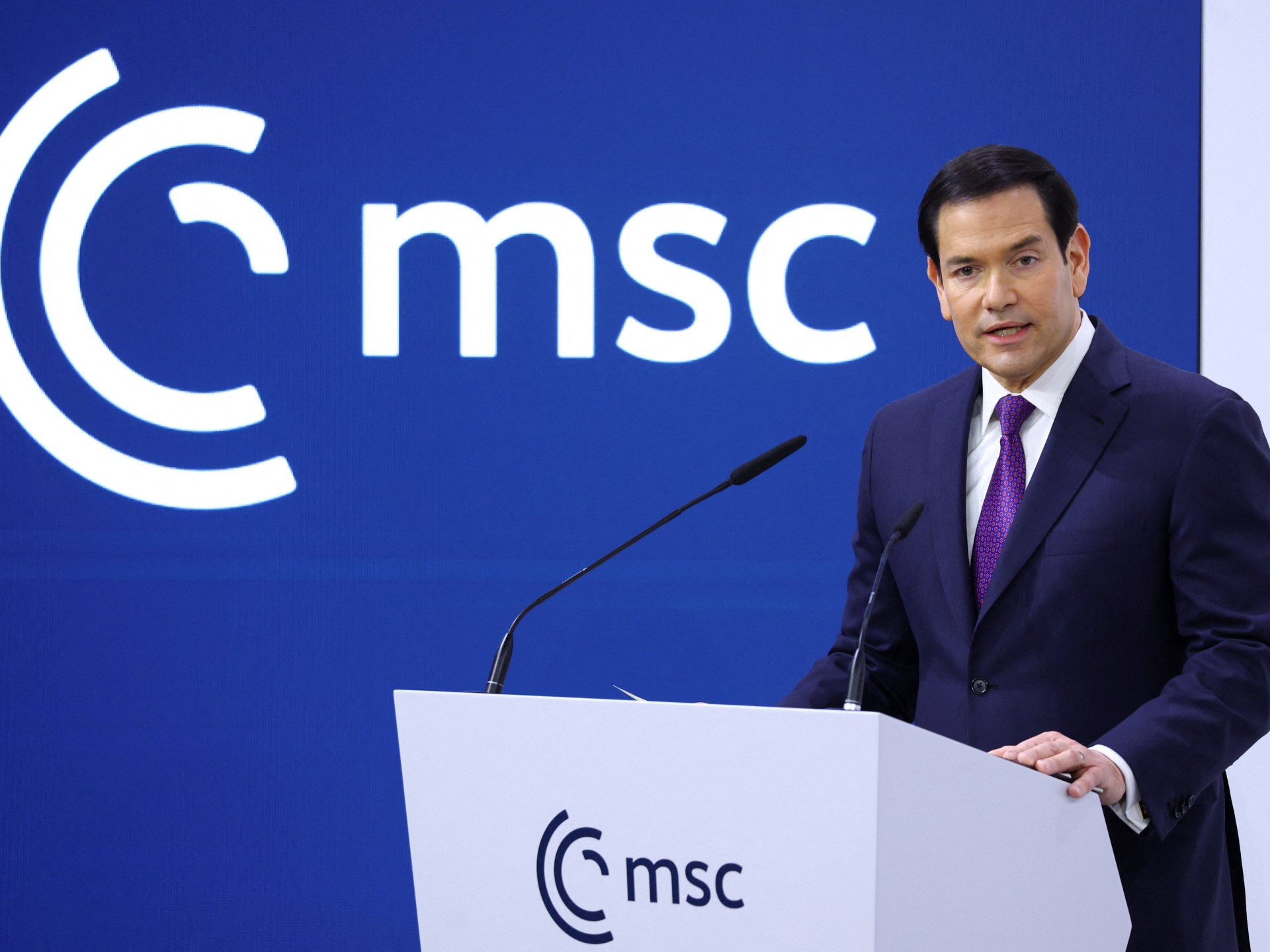
United States Secretary of State Marco Rubio has addressed European leaders at the Munich Security Conference (MSC) in an address seen as more conciliatory than in previous years.
Rubio on Saturday said Washington and Europe “belong together”, adding: “We want Europe to be strong. We believe that Europe must survive.”
Recommended Stories
list of 3 itemsend of list
He also said the US under Trump wants to lead global “renewal and restoration … and that while we are prepared, if necessary, to do this alone, it is our preference and it is our hope to do this together with you, our friends here in Europe”.
Rubio’s speech on Saturday was seen as more conciliatory than remarks made by US Vice President JD Vance last year, who used his appearance at the event to attack European policies on immigration and free speech, shocking European allies.
Despite the softer tone, Rubio still criticised Europe on migration. He warned of “civilisational erasure” caused by mass migration and said it is “destabilising” the West – a line that has been frequently repeated by US officials, including the president.
Other divisions remain between the once-ironclad allies. European leaders remain bruised by Trump’s desire to take control of Greenland, an autonomous territory of NATO-member Denmark.
European leaders have used the MSC as an opportunity to pledge to shoulder more of the burden of shared NATO defences. Leaders said this is essential for Europe to counter a hostile Russia, with NATO chief Mark Rutte saying “a strong Europe in a strong NATO means that the transatlantic bond will be stronger than ever.”
“This is the right time for a strong Europe,” said French President Emmanuel Macron, who stressed on Friday that the continent was “clear in the support of Ukraine” and “building its own architecture of security”.
“This Europe will be a good ally and partner for the United States of America,” the French leader said.
British Prime Minister Keir Starmer told the conference that Europe “must be ready to fight, to do whatever it takes to protect our people, our values and our way of life,” and added that the continent should focus on decreasing “some dependencies” and focus on creating a “more European NATO”.
German Chancellor Friedrich Merz acknowledged a “rift” had opened up between Europe and the US, prompted by culture wars, but issued an appeal to Washington: “Let’s repair and revive transatlantic trust together.
“In the era of great power rivalry, even the United States will not be powerful enough to go it alone,” said the conservative leader, who has ramped up defence spending in the top European Union economy.
Russia’s full-scale war on Ukraine is set to enter its fifth gruelling year.
Ukrainian President Volodymyr Zelenskyy, who has been in Munich since Friday and meeting multiple allies, was expected to address the meeting on Saturday.
No Russian officials have been invited, but Foreign Minister Wang Yi of China has been invited and will deliver a key speech.
A US official said Rubio will meet with Zelenskyy at the conference. US officials have worked for months to try to broker a peace deal between Russia and Ukraine, with little success.
At the White House on Friday, Trump urged Zelenskyy to “get moving” to end the war. “Russia wants to make a deal… He has to move,” the US leader said.
Speaking at the MSC, however, Rubio said he did not know if Russia was serious about ending its war against Ukraine.
A German government source said Merz and Rubio met at the conference on Friday and discussed “Ukraine, the status of negotiations with Russia and further support for the country, particularly in terms of military aid”.
They also discussed Europe’s role in NATO, and “Rubio praised Germany’s steps to strengthen the alliance,” the source added.
Macron said a new framework was needed to deal with “an aggressive Russia” once the fighting in Ukraine ends.
At the conference, the US secretary of state also touched on issues outside Europe.
On China, he said the US owes it to the world to manage its relations with China, even when the national interests of the two superpowers do not align. Speaking about Iran, he said President Trump’s preference is to reach a deal with Tehran, but said that’s “very hard to do”.

Post Comment