Trump’s Board of Peace meets: Who’s in, who’s out, what’s on the agenda? | Explainer News
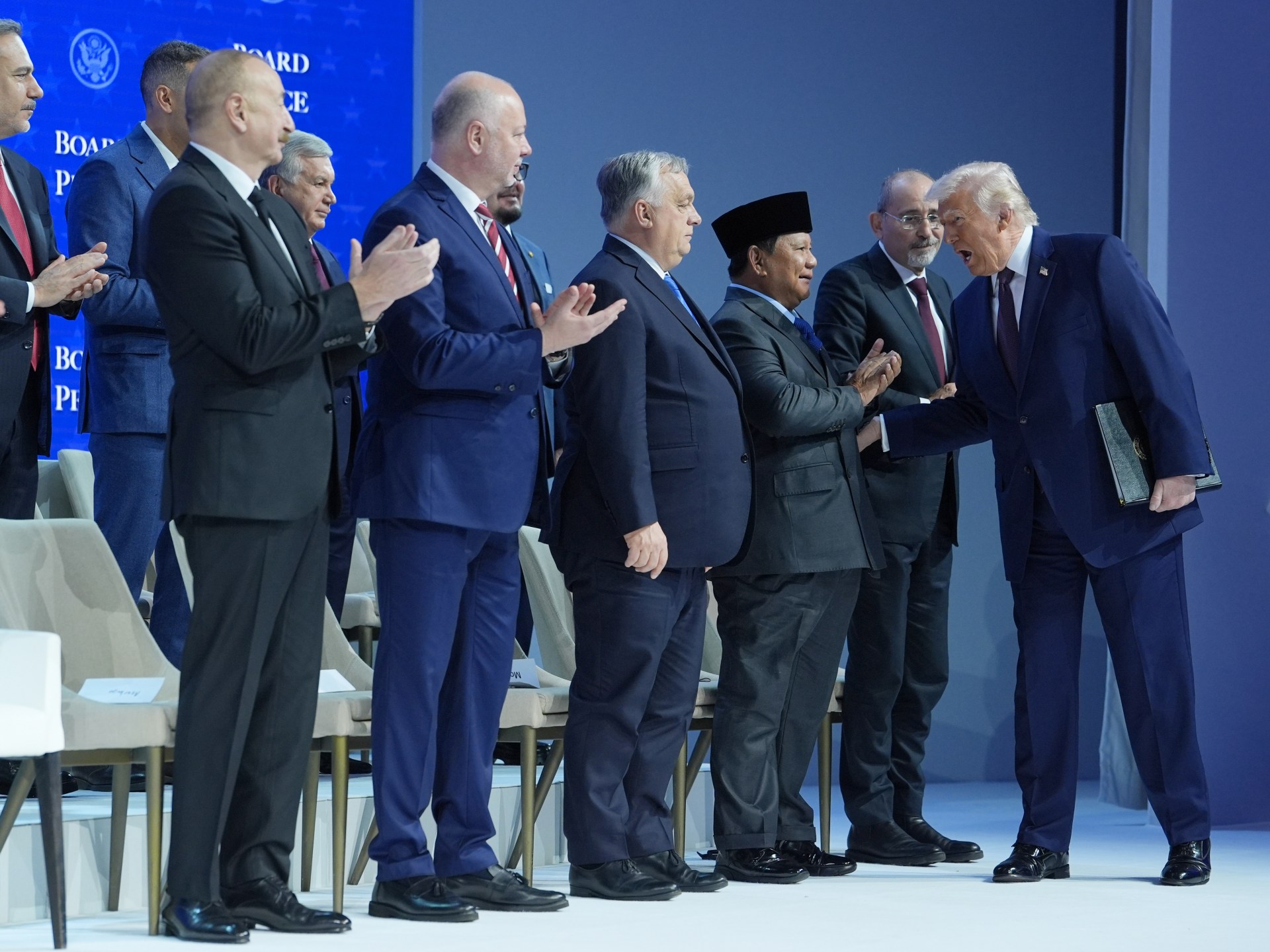
United States President Donald Trump will host the inaugural meeting of his so-called “Board of Peace” in Washington on Thursday, assembling representatives from member nations to announce strategies and funding for the reconstruction of Gaza.
While the US’s Western allies cautiously keep the board at arm’s length, some Middle Eastern nations are joining the first meet-up, which will take place at the US Institute of Peace in Washington.
Lauding the board’s “unlimited potential”, Trump, its indefinite chairman, wrote in a post on his Truth Social platform: “The Board of Peace will prove to be the most consequential International Body in History.”
Critics have called out Trump’s “imperial agenda” with the board’s expanding charter viewed by many analysts as rivalling the United Nations.
Trump has also been criticised for offering seats on the board to Israel’s Benjamin Netanyahu and Russia’s Vladimir Putin, both leaders wanted for allaged war crimes by the International Criminal Court. Only Netanyahu has formally accepted so far, despite being angered about the inclusion of Turkish and Qatari officials on the Gaza Executive Board.
For some attendees in Washington on Thursday, the stakes are not just diplomatic but domestic, as decisions made at the inaugural meeting on the occupied Palestinian territory could reverberate at home.
So, who’s coming and who’s not? And what’s at stake?

What’s on the agenda for the first Board of Peace meeting?
The prime focus for Thursday’s inaugural meeting is a reconstruction plan for Gaza, which has been largely reduced to rubble by Israel’s ongoing genocidal war, which was diplomatically backed and armed by the US.
The US is expected to announce $5bn in funds from member states “toward the Gaza Humanitarian and Reconstruction efforts”.
The board is also expected to hear more details about a so-called International Stabilization Force, which would police Gaza as per the Trump administration’s 20-point plan to end Israel’s war on the strip, announced last year.
This proposed a phased ceasefire in Gaza, the disarmament of Hamas, and the establishment of a technocratic governance structure to administer Palestinian territories during a transitional period.
The Board of Peace was unveiled officially on the sidelines of the World Economic Forum in Davos, Switzerland, last month. Jared Kushner, Trump’s son-in-law and executive member, also presented a glossy reconstruction vision – including beach resorts and high-rise towers – for Gaza in a presentation, decried by Palestinian advocacy groups as “imperialist”.
On February 15, Trump wrote on Truth Social that the board’s member states “have committed thousands of personnel to the International Stabilization Force and Local Police to maintain Security and Peace for Gazans”.
Rebuilding the flattened Palestinian territories, ravaged by the Israeli bombardment of Gaza and demolitions and raids in the West Bank, would be a monumental task on its own, estimated to cost about $70bn by the United Nations.
But, while the board was initially envisioned as a body which would mediate Israel’s war on Palestine and stability in the region, it has since expanded its charter to resolve conflicts across the world. The board will “present a bold Vision for the Civilians in Gaza, and then, ultimately, far beyond Gaza – WORLD PEACE!” Trump added in his post.
Who’s coming to Washington, and who’s not?
The White House has formally invited 50 countries to join the Board of Peace, with 35 leaders showing interest so far. As of now, 26 countries have come on board and been designated as founding members of the board. At least 14 countries have declined invitations.
Europe
Europe is divided over Trump’s Board of Peace and its extensive charter, which the US president would continue to chair after his presidency ends.
The European Union itself has stated it is not looking to join the Board of Peace over concerns about its charter and President Ursula von der Leyen declined her invitation to Thursday’s meeting.
Trump’s invitation to Russian President Vladimir Putin to take a seat on the board has further complicated any alignment for European countries while the war in Ukraine goes on. As yet, Putin remains undecided about whether he will become a member.
Major European powers, including France, Germany, the United Kingdom and Spain, have all declined invitations to join the Board of Peace as members.
Despite concerns, the EU is sending its commissioner for the Mediterranean, Dubravka Suica, as an observer to the meeting on Thursday. A spokesperson said that while questions remain about the charter, the EU would work with the US on “implementation of the peace plan for Gaza”.
While the EU has not joined the board as a member, two member nations of the bloc – Hungary and Bulgaria – have come on board. Hungarian Prime Minister Viktor Orban, who is attending the meeting, is a close ally of Trump.
Kosovo and Albania have also joined as board members and will attend the meeting on Thursday.
Italy, Cyprus, Greece and Romania confirmed they would send representatives as “observers”. Romanian President Nicusor Dan, who also handles foreign policy, will attend in person.
Meanwhile, Pope Leo, who leads 1.4 billion Catholics around the world, declined his invitation to the board’s seat, stressing that crisis situations should be managed by the United Nations.
Tahani Mustafa, a visiting fellow on the Middle East and North Africa programme at the European Council on Foreign Relations, told Al Jazeera that the Western allies of the US “are insisting on sticking to a liberal rules-based order, multilateralism, which gives them something of an equal footing, whereas the rest of the Global South have been much more pragmatic of their backing and support, and even membership that they’re providing to the Board of Peace”.

Middle East
Several major regional powers in the Middle East have joined Trump’s Board of Peace.
From Israel, Foreign Minister Gideon Saar will attend the meeting on Thursday.
Longtime US allies, the United Arab Emirates, Morocco and Bahrain, were among the first Arab states to agree to join last month, followed by Egypt.
Then, the region’s largest economy, Saudi Arabia, came in alongside Turkiye, Jordan and Qatar, stating that the countries were committed to supporting Palestine’s “right to self-determination and statehood in accordance with international law”. Finally, Kuwait also joined. These countries are all sending delegations to the meeting.
“Middle Eastern partners say they’re trying to be pragmatic and do what they think is best for Gaza and to stop the bloodshed,” said Mustafa, who has previously worked as a senior Palestine analyst at the International Crisis Group.
“The reality, ultimately, is that this is more about strengthening their relationship with the US, and not upsetting someone as temperamental as Trump,” she told Al Jazeera. In addition, Mustafa argued, “The Middle Eastern countries also have a notorious record of not being the best advocates for Palestine, especially in recent decades.”
Asia and Oceania
From Central Asia, the presidents of Kazakhstan and Uzbekistan – Kassym-Jomart Tokayev and Shavkat Mirziyoyev, respectively – will be attending the meeting in Washington as members of the Board of Peace.
Armenian Prime Minister Nikol Pashinyan and Azerbaijani President Ilham Aliyev are also travelling to the US capital for the meeting, also as members of the board.
From Southeast Asia, Indonesia’s President Prabowo Subianto is also in Washington for the meeting, while Vietnam’s Communist Party General Secretary To Lam will attend the meeting of members of the board.
Pakistan is the only country joining Trump’s Board of Peace from South Asia. Prime Minister Shehbaz Sharif is travelling to Washington to attend. India says it is reviewing its invitation, but has not joined the board yet and is not sending anyone as an observer.
Meanwhile, New Zealand declined its invitation to join the board, stating it is seeking more clarity about it, while Australia says it is still reviewing its invitation.

Which leaders are under pressure at home over this issue?
With more than 20 leaders convening in Washington, decisions on policing and governance in the occupied Palestinian territory may reverberate politically at home, especially for the governments of Indonesia and Pakistan.
In Indonesia, the world’s largest Muslim-majority nation, advocacy for an independent Palestine goes back decades.
Indonesia also found supporters among the Palestinian leadership during its own independence movement that culminated in 1945. Opinion about the Board of Peace in the country has been divided since Prabowo joined it, and outcomes from the Washington meeting will have ramifications for him at home.
Sharif, the prime minister of Pakistan, is also likely to face pressure at home, where people have long supported the Palestinian cause.

Post Comment