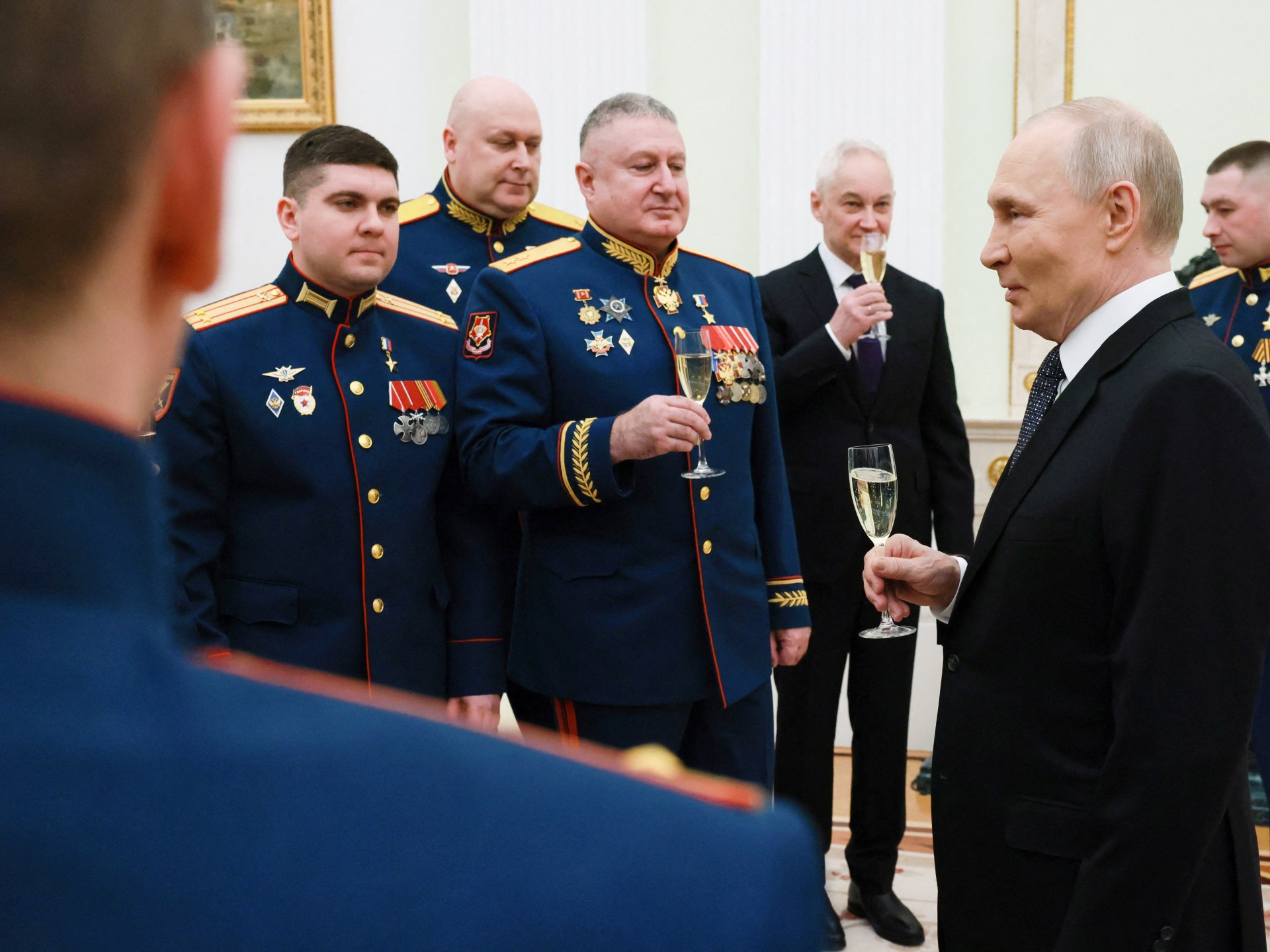
Four years into the Ukraine war, Moscow sees vindication, not failure | Russia-Ukraine war
As the all-out war in Ukraine enters its fifth year, Russian political elites remain convinced that their leader, Vladimir Putin, did not make a grave error by launching it in February 2022. Instead, they are looking back with a sense of achievement, and they have good reason to believe that the war is ending on their terms, perhaps even soon.
A striking feature of this conflict is the discrepancy between Russia’s real expectations of it and how these are interpreted by the Western media and expert community. The latter tend to describe Russia’s motives as a manifestation of its allegedly inherent imperialism and an ambition to re-establish control over half of Europe, as in Soviet times.
The true Russian motives are far more ad hoc and pragmatic. In general terms, they boil down to drawing a very firm red line against NATO’s expansion towards Russia’s borders, which, instead of envisaging the eventual integration of Russia itself, was clearly aimed at Russia’s isolation and containment.
A separate but significant factor is that the more belligerent and security-obsessed elements within Putin’s regime have always benefitted from the West’s open hostility towards Russia. The close symbiosis between these security elites and hawkish Western lobbyists who service the military-industrial complex is a lucrative joint venture that rewards both parties with money and power. In Russia’s case, the all-out conflict in Ukraine – which most Russians see as a proxy war with NATO – allowed securocratic elites to eliminate the pro-Western liberal opposition that threatened their political hegemony.
But there was also more ad hoc logic to Putin’s decision stemming from the events of 2019-2021 when the newly elected Ukrainian President Volodymyr Zelenskyy sought rapprochement with Russia – a policy that resulted in a near ceasefire along the front line in the Donbas region where a low-intensity conflict had simmered since 2014.
Zelenskyy came under immense pressure from Ukraine’s own securocratic elites, and he even claimed he faced a coup threat over what was described as “capitulation”. Meanwhile, hawkish lobbies in the West kept persuading him that Russia could in fact be defeated militarily, especially after Azerbaijan’s victory over Armenia in the last few months of 2020.
In January 2021, Zelenskyy made a U-turn in his Russia policy, abruptly transforming from a dove into a hawk aiming to cross each of Putin’s red lines by clamping down on his key Ukrainian allies and launching an aggressive campaign for Ukraine’s NATO membership and against the Nord Stream 2 gas pipeline project. This transformation coincided with President Joe Biden’s inauguration in the White House.
In March 2021, Putin started deploying troops at the Ukrainian border, but it took another 11 months of brinkmanship before he launched the all-out invasion. All the while, Ukraine’s Western partners seemed far more eager to challenge Russia and call its perceived bluff than to avert the catastrophe.
When Putin finally launched his brutal invasion, it soon transpired that his plan went along the lines of Russia’s war in Georgia in 2008, prompted by President Mikheil Saakashvili’s ill-fated decision to recapture the breakaway region of South Ossetia. It was designed as a shock-and-awe operation aimed at creating a tangible existential threat to the Ukrainian leadership in Kyiv and forcing upon Ukraine a more unsavoury version of the Minsk agreements, reached in 2015 but not implemented since then.
The hope was to avoid a protracted war along the heavily fortified old line of contact in the eastern region of Donbas. That plan failed, perhaps due to miscalculations about the power of Ukrainian resilience and the immediacy of large-scale Western military aid. But the Russians definitely do not see it as something that was not worth attempting. While threatening Kyiv, they achieved more than they could have hoped for by establishing a land corridor between Russia and Crimea, annexed in 2014.
After the Istanbul talks were derailed – as a result of Anglo-American intervention, according to a range of international sources – the Russians chose to regroup, abandoning loosely controlled and difficult-to-hold areas, and embarked on a prolonged war of attrition along the Donbas front line. They also raised the cost of what they see as Ukrainian intransigence by formally annexing four partially occupied Ukrainian regions.
The next four years were a test not just of Ukrainian, but also of Russian resilience. Crucially, the Russians see themselves as underdogs in a battle with the mighty Western military-industrial machine, which, in their view, is using Ukrainian proxies merely as gun fodder. During the first two years of this war, Western punditry and media prophesied the collapse of the Russian army and economy. The former was pictured as an unruly marauding horde of poorly equipped and poorly motivated soldiers. The latter was described as a colossus on legs of clay.
But neither the Russian economy nor its military machine collapsed. In fact, Russia experienced an economic boom during the first two years of the war, and the rouble was the world’s best-performing currency in 2025. The Russian army withstood the Ukrainian counter-offensive of 2023, which was advertised by the Ukrainian leadership and Western punditry as an easy advance towards Crimea. Having done so, the Russians resumed their slow offensive, aiming to break Kyiv’s will rather than occupy huge territories. Besides, the Russian military proved its ability to adapt and innovate, gradually taking the lead in what makes this war the most technologically advanced form of warfare ever seen – drones.
In the fifth year of Russian aggression, Ukraine looks thoroughly devastated, depopulated and deprived of a demographic and economic future, while Russian society continues to enjoy largely the same lifestyle as before the war. The human toll of the war, currently estimated at 200,000-219,000 dead by BBC/Mediazona, is significant for a country of 140 million but primarily affects the most destitute social classes and regions, while largely sparing the country’s urban middle classes.
Sensing victory, Putin is patiently waiting for Ukrainian and European leaders, too heavily invested in illusory outcomes of this war, to accept reality on the ground and to find ways of scapegoating others rather than themselves for the looming fiasco.
This year will likely see multiple attempts to derail direct peace talks currently under way between Russia and Ukraine. However, delays in reaching a peace settlement come at the cost of numerous Ukrainian lives, territory and already devastated critical infrastructure. The longer the war continues, the more likely it is that Ukrainians will start feeling at least as bitterly about pro-war cheerleaders in the West as about the prime cause of their suffering, Putin’s Russia.
The views expressed in this article are the author’s own and do not necessarily reflect Al Jazeera’s editorial stance.

Post Comment