Nepal election: Is the monarchy still a force, two decades after ouster? | Elections
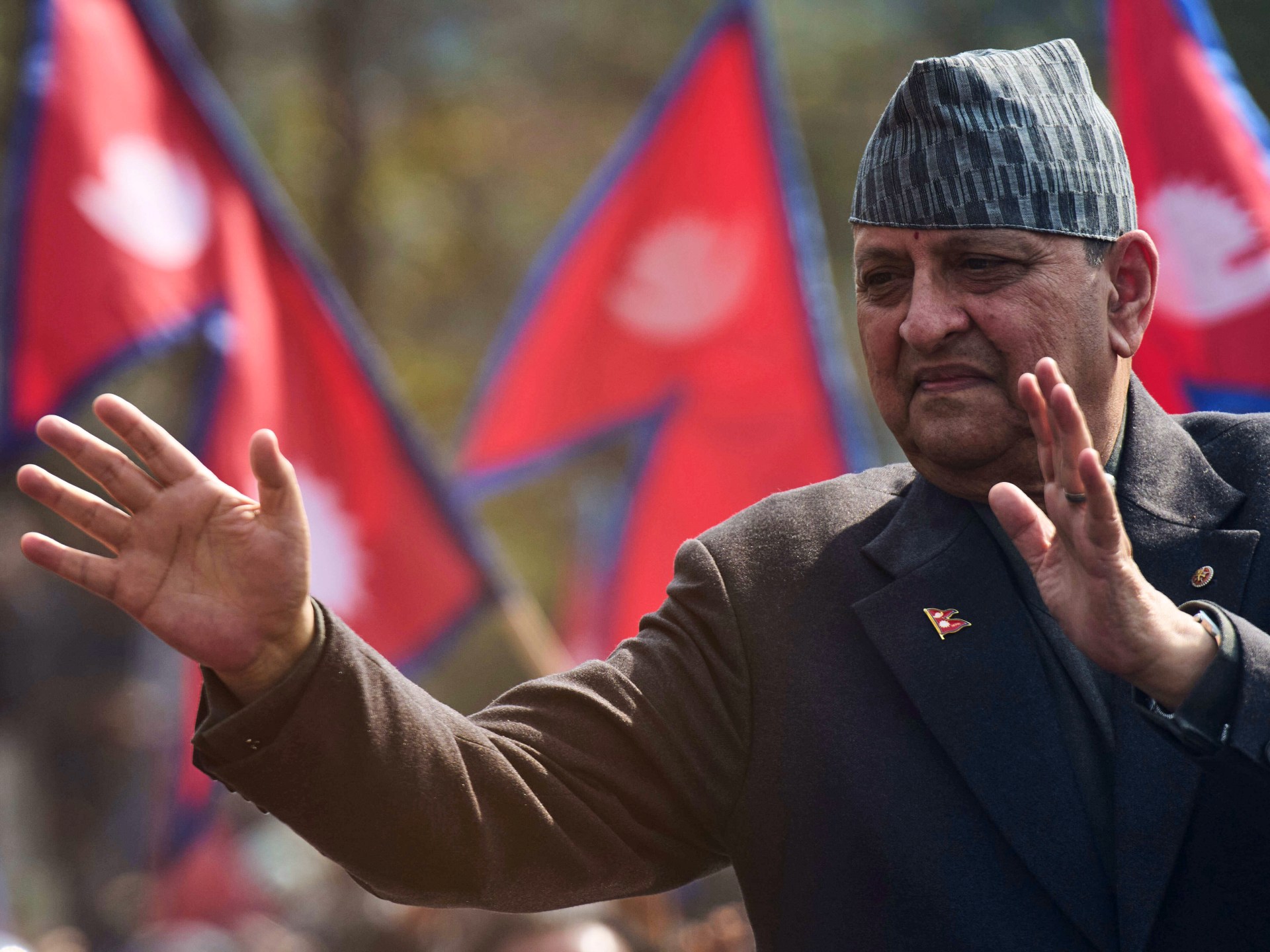
Kathmandu, Nepal – On the eve of Valentine’s Day last month, a former king in Nepal was on a helicopter, making his way to the capital, Kathmandu, from Jhapa, a district to the southeast where he has business interests.
Gyanendra Bir Bikram Shah landed in Kathmandu to a red carpet welcome by thousands of supporters, with chants of “Raja aau, desh bachau!” (“Come back, king, save the country!”), a slogan popular among Nepal’s royalists, ringing out.
Four days later, on the eve of Nepal’s Democracy Day, the 78-year-old former monarch released a video message with English subtitles, speaking of his “unwavering sense of duty and responsibility” towards a nation he suggested was trapped in an “unusual whirlwind of distress”.
“The country is in one of the most painful situations in its history,” he said.
“In a democracy, it is appropriate for state systems and processes to operate in accordance with constitutional principles. While periodic elections are natural processes in a democratic system, prevailing sentiments suggest that elections should proceed only after national consensus to avoid post-election conflict or unrest.”
Shah’s explicit opposition to the parliamentary election – scheduled for Thursday – was aimed at Nepalis who have a lingering nostalgia for the monarchy, which was abolished in 2008 after seven years of Shah on the throne.

Why Shah is hopeful
Since the 239-year-old monarchy was abolished in 2008, Nepal, an impoverished nation of 30 million people, has been plagued with political instability.
It has seen 14 governments and nine prime ministers since, with power rotating between the former Maoist rebels’ party, the Communist Party of Nepal (Unified Marxist-Leninist), and the Nepali Congress.
However, a Gen Z-led uprising in September last year challenged the dominance of Nepal’s established political parties and forced the formation of an interim government, which is overseeing the March 5 election.
The youth-led challenge to an ageing political class has reignited debates in Nepal about a possible return of monarchy, and whether the prospect has significant public support.
There is marginal political support, too.
The Rastriya Prajatantra Party (RPP), which won 14 of the 275 seats in the 2022 parliamentary election, openly advocates for the restoration of a constitutional monarchy. Its leader, Rabindra Mishra, told Al Jazeera that Shah’s call for consensus on the issue echoed his own thoughts.
“I believe we need national consensus and a systemic overhaul of the system,” Mishra said, while campaigning in his constituency in Kathmandu. “I have been saying the election should be slightly postponed to forge consensus before announcing new dates. But we are not a formidable political force. The major parties are moving ahead with the election regardless.”
A year ago, Shah had put up a similar show of support in Kathmandu, fuelling speculation about whether he was trying to test the waters to push for the restoration of the constitutional Hindu monarchy. The demonstration turned violent after Durga Prasai, the royalist businessman who had mobilised crowds for the rally, broke the police barricade with his car and entered the restricted zone, which was not designated for demonstrations. Two people were killed, more than 100 were injured, and more than 100 were arrested for clashing with police.

‘Trying to remain relevant’
Critics see calculated political signalling behind Shah’s public appearances.
Baburam Bhattarai, an ex-prime minister and former Maoist leader, said Shah’s statements were concerning.
“These kinds of public statements during crucial times are not good,” Bhattarai told Al Jazeera. “The Constituent Assembly lawfully abolished the monarchy and established a democratic republic. He should think about how to contribute responsibly as a citizen. Suggesting elections should not happen just before they take place sends the wrong message.”
Political analyst CK Lal offered a more tempered view.
“He [Shah] has seen power, and that nostalgia does not fade easily,” Lal told Al Jazeera. “Perhaps he hopes that if circumstances change, keeping the idea alive may prove useful. But at present, he appears to be trying to remain relevant. It is difficult for anyone who once held absolute authority to accept irrelevance.”

‘Unifying symbol’
The RPP’s election manifesto describes the monarchy as a “guardian institution”, necessary for a country in crisis.
“To move forward, both wheels must be strong,” said party leader Mishra, using the metaphor of a royal chariot. “We are not proposing the monarchy will run the government. Political parties will govern. The monarchy would serve as a unifying symbol above partisan politics.”
Mishra said Nepal faces internal security challenges and regional geopolitical pressures, and a ceremonial monarchy could provide stability.
But Bhattarai rejects this, saying the idea of a Hindu monarchy conflicts with Nepal’s religious, ethnic and cultural fabric, and its secular constitution.
“Monarchy is obsolete,” he said. “It will not solve our crises. These are inherent challenges that can only be addressed through democratic processes. Nepal is an inclusive, secular state. We cannot reverse that.”
Lal, however, argued that the monarchy retains a limited but symbolic resonance among some people.
“It would be presumptuous to say it is not a force,” he said. “But it is not a considerable force. It appeals mainly to religiously minded elders and cultural conservatives. The younger generation has no lived experience of monarchy. To them, it appears antiquated.”

Calls to restore Hindu state
Nepal’s monarchy under the Shah dynasty ended in 2006, when Maoist-led mass protests forced Shah, who had seized power and imposed emergency rule, to reinstate parliament. In 2008, a constituent assembly formally abolished the monarchy and declared Nepal a secular federal democratic republic.
Now, the RPP advocates for reinstating Nepal as a Hindu state. Nepal was the world’s only officially Hindu kingdom until 2008.
Mishra frames the proposal as cultural preservation rather than religious majoritarianism. “Nepal is a centre of both Hinduism and Buddhism,” he said. “We do not oppose any religion.”
However, he insisted: “To protect Nepal’s identity and maintain social cohesion, we need a Hindu king as the head of state.”
More than 80 percent of Nepal’s population is Hindu.
Bhattarai dismissed the idea as “romanticism”.
“Religion is a personal faith,” he said. “A nation state does not have a religion – people do. Enforcing one religious identity on a diverse society is anti-democratic.”
Lal pointed out that calls to restore the monarchy and a Hindu state are closely intertwined. “From a monarchist perspective, a Hindu state is a first step,” he said. “For Hindu nationalist forces, it may be an end goal. There appears to be a convergence of interests.”
Since 2008, Shah has not formally entered politics, though he maintains a visible public presence. He appears at restaurants, night clubs, and other public places on his birthday and during festivals, casually posing for photographs with people. His occasional private visits abroad, including to India, have drawn political scrutiny, though he holds no official diplomatic role.
India’s governing Bharatiya Janata Party of Prime Minister Narendra Modi also holds the ideology that India ought to be a Hindu state.
At a pro-monarchy rally in 2025, a prominent poster showed Yogi Adityanath, a Hindu nationalist politician who is the chief minister of the Indian state of Uttar Pradesh, which borders Nepal. Adityanath is also the chief priest at Gorakhnath Temple, which the Shah dynasty considers sacred, and has been publicly sympathetic to the idea of Nepal as a Hindu state.
But Lal downplayed speculation about Shah being backed by India, home to the world’s largest Hindu population.
“Foreign governments support winners, not losers. Their [India’s] interests lie with whoever holds power,” he said. “Despite a close relationship between the monarchy and the [Hindu nationalist] lobby in India, which is the ruling class now, they know that the monarchy has almost no relevance in Nepal.”
Monarchists mainly draw their support for the institution from an 18th-century treatise called Dibya Upadesh (Divine Counsel). Attributed to the “Prithvipath” philosophy of Nepal’s unifier, King Prithvi Narayan Shah. The idea describes Nepal as “a yam between two boulders”, referring to its precarious position between India and China, and urges its leaders to pursue cautious diplomacy, economic self-reliance and internal unity.
The RPP’s Mishra argues that these principles remain relevant.
“What Prithvi Narayan Shah formulated more than 240 years ago is still applicable today, in foreign policy, diplomacy, economic protection and national stability,” he told Al Jazeera. “We already had our organic values in Dibya Upadesh, but we went looking elsewhere for ideological models.”
But analyst Lal dismissed the idea that an 18th-century doctrine could guide a 21st-century republic.
“It is largely nostalgia. Invoking Prithvipath does not address contemporary geopolitical and economic realities. Nepal today operates in a completely different global context,” he said.
“I don’t see much chance for the monarchy to be restored.”

Post Comment