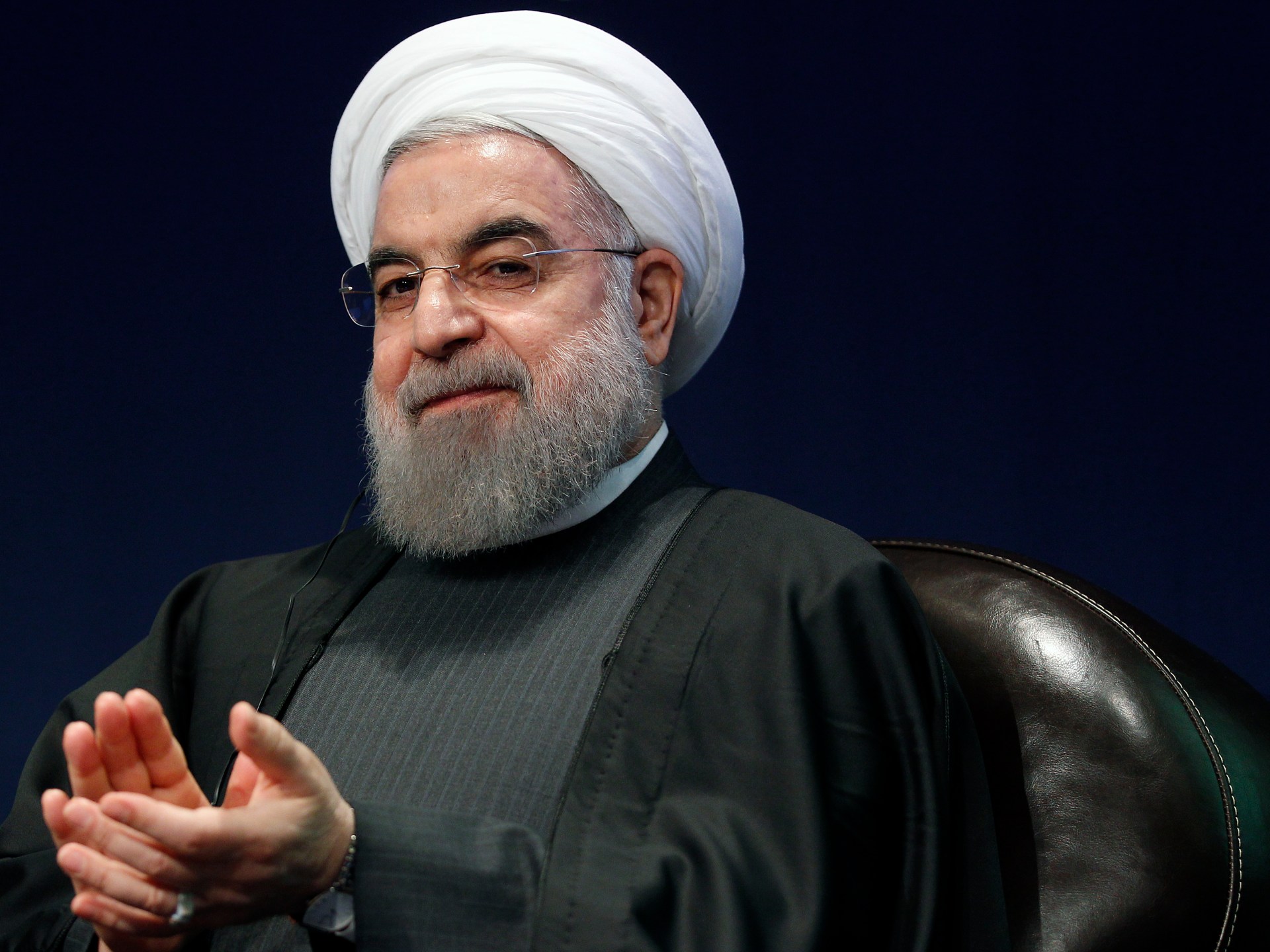
Iran’s succession question: Rouhani’s name resurfaces amid leadership void | Israel-Iran conflict
In Iran’s major turning points, Hassan Rouhani’s name tends to resurface – even when he is no longer at the centre of decision-making. And as the Islamic Republic enters a sensitive transitional phase after Supreme Leader Ali Khamenei was killed in a joint United States-Israeli strike, the question of which figures might be used to calm the domestic arena or rebalance power inside the system has returned to the forefront.
Rouhani, Iran’s former president (2013–2021), a Muslim leader with a doctorate in law, is not an outsider to the system he once promised to “reform”. He is a product of it: a longtime parliamentarian, a veteran of the national-security apparatus, and a former chief nuclear negotiator who rose to the presidency in 2013 as a pragmatist offering economic relief through diplomacy.
The long road through parliament
Rouhani was born in 1948 in Sorkheh, in Iran’s Semnan province. He received religious training in the Hawza system (Islamic religious seminary), then studied law at the University of Tehran, before earning a PhD in law from Glasgow Caledonian University in 1999.
After the revolution, he built his career through parliament. He was elected to the Majlis (Iran’s legislature) for five consecutive terms between 1980 and 2000, giving him practical political experience and longstanding relationships within the elite.
That background explains part of his later image as a “consensus man” more than an ideological confrontational leader: someone who moves within the rules of the game, not outside them.
A ‘third road’ in Iran’s post-revolution politics
To understand Rouhani’s political brand, it helps to place it in a longer arc of post-1979 ideological currents inside the Islamic Republic – an arc often described in Iranian political writing as a sequence of competing “discourses” that nonetheless remained anchored to the revolution and the system’s religious-constitutional framework.
Iran moved through phases that emphasised different priorities: currents sometimes described as “Islamic left”, “Islamic liberalism”, and a more market-oriented turn under former leader Hashemi Rafsanjani; then a period of “Islamic democracy” and “civil society” associated with Mohammad Khatami; followed by a social-justice-heavy, populist register under Mahmoud Ahmadinejad.
That’s when Rouhani arrived with the language of e‘tedal –or “moderation”.
Within that framework, “moderation” presents itself as an attempt to balance what supporters call the system’s two pillars: the “Republic” (pragmatism, governance, responsiveness) and the “Islamic” (ideals, clerical authority, revolutionary identity). This balance became central to Rouhani’s pitch in 2013: He promised to reduce external pressure, restart economic growth and lower domestic polarisation without challenging the authority structure that ultimately constrains any elected president in Iran.

The negotiator and president
Between 2003 and 2005, Rouhani led Iran’s delegation in nuclear negotiations with the “European troika” (Britain, France and Germany). He gained a reputation as a “pragmatist” among Western diplomats, while Iranian hardliners accused him of making concessions.
Later, that record became a pillar of his 2013 presidential campaign: a negotiator rather than a confrontationist.
In June that year, Rouhani won the presidency in the first round with more than 50 percent of the vote, avoiding a run-off in an election that saw high turnout.
Rouhani’s signature achievement was the 2015 nuclear agreement, the Joint Comprehensive Plan of Action (JCPOA), negotiated between Iran and the P5+1 – the US, China, Russia, France, United Kingdom and European Union.
Under the deal, the US and its allies lifted the bulk of sanctions imposed on Iran, and allowed Tehran access to more than $100bn in frozen assets. In exchange, Iran agreed to major caps on its nuclear programme.
At home, Rouhani sold the deal as a route to normalise the economy and curb inflation.
2017: A second mandate – and first brush with Trump
In May 2017, Rouhani won a second term with about 57 percent of the vote. Many inside Iran read the result as a bet by the country’s people on continued “opening” and reduced isolation.
But the power equation within Iran did not change. The presidency manages day-to-day governance, but it does not decide alone on the security services, the judiciary, the Revolutionary Guards or the core media architecture.
The diplomatic opening proved short-lived. In 2018, US President Donald Trump, in his first term, withdrew Washington from the JCPOA and reimposed sweeping sanctions, sharply limiting the economic gains Rouhani had promised. The reversal weakened Iran’s pragmatists and reformists, who had invested political capital in defending the agreement as the best available route out of isolation–while giving hardliners new ammunition to argue that negotiations with the US cannot deliver durable relief.
Post-presidential year – and a return from political exile?
Rouhani’s presidency ended in 2021, and with the rise of conservative dominance within Iran’s politics, he appeared to be gradually pushed to the margins. He then became a member of Iran’s Assembly of Experts – the body constitutionally empowered to choose the supreme leader.
But in January 2024, the Reuters news agency reported that the Guardian Council barred Rouhani from running again for the Assembly of Experts.
Two years later, after the February 28 strike that killed Khamenei, the country – according to the constitution– entered a temporary arrangement phase until the Assembly of Experts selects a new leader. President Masoud Pezeshkian, Supreme Court Chief Justice Gholam-Hossein Mohseni-Ejei and Guardian Council member Ayatollah Alireza Arafi form the interim leadership council that are in charge until the Assembly of Experts announces its pick for the next Supreme Leader.
And from the hushed conversations and chatter that have emerged from within Iran’s elite circles over potential candidates for the supreme leader’s role, Rouhani’s name has resurfaced.
That possible return to political life, analysts say, is a testament to what Rouhani represents in Iran’s factional geometry: a governing style that privileges tactical compromise, economic management and controlled engagement – while remaining fundamentally loyal to the Islamic Republic’s constitutional-religious architecture.
As Iran plans Khamenei’s succession, it faces a central question: whether to broaden legitimacy by incorporating pragmatic faces or double down on a security-first posture. Rouhani sits at that crossroads – not the architect of the system, and no longer a principal decision-maker, but a durable indicator of how far Iran’s establishment is willing to bend without breaking.

Post Comment