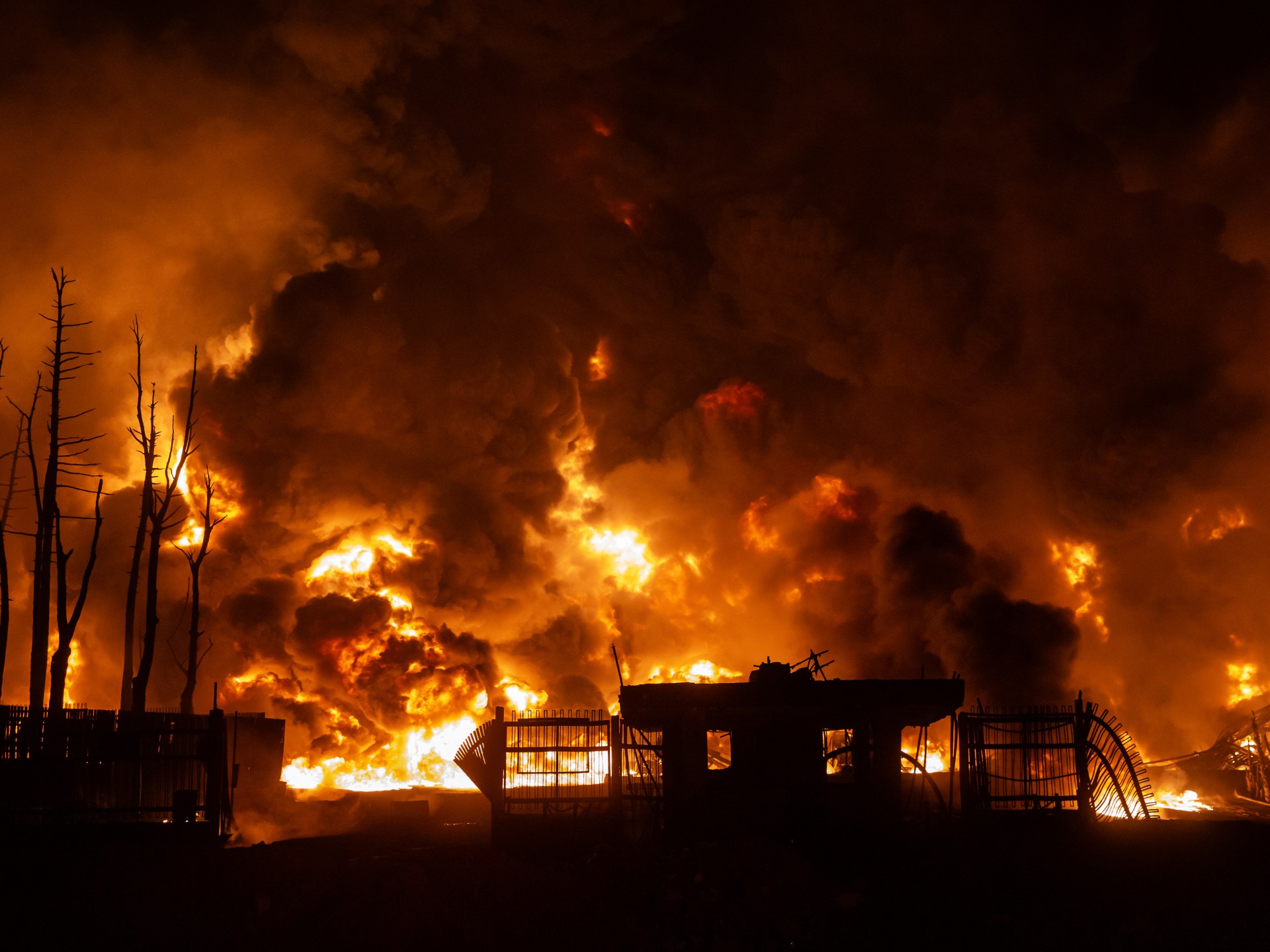
Oil soars past $100 a barrel, stocks plunge as US-Israel war on Iran rages | Oil and Gas
Oil prices have surged past $100 a barrel amid the fallout of the United States and Israel’s war on Iran.
Brent crude, the international benchmark, rose more than 30 percent on Sunday, at one point topping $119 a barrel, as fears grew of prolonged disruption to global energy supplies.
Recommended Stories
list of 4 itemsend of list
The surge marked the first time oil rose above $100 per barrel since Russia’s 2022 invasion of Ukraine.
Oil prices dropped back to around $110 per barrel after The Financial Times reported that G7 finance ministers would discuss the release of petroleum reserves in coordination with the International Energy Agency.
US President Donald Trump, who campaigned heavily on cost-of-living concerns in the 2024 election, brushed off the spike in prices.
“Short term oil prices, which will drop rapidly when the destruction of the Iran nuclear threat is over, is a very small price to pay for U.S.A., and World, Safety and Peace,” Trump said in a post on Truth Social.
“ONLY FOOLS WOULD THINK DIFFERENTLY!”
US Secretary of Energy Chris Wright also downplayed the prospect of rising energy prices earlier on Sunday, telling CBS News’ Face the Nation programme that any increase in prices at the petrol pump would be “temporary”.
Crude oil prices have surged by about 50 percent since the US and Israel launched joint strikes on Iran on February 28.
Iran has brought shipping in the Strait of Hormuz to an effective halt in retaliation, threatening about one-fifth of the global oil supply.
Iraq, the United Arab Emirates and Kuwait, three of the biggest producers in The Organization of the Petroleum Exporting Countries (OPEC), have cut production amid an accumulating backlog of barrels with nowhere to go due to the effective closure of the waterway.
Attacks on energy production facilities in the region have further threatened supplies.
Iran has been blamed for multiple attacks on energy facilities across the Gulf, including in Qatar, Saudi Arabia and Kuwait.
On Saturday, Israel carried out air strikes targeting Iran’s oil infrastructure for the first time since the start of the war.
The strikes hit four oil storage facilities and an oil production transfer centre in Tehran and the province of Alborz, according to Iranian state media.
Iran’s Revolutionary Guard Corps (IRGC) on Sunday threatened to target energy facilities across the region in retaliation, warning that oil could soar to $200 a barrel if the US and Israel “continue this game”.

Stocks in Asia fell sharply on Monday, as investors braced for the fallout of rising energy prices.
Japan’s Nikkei 225 closed more than 5 percent lower after falling as much 7 percent in early trading.
South Korea’s KOSPI was down 6 percent after plunging as much as 8 percent in the session.
In Hong Kong, the Hang Seng Index was down 1.35 percent.
European stocks opened lower, with the FTSE 100 in London and the DAX in Frankfurt down about 2 percent and 3 percent, respectively.
US stock futures, which are traded outside of regular market hours, also saw substantial losses.
Futures tied to Wall Street’s benchmark S&P 500 fell by 1.7 percent, while those for the tech-heavy Nasdaq Composite dropped by 1.90 percent.
While Trump administration officials have insisted that the war will be over within weeks, the prospect of prolonged disruption to global energy supplies has stoked fears of higher inflation and slowing economic growth.
The International Monetary Fund has estimated that every sustained 10 percent rise in oil prices results in a 0.4 percent rise in inflation and a 0.15 percent reduction in global economic growth.
“If the shock proves short-lived, the global economy can quickly recover,” Mike O’Rourke, chief market strategist at JonesTrading, told Al Jazeera.
“If oil remains at these levels for several weeks, it will be a major global headwind. Thus far, markets have underestimated the risks related to the conflict in Iran.”
In an interview published by The Financial Times on Friday, Qatari Minister of Energy Saad al-Kaabi warned that all of the region’s producers could soon be forced to halt production and that prices could hit $150 a barrel.
“Everybody that has not called for force majeure we expect will do so in the next few days that this continues,” Al-Kaabi told the newspaper.
“All exporters in the Gulf region will have to call force majeure.”



Post Comment