Colombia’s President Gustavo Petro under investigation in US for drug ties | Donald Trump News
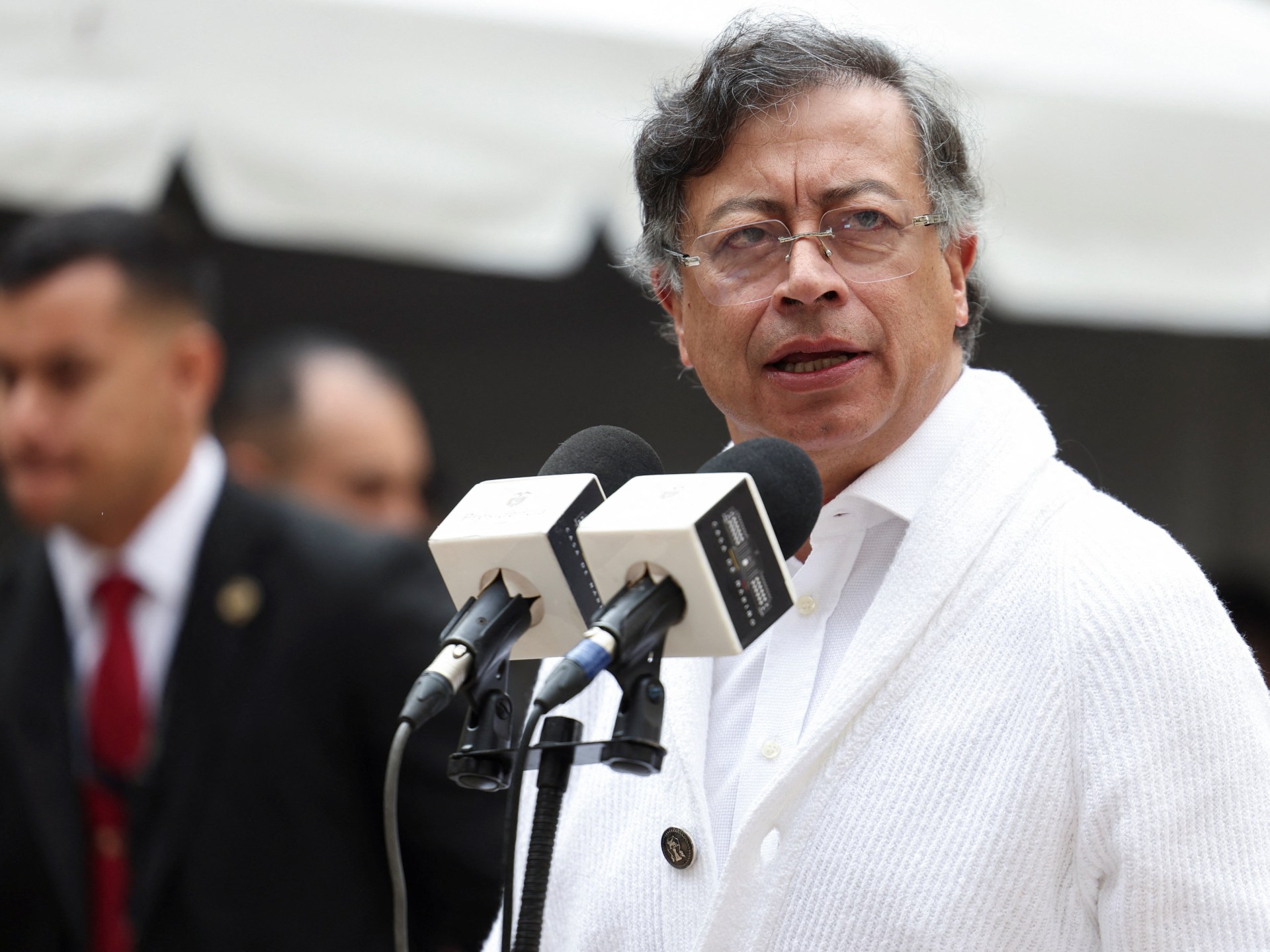
Colombia’s President Gustavo Petro has been named in two separate criminal investigations led by prosecutors in the United States.
The New York Times was the first to report the existence of the two probes on Friday, citing sources familiar with the proceedings.
Recommended Stories
list of 3 itemsend of list
Media reports indicate that Petro is not personally the target of the investigations, which focus on drug-smuggling in Latin America.
But according to the Times, US attorneys in Brooklyn and Manhattan are looking into whether Petro met with drug traffickers and solicited donations from them for his 2022 presidential campaign. Al Jazeera has not independently verified the Times report.
By Friday afternoon, Petro had issued a statement denying the claims, which threaten to reopen the rift between the US and Colombia.
“In Colombia, there is not a single investigation into my relationship with drug traffickers, for one simple reason: I have never in my life spoken with a drug trafficker,” Petro wrote on the social media platform X.
He added that he told campaign managers to never accept donations from bankers or drug traffickers.
The investigations in the US, he argued, would ultimately exonerate him, and he blamed Colombia’s right-wing opposition for stirring controversy.
“So, the proceedings in the US will help me to dismantle the accusations of the Colombian far right, which is indeed closely linked to Colombian drug traffickers,” Petro said.
Petro has not been charged with any crimes, and the investigations are in their initial stages, according to the Times.
But experts say the timing of the report is significant, as it comes barely two and a half months before Colombia is set to hold a closely watched presidential election on May 31.
“If this would have happened a week before the first round, it would be election interference,” Sergio Guzman, director at Colombia Risk Analysis, a security think tank, told Al Jazeera.
“This seems to be more of a warning that shows how the US could influence the outcome of the election.”
Petro, Colombia’s first left-wing president, is limited to a single term in office, but the election is likely to be a referendum on his four years in office.
It will also be a test for Petro’s Historic Pact coalition, whose candidate, Ivan Cepeda, is currently leading in the polls.

But United States President Donald Trump has repeatedly sought to boost the prospects of right-wing candidates in Latin America. He and Petro have been at loggerheads since Trump returned to office in January 2025.
Their feud came to a head in January after the US attacked Venezuela and abducted its president, Nicolas Maduro.
Shortly afterwards, a reporter asked if the US would take military action against Colombia. Trump replied: “It sounds good to me.”
To cool tensions, Trump and Petro held a call afterwards and agreed to meet.
Petro then visited the White House in early February to mend his often-combative relationship with Trump. While there, the Colombian delegation interacted with their counterparts, including Secretary of Defense Pete Hegseth and Secretary of State Marco Rubio.
Republican Senator Bernie Moreno, a longtime critic of Petro’s government, was also in attendance. Guzman believes the senator’s presence was significant.
“We don’t have a lot of straightforward answers about what were the commitments during that meeting, but Bernie Moreno did say that he wanted Petro not to be as involved in elections,” Guzman told Al Jazeera.
“And guess what? Petro is fully involved in the elections.”
The meeting also addressed collaborative efforts to combat drug trafficking, an issue core to Trump’s foreign policy.
Both presidents walked away from the meeting in good spirits, with Petro sharing a photo signed by Trump that read, “Gustavo – a great honor. I love Colombia.”
But Petro and Trump have long been at odds over how to tamp down on narcotics smuggling.
Colombia, the region’s largest producer of cocaine, has been criticised by the Trump administration for what it sees as soft-on-crime policies, including negotiations with armed groups.
Petro, meanwhile, has denounced the US for its lethal tactics, calling them tantamount to murder.
The US, for instance, has bombed at least 46 alleged drug boats and vessels in the Caribbean Sea and eastern Pacific Ocean. Some of the 159 people killed were Colombian citizens.
The US has also floated the idea of conducting military attacks in Latin America against suspected drug traffickers, and it recently began joint operations against gangs in Ecuador, Colombia’s neighbour.

Analysts say actions like these have Latin American leaders on edge.
Trump’s aggressive manoeuvres suggest that the US president is willing to jeopardise “the sovereignty and peace of every nation” in his campaign against illicit drugs, according to Rodrigo Pombo Cajiao, a constitutional law professor at the Pontificia Universidad Javeriana.
Pombo Cajaio pointed to the US abduction of Venezuelan President Nicolas Maduro on January 3. Maduro was a longtime adversary of Trump, and he is currently being held in prison in New York on drug-related charges.
“Every political leader in the region has been put on notice” after that abduction, Pombo Cajiao said.
“As the world’s leading producer of cocaine, Colombia found itself at high risk of judicial prosecution” from the US, he added.
Currently, Petro’s Historic Pact is leading May’s presidential race. A GAD3 poll released this week suggested Cepeda is ahead in the polls with 35 percent voter approval, ahead of far-right candidate Abelardo de la Espriella, who had 21 percent.

Post Comment