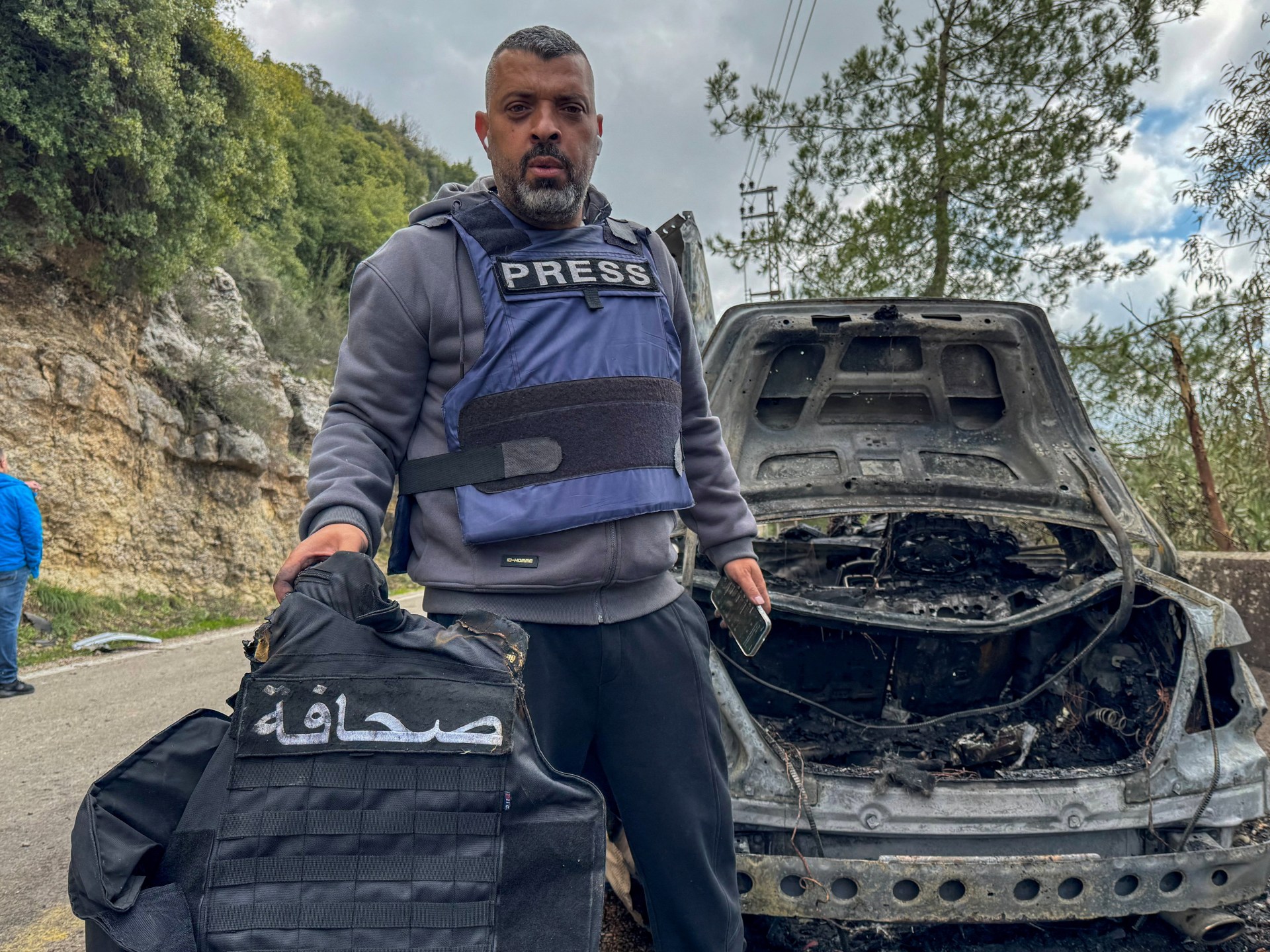
Three journalists killed in Israeli strike on marked press car in Lebanon | US-Israel war on Iran News
Three journalists and nine paramedics were killed in southern Lebanon on Saturday as the US-Israel war on Iran intensified.
An Israeli attack on the reporters’ clearly marked press vehicle killed Fatima Ftouni and her brother and colleague, Mohammed, of Al Mayadeen and Al-Manar’s Ali Shuaib on the Jezzine Road.
Recommended Stories
list of 3 itemsend of list
Four precision missiles hit the vehicle, Al Mayadeen said.
Other journalists were wounded in the attack, and one paramedic was killed as ambulances were also reportedly targeted.

The World Health Organization said that eight other paramedics were killed on Saturday and seven more were wounded in five separate attacks on healthcare in southern Lebanon.
The Israeli military acknowledged the strike that killed the journalists, claiming Shuaib was embedded within a Hezbollah intelligence unit and had been tracking Israeli troop positions in southern Lebanon. It also alleged he had been distributing Hezbollah propaganda.
Al-Manar, his employer, described him as one of its most prominent war correspondents, having covered Israeli attacks on Lebanon for decades.
Israel, which has killed more than 270 journalists in Gaza, often alleges that the reporters it targets are members of or are linked to armed groups without providing evidence.
Neither network accepted Israel’s characterisation.
Lebanese President Joseph Aoun said Israel had once again violated “the most basic rules of international law” by targeting civilians carrying out their professional duty.
He called it “a blatant crime that violates all norms and treaties under which journalists are granted international protection during armed conflicts”.
Prime Minister Nawaf Salam decried the attack as “a flagrant violation of international humanitarian law”.
Reporting from Tyre in southern Lebanon, Al Jazeera’s Obaida Hitto said, “All the journalists that I’m speaking to here today say that they were just doing their job, and that the journalists that are still here are going to continue to carry out their work despite the obvious dangers.”
Nine paramedics killed in one day
WHO’s chief Tedros Adhanom Ghebreyesus did not specify the perpetrator when announcing the deaths of paramedics.
“In Zoutar al-Sharqiya, five health workers were killed in a strike, and two were injured, one critically. Two more health workers were killed and three wounded in Kfar Tibnit; one paramedic died in an attack at a health facility in Ghandouriyeh, while another was killed in a strike in Jezzine. Two were wounded in an attack on Kfar Dajjal,” he said.
Tedros noted the repeated attacks have severely disrupted health services in southern Lebanon, with four hospitals and 51 primary healthcare centres now closed and several other facilities operating at reduced capacity.
‘Intense day of bombardment’
For Ftouni, one of the journalists who was killed, the war had already struck close to home. Earlier this month, her uncle and his family were killed in an Israeli strike, a loss she had reported on live television.
Al Mayadeen has now lost six journalists since hostilities began. Farah Omar, Rabih Me’mari, Ghassan Najjar and Mohammad Reda were killed in earlier attacks.
According to Lebanon’s Ministry of Health, 1,142 people have been killed and more than 3,300 injured in Israeli attacks since March 2 amid the rapidly widening regional conflict now entering a second month.
Israeli troops have pushed further into the south, advancing towards the Litani River. Hezbollah has claimed dozens of operations against Israeli forces in the past 24 hours.
An Israeli air raid in the southern Lebanese town of Deir al-Zahrani killed one Lebanese soldier, Lebanon’s National News agency reported.
Reporting that he could still hear “explosions”, Al Jazeera’s Hitto said the south had experienced an “intense day of bombardment and air strikes”, describing the entire area south of the Litani River as a “no-go zone”.
He said that some 20 percent of the population of southern Lebanon was staying put in defiance of Israel’s forced displacement orders, but that their decision was “turning into a very deadly gamble”.
Saturday’s killings of the journalists fit a pattern that press freedom organisations have been tracking with alarm.
The Committee to Protect Journalists recorded a global high of 129 journalists killed in 2025, the most since it began collecting data over three decades ago, with Israel responsible for two-thirds of those deaths.
It has now killed more journalists than any other nation in CPJ’s recorded history.
A separate assault earlier this month killed Al-Manar’s political programmes director, Mohammad Sherri, in central Beirut.

Post Comment