Civilians under fire by gangs in Gaza: What happened in Maghazi? | Israel-Palestine conflict News
Gaza City, Gaza Strip – At noon on Monday, Asaad Nteel and his family were terrified when a group of armed men suddenly stormed their home in eastern Maghazi, central Gaza. There had been no prior warning.
Family members quickly found themselves in the centre of a gunfight involving an armed Palestinian groups, which currently operates in Israeli-controlled areas of the Gaza Strip in the wake of Israel’s brutal war.
At first, Nteel and his family thought the gunmen, who rushed into their home as heavy fire thundered outside, must be Israeli soldiers, as they live very close to the “yellow line” that separates Palestinian and Israeli-controlled areas of Gaza.
The armed men, however, quickly identified themselves to the family as the “Popular Forces combating terrorism”, an armed group operating in central Gaza with the support of the Israeli army.
“They broke the doors, detained my uncle and the other man, and took them away towards an area near the yellow line,” Nteel told Al Jazeera.
Nteel, his wife, and their extended family, including his parents and siblings in the upstairs apartment, say they froze in fear.
“The militia members ordered us to gather in one room and not move at all,” Nteel explained.
“We chose not to resist so they wouldn’t harm us or the children and women with us.”
As the family crowded into a single room of the house, the armed men positioned themselves near windows and openings, exchanging gunfire with other gunmen believed to be affiliated with Hamas.
The family later discovered theirs was one of four houses in the neighbourhood that the armed group used as cover during this particular battle.
“We didn’t understand what exactly was happening or what these militias wanted. We stayed like that until they received orders to withdraw,” Nteel said.
Before the gunmen left, they interrogated Nteel at length about whether any nearby residents were affiliated with Hamas.
They also accused him of attempting to film them after spotting cameras in the house. He tried to convince them that the cameras were not working and explained that he and his wife had worked as wedding photographers before the war.
“They reluctantly believed my story and confirmed it with my father, but still confiscated all my equipment, my cameras and lenses,” he said.

Backed by the Israeli army
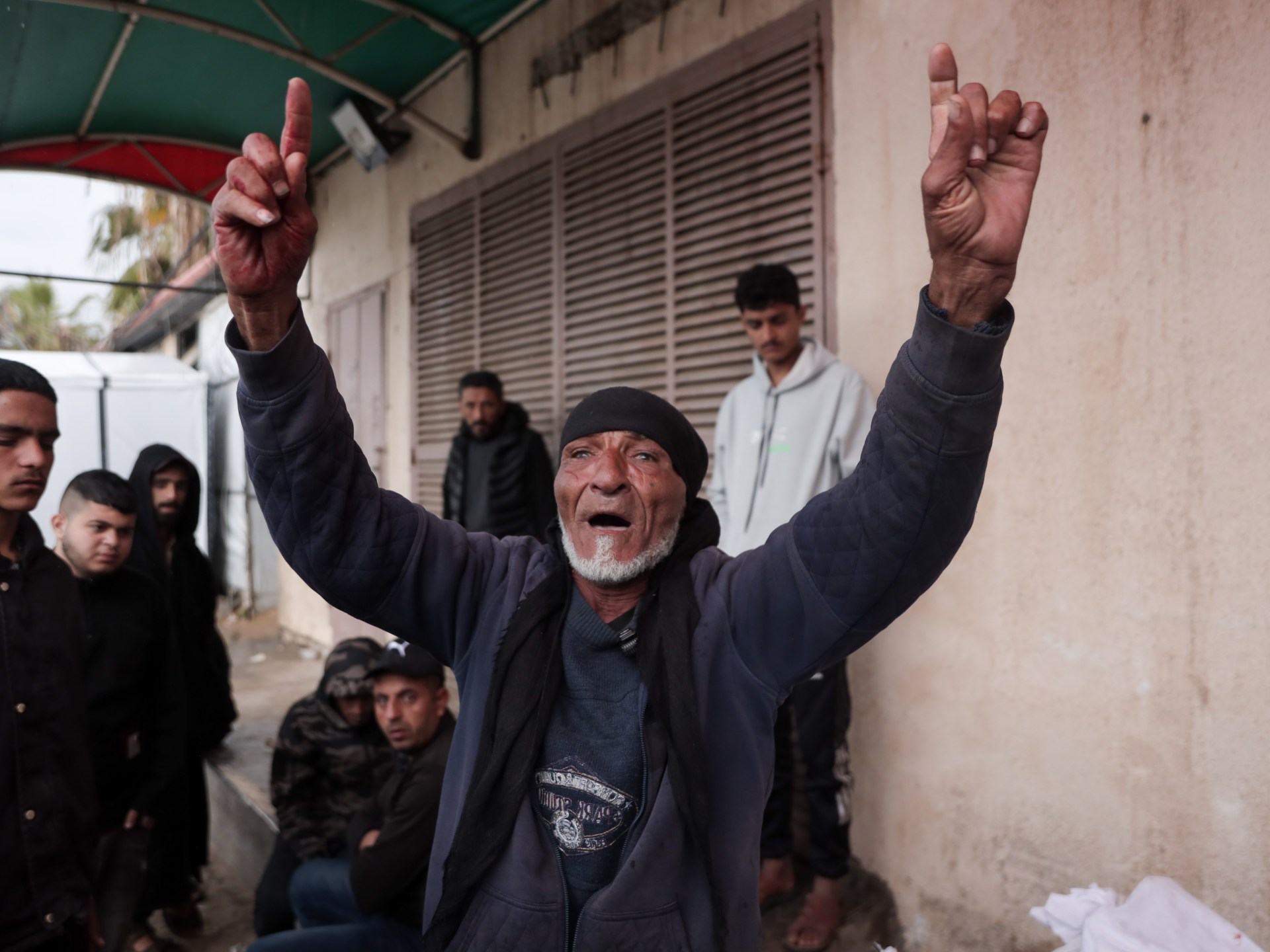
The gunfight the Nteel family was terrifyingly caught up in on Monday was just one part of a series of raids and clashes by armed gang members on the east side of the camp, which resulted in the killing of at least 10 Palestinians and the injury of dozens more that day, according to Al-Aqsa Hospital reports.
The Ministry of Health also reported 10 deaths in the violence in Maghazi as well as 44 people injured on Monday.
Local people claim the armed men were provided with cover and support by Israeli forces.
The attack began when armed groups approached from the direction of the yellow line, moving towards civilian homes and the Al-Maghazi Preparatory Boys School, run by the United Nations Relief and Works Agency for Palestine Refugees (UNRWA), which is sheltering large numbers of displaced people.
As gunfire rained down on the school, residents tried to stop the men, triggering clashes.
Mohammad Jouda, 37, one of the displaced people living in the school, told Al Jazeera from Al-Aqsa Hospital that people had been caught completely off guard by the gunfire, triggering panic and chaos.
“We couldn’t move at all because of the intensity of the fire. Armed men stormed the school and started shooting directly inside… it was pure panic and shock. The school is full of displaced people, children and women. Then, minutes later, warplanes struck the school gate… we were surrounded from all sides… there were casualties everywhere.”
Resistance by local residents and people inside the school prompted fire cover from accompanying Israeli forces, which allowed the armed men to withdraw, he said.
Khaled Abu Saqr, another resident of Maghazi, told Al Jazeera that Monday’s events had come as “a major shock” for residents and displaced people, as the camp’s streets turned into a “war zone”.
“I was about 400 metres [1,300 feet] away. People started saying there was a raid, then news spread that Israeli-backed militias were advancing,” he said.
“Many people gathered, trying to confront them and stop their advance amid heavy clashes. Suddenly, multiple reconnaissance missiles were fired.”
According to eyewitnesses, large crowds of people were fired upon or shelled, particularly near the school packed with displaced civilians.
“I was watching and trying to hide to avoid being hit. People were running in fear, women and children fleeing the militias, while streets filled with cars carrying the wounded and the dead,” Abu Saqr told Al Jazeera.
The incident has sparked widespread outrage on social media, with activists sharing videos documenting victims being transported to hospitals.
‘Bombing and blood never stop’
The groups are spread geographically across Gaza, operating near front lines, where they have taken advantage of the collapse in security caused by the war. Analysts say reports indicate they mostly consist of small numbers and operate outside traditional structures.
There is one in the far north, in Beit Lahiya; and a second, also in the north, in eastern Gaza City, particularly Shujayea.
In central Gaza, mostly east of Deir al-Balah, there is a third group responsible for the Maghazi attack.
In the south, there is a fourth group in eastern Khan Younis. There is also a fifth group in the south, in Rafah.
These groups appear to operate near areas along the “yellow line”.
According to Abu Saqr in Maghazi, the violence on Monday lasted for more than an hour and a half, causing extreme distress to residents who, he says, do not support these groups.
“Security forces and many civilians tried to confront the militias. People strongly reject them and tried to stop them by any means, but they were bombed… the scene was like a massacre.”
“They say there’s a truce and a ceasefire… that’s all lies. Bombing, killing, and blood never stop. We are exhausted.”
Indeed, since the ceasefire between Israel and Hamas supposedly began on October 11, some 733 Palestinians have been killed in Gaza, and 2,034 injured. That is in addition to 759 bodies recovered.
The Gaza Centre for Human Rights claims that Israel is increasingly supporting these groups to carry out operations within densely populated camps and neighbourhoods.
It said armed drones provided direct support on Monday, firing heavily and randomly into alleys in the camp to aid the armed men’s withdrawal.
The centre added that it has documented previous violence by these groups, including looting of aid convoys, kidnappings, torture and killings, with cover or support from the Israeli army.
Legally, it pointed out, forming and supporting such armed groups constitutes a violation of the Fourth Geneva Convention of 1949. Israel ratified the Geneva Conventions in 1951.
The emergence of these armed groups in Gaza represents a “dangerous escalation and evasion of legal responsibility”, the human rights group said. It called on the international community and the United Nations to launch an urgent independent investigation, hold those responsible accountable, and ensure effective protection for civilians.

Post Comment