Makeshift Gaza university offers chance to resurrect academic studies | Israel-Palestine conflict News
The new academic semester kicked off in Gaza in late March. But the mornings no longer carry the familiar vibrance of students waiting for buses, crossing cities towards universities and colleges.
That feeling has instead been replaced by the hardship of displacement.
Recommended Stories
list of 3 itemsend of list
Israel’s destructive campaign has reduced Gaza’s academic institutions to rubble, many now repurposed as crowded shelters for displaced families. With campuses gone, in-person education has largely disappeared, forcing universities to shift to online learning. But for students living in tents, struggling to secure food, water, electricity, and internet, attending a lecture, even online, has become a privilege.
Amid this chaos, a glimmer of hope has materialised.
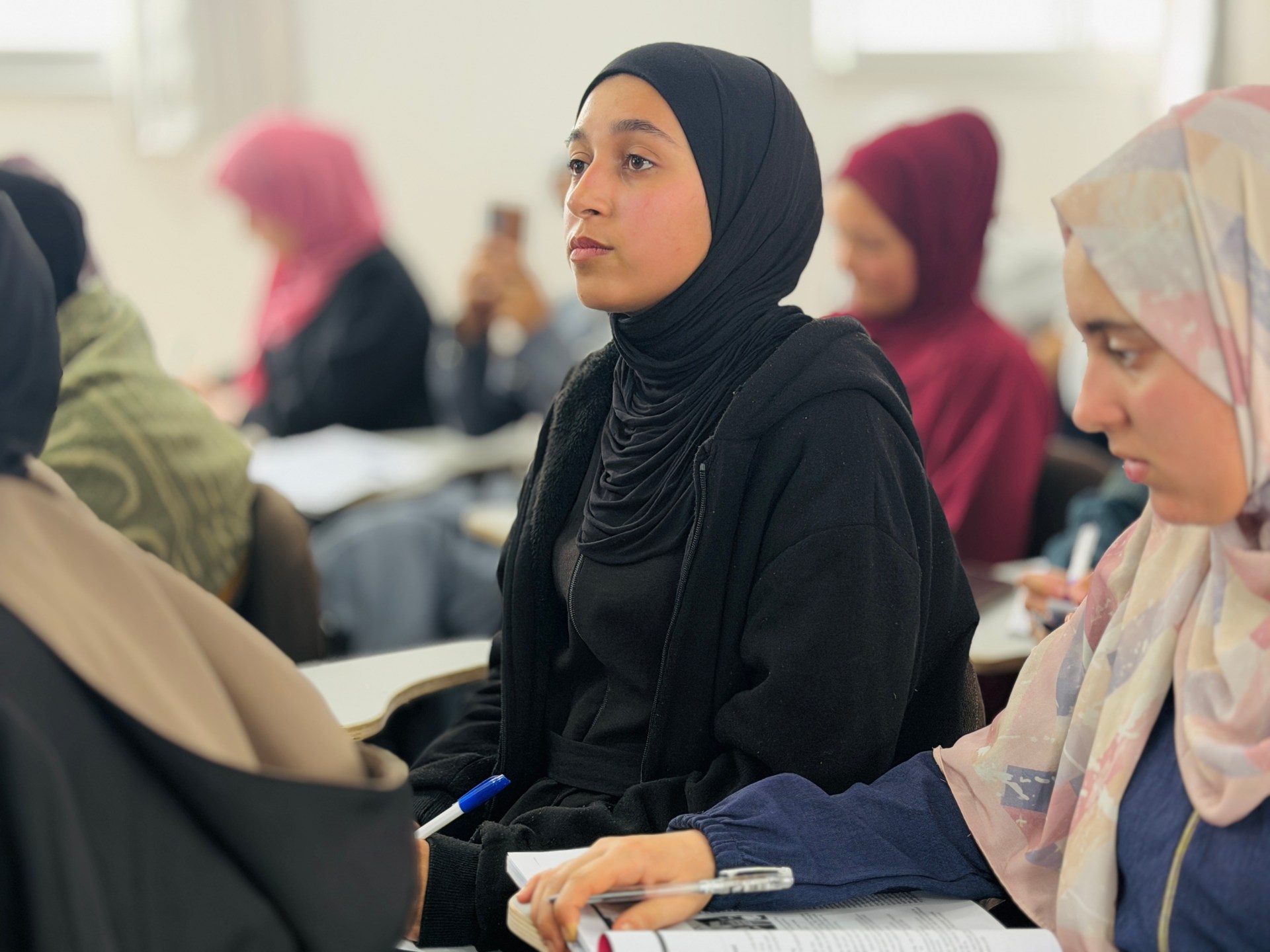
In the densely crowded area of al-Mawasi in southern Gaza’s Khan Younis, a new academic initiative is taking shape. Scholars Without Borders, a US nongovernmental organisation, has established what it calls “University City”, a makeshift academic space designed to bring students back into lecture halls.
Built from wood, metal sheets, and whatever materials could be sourced locally, the site stands as a modest reconstruction of what Gaza’s academic life once looked like.
“Despite the hardships, our mission is to bring education closer to students in a better environment,” said Hamza Abu Daqqa, the organisation’s representative in Gaza.
“We designed this space to serve multiple academic institutions and as many students as possible,” he added. “There are six halls here, accommodating up to 600 students a day. It may look simple, but it creates a sense of normal academic life, something students have been deprived of.”
The space includes internet access powered by solar panels, improvised green areas, and even a small business incubator aimed at helping students engage on their own prospects.
According to the organisation, University City operates on a rotating weekly schedule, with each day allocated to a different academic institution. This system allows multiple institutions to share the limited space, ensuring the widest possible access for students.
Given the constraints, universities prioritise courses that require in-person instruction the most, such as practical and discussion-based classes.
Gaza’s prominent universities, such as the Islamic University and Al-Azhar University, have begun using the site, alongside other colleges like the Palestine College of Nursing.
But behind this modest structure lies a far heavier reality.

A glimpse of what was lost
Across Gaza, universities have been systematically damaged or destroyed since Israel began its genocidal war in October 2023. In the south, all institutions have been rendered inoperable. A limited number of campuses in northern Gaza have been partially restored, but their capacity remains extremely restricted.
The Palestine College of Nursing, for example, has been surrounded by ruins after falling within the “yellow line” where the Israeli military continues to be based since the October ceasefire, cutting off students from their classrooms entirely.
For a generation of students, university life has simply not existed, as they instead battled to survive.
Each academic year is usually marked by new beginnings, especially for freshmen stepping into a new phase of independence and discovery. But for two consecutive years, thousands of Gaza’s students have been denied that experience.
Now, inside University City, they are encountering it for the first time.
‘It feels like a real university’
Mariam Nasr, 20, a first-year nursing student displaced from Rafah, sat in one of the makeshift halls, reflecting on what the space meant to her.
“Before the genocide, everything we needed to study was available; our homes, electricity, materials, and most importantly, safety,” she said. “But for more than two years, our lives have been completely disrupted.”
Mariam began her final year of high school just as the war started. It took more than a year to complete her exams under difficult conditions before she could finally enrol in the university.
“I always dreamed of studying medicine,” she said. “But the circumstances affected my results. My late grandfather told me that healing people isn’t limited to one path, so I chose nursing.”
Still, her degree requires in-person courses, something she had never experienced until now.
“When I saw this place, I was amazed,” she said. “It was the first time I attended classes in a space that actually feels like a university. We are all excited. It feels different; it feels real.”
For students like Mariam, their first year was spent behind screens, if they were lucky to have one in their tents, disconnected from the academic environment they had hoped for.
Amr Muhammad, 20, another first-year nursing student from al-Magahzi Camp in central Gaza, shared a similar reaction.
“I expected something much simpler, just tents and basic setups,” he said. “But this was different. Being here with other students, discussing and engaging in class makes a huge difference.”

Academia under fire and siege
The experience faced by students in this small space reflects a much larger tragedy.
Israel’s destruction of Gaza’s academic sector has been described by UN experts as scholasticide; the systematic dismantling of education through the targeting of institutions, students, and academic life itself. Universities have been destroyed, professors and students killed, and reconstruction efforts obstructed.
More than 7,000 university students and academics have been killed or injured by Israeli attacks, while more than 60 university buildings were completely demolished by Israeli aerial attacks or ground detonations, according to the Euro-Med Human Rights Monitor and information shared by Palestinian officials.
As a result, hundreds of thousands of students have been cut off from formal education, forced into alternatives that are not able to match their former experiences.
And those alternatives, such as University City, face enormous difficulties in just getting their work started.
“All the materials you see here were sourced from inside the Gaza Strip,” Abu Daqqa said, gesturing around the site. “We had to work within what was available, with rising costs and scarcity of resources. But we were determined to create something that gives students a sense of normalcy.”
Under the October ceasefire, Israel is obliged to allow reconstruction materials to help restore shelter, essential services for Palestinians. But Israel has not adhered to that stipulation and has continued to impose restrictions, while carrying out deadly attacks across Gaza.
And for many students, reaching the University City is itself a challenge.
“I am displaced in al-Mawasi, so I’m supposed to be relatively close, but even getting here is difficult,” Mariam said. “My classes start at 9am, and I wake up at 5 just to find transportation.”
With roads damaged and fuel scarce, options for students are limited to worn-out vehicles and donkey or horse carts.
“Getting cash is frustrating. Taxis and carts only accept coins. My father barely got me eight shekels [$2.64] today, but I couldn’t find a ride,” she said. “So I walked nearly four kilometres[2.5 miles] with my friends.”
For Amr, the journey is even longer.
“I left at 6am and waited for two hours before finding a crowded vehicle,” he said. “It was the only way to get here.”
And once the day ends, the challenges resume.
“This space is only for a few hours,” he added. “The rest of the week, we go back to struggling with electricity, internet, and basic needs. We can’t even print materials or access online lectures properly.”
Students rely on shared or damaged devices, unstable connections, and limited resources, making consistent learning difficult.
“Back in the tent, I rely on my father’s old phone just to follow lectures when I can,” Mariam said. “Most days, there’s no stable internet or power. I try to hold on and keep going, but I often wish for something as simple as a steady power source and a better device like an iPad to study properly and not fall behind.”
Holding on to education
Despite everything, a scene of resilience unfolds as students continue.
Inside the halls, discussions resume, notes are taken, and a sense of academic life slowly returns, even if temporarily.
“For medical education, in-person learning is essential,” said Dr Essam Mughari, a professor at the Palestine College of Nursing. “It’s quite hard for online education to replace practical engagement.”
He described the emotional significance of meeting students again.
“After everything they’ve been through, being able to gather, interact, and learn together, it restores something vital,” he said. “We have a responsibility to support them, despite the circumstances, because tomorrow they will be in our place”
For Mariam, that determination is deeply personal.
“Some people might think it’s impossible to study in these conditions,” she said. “But I want to continue. My cousin was a nurse. An Israeli air strike levelled her family’s three-storey house in Gaza City, killing her and several others. I remember her to remind myself why I hold onto this path to heal others and serve my people.”
The University City now serves hundreds of students each day. But thousands more remain without access to similar spaces.
Scholars Without Borders says the initiative is only the beginning of a mission that is still crippled by the Israeli siege.
“Our work is ongoing,” Abu Daqqa said. “We have established dozens of makeshift schools and established this university city, but the need is far greater. This is what we were able to build under blockade,” he said. “Imagine what could be done if the truly needed resources are allowed.”

Post Comment