Indonesian soldiers accused of acid attack. What happened and why? | Human Rights News
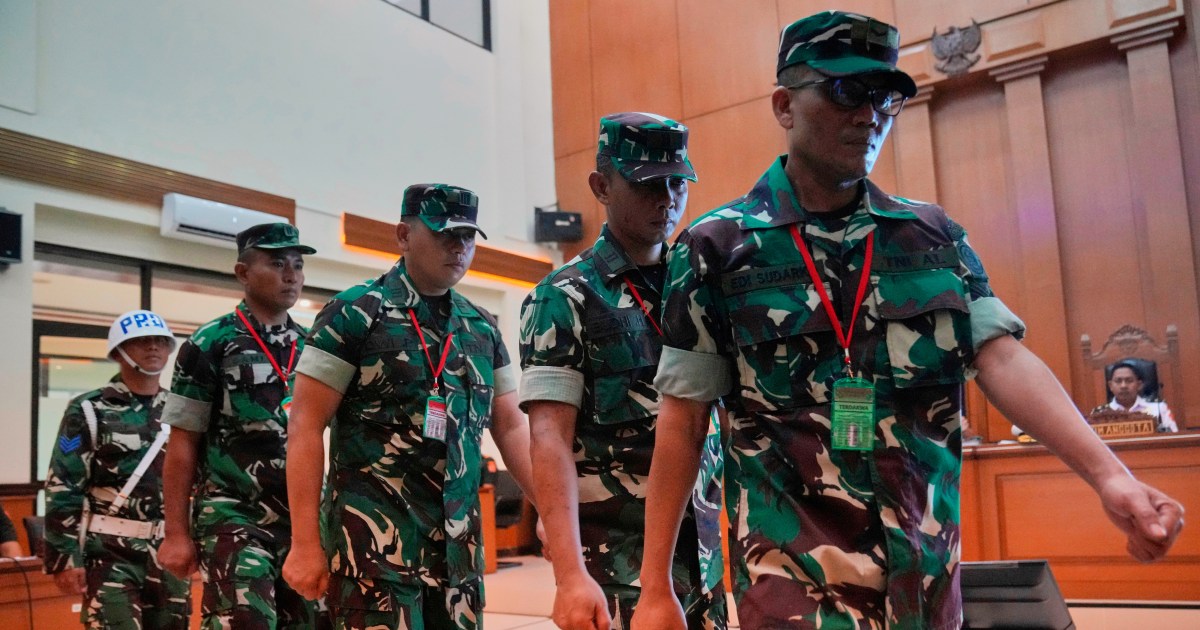
The trial of four Indonesian soldiers accused of carrying out an acid attack on an activist who had campaigned against the expanding role of the armed forces in government has begun in a military court in Jakarta.
The case has drawn national and international attention with experts describing the soldiers’ alleged actions as part of a broader pattern of repression amid growing concerns over rising military influence and democratic backsliding in Indonesia.
Recommended Stories
list of 4 itemsend of list
The trial, which began on Wednesday, centres on an attack that took place on March 12 when Andrie Yunus, a 27-year-old activist with the Commission for Missing Persons and Victims of Violence, was riding a motorbike in Jakarta.
Two men on another motorbike threw acid at him, leaving him blind in one eye and with burns on more than 20 percent of his face and body, according to military prosecutor Mohammad Iswadi.
Prosecutors have charged the four soldiers, all of whom are linked to the military’s Strategic Intelligence Agency, with premeditated assault, which carries a maximum sentence of 12 years in prison. The agency’s chief has since stepped down, but no reason has been publicly given for the resignation.
Prosecutors have alleged the suspects were motivated by anger over Yunus’s activism but said they were not acting under official orders.
The United Nations has condemned the attack with High Commissioner for Human Rights Volker Turk calling it a “cowardly act of violence” and Special Rapporteur Mary Lawlor describing it as “horrific”.
Why was Yunus believed to have been targeted?
Yunus has been a vocal critic of recent efforts to expand the military’s role in civilian governance in Indonesia.
He protested against an amendment passed last year that allows active-duty military personnel to hold a wider range of government positions, including in the attorney general’s office and in disaster management and counterterrorism agencies.
Days before the law was passed, Yunus disrupted a closed-door parliamentary meeting discussing the amendment, shouting objections before being forcibly removed.
At the time of the attack against him, Yunus had just recorded a podcast criticising what he described as the “militarisation” of government under President Prabowo Subianto, himself a former general.
What concerns are there about this case?
Rights groups said there are serious concerns about impunity and whether the full scope of the acid attack will be investigated.
Amnesty International regional researcher Chanatip Tatiyakaroonwong told Al Jazeera it also has significant concerns about the fairness of the trial. In particular, he said, trying the case in a military court could weaken accountability.
“We could see many challenges around fair trial in this case, particularly due to the use of military courts,” Tatiyakaroonwong said. “Amnesty International previously documented that military courts in Indonesia often lacked the impartiality, independence and transparency required under international legal standards on fair trial.”
He added: “Civil society has already raised concerns about the indictment that included only four military officers, even though other investigations indicated that at least 14 individuals might have been involved in this acid attack.”

A wider pattern?
Observers said the attack was no isolated incident but part of a broader trend in Indonesia of pressure on activists and journalists.
Wijayanto, director of the Center for Media and Democracy at the Institute for Economic and Social Research, Education and Information (LP3ES) in Indonesia, told Al Jazeera the case reflects a steady rise in repression over the past decade.
“Andrie Yunus is just one example. … This is a symptom of democratic decline in Indonesia and one of the signs of the increasing role of the military,” he said.
In March 2025, investigative news outlet Tempo received packages containing a severed pig’s head and rat carcasses. The incident was widely seen as an attempt to intimidate journalists working there.
Is the role of the military expanding in Indonesia?
At the centre of concerns about this trial is the growing role of Indonesia’s military in the government as the boundaries between political power and the armed forces become increasingly blurred, analysts said.
Under Prabowo, who has served as president since 2024 and is a former special forces general and son-in-law of former President Soeharto, the military’s role in public life has expanded, according to experts.
Soeharto’s three-decade rule was marked by political repression and widespread human rights abuses. Despite this legacy, he was posthumously named a “national hero” during Prabowo’s presidency, a move that drew criticism from rights groups and democracy activists.
The shift comes amid new legislation allowing active-duty military officers to take up civilian posts without resigning from their military posts, reversing reforms introduced after Soeharto’s fall in 1998 when Indonesia moved to limit the military’s role in government and political affairs.
Civil society groups have challenged the changes in the Constitutional Court, warning it could erode democratic safeguards and weaken civilian oversight.
Wijayanto said the changes risk undermining both governance and public trust. “We doubt whether the military can really run civilian projects. They don’t have the skills,” he said.
“More importantly, it has a political effect. The military should be for defence, not for interfering in civilian life. It makes people afraid to criticise the government.”

What is the public response to all this?
Concerns about military influence have grown alongside broader public dissatisfaction.
In early 2025, students took to the streets to protest against budget cuts and the expansion of military powers. Later in the year, demonstrations intensified, driven by the rising cost of living, inequality and anger about corruption.
Protesters have pointed to mounting economic pressures, including inflation and stagnant wages, as well as benefits for lawmakers.
Reports that 580 parliamentarians receive a monthly housing allowance of 50 million rupiah ($3,000) in addition to their salaries have fuelled public anger. The allowance, introduced last year, is nearly 10 times the Jakarta minimum wage and about 20 times the minimum wage in poorer parts of the country.
Wijayanto said economic inequality is deepening political frustration. “The grievance of the people is not just about less freedom of speech but also about the economic gap,” he said. “Inequality is increasing while people are getting poorer. That creates a grievance.”
The attack on Yunus encapsulates a deeper shift in Indonesia, raising questions about whether criticism of the military is becoming more dangerous, whether accountability mechanisms are weakening and whether democratic reforms introduced after 1998 are being rolled back.
Rights groups said the case also reflects a broader pattern in how authorities have responded to dissent. Tatiyakaroonwong said: “These protests have all been met with severely repressive responses from Indonesian authorities, including killings, assaults and intimidation against protesters as well as journalists reporting on these protests and human rights defenders providing assistance to the protesters.”
As the trial continues, rights groups said the key question is whether it will lead to wider scrutiny of the military’s role in public life.
Tatiyakaroonwong said Yunus’s case is emblematic of broader developments in the country.
“What we are documenting in Indonesia is the entrenchment of authoritarian practices with serious human rights consequences. These include expanding military powers, shrinking space for peaceful protest and independent journalism, and new laws … that facilitate repression rather than accountability,” he said.
“During the past 18 months since President Prabowo came to power, Amnesty International has documented many cases where individuals like Andrie who spoke out against the militarisation of Indonesia have faced offline and online attacks and harassment,” he added.

Post Comment