Arab, Muslim nations reject Israel exit-only plan for Gaza’s Rafah crossing | Israel-Palestine conflict News
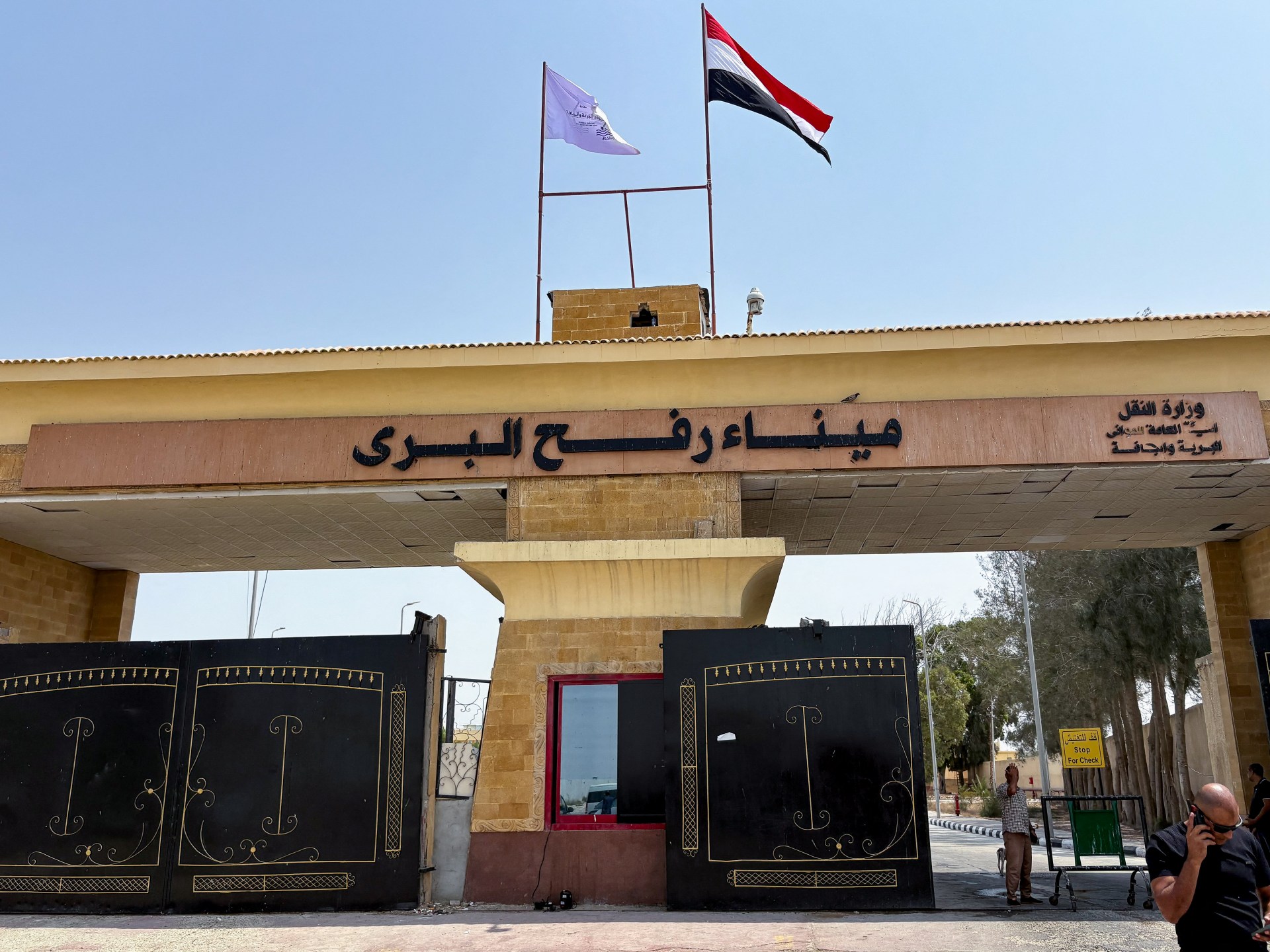
Gaza mediators Egypt and Qatar, and six other Muslim-majority countries have raised the alarm over Israel’s stated plan for a one-way opening of the Rafah border crossing, which would allow Palestinians to leave their territory, but not to return, and block the entry of humanitarian aid.
Their warning comes as Israel’s genocidal war on Gaza continues unabated, with some 600 violations of the ceasefire in the last seven weeks, and reports that two people were killed in the latest round of attacks on Saturday in the northern town of Beit Lahiya.
Recommended Stories
list of 3 itemsend of list
The foreign ministers of Egypt, Indonesia, Jordan, Pakistan, Qatar, Saudi Arabia, Turkiye and the United Arab Emirates issued a joint statement on Friday that expressed “deep concern” over a recent Israeli military announcement that the “Rafah Crossing will open in the coming days exclusively for the exit of residents from the Gaza Strip to Egypt”.
The announcement, which breaches Israeli obligations under the first phase of a United States-led peace plan, was made on Wednesday by an Israeli military unit called the Coordination of Government Activities in the Territories (COGAT), stating that one-way crossing would be allowed with Israeli “security approval” in coordination with Egypt.
However, Egypt and its cosignatories slammed the plan, expressing their “complete rejection of any attempts to displace the Palestinian people from their land” and stressing the need for Israel to fully comply with US President Donald Trump’s 20-point plan, which calls for the Rafah crossing to be opened in both directions.
Eight Arab and Islamic countries issued a joint statement expressing their deep concern over Israeli statements about opening the Rafah crossing in one direction, allowing Gaza residents to leave for Egypt#MOFAQatar pic.twitter.com/sW3Gg7rd09
— Ministry of Foreign Affairs – Qatar (@MofaQatar_EN) December 5, 2025
The Rafah crossing has been mostly closed throughout the war.
Since the October 10 ceasefire took effect under Trump’s plan, Israeli authorities have stalled on reopening it to allow desperately needed aid to enter and people requiring medical treatment to leave, citing Hamas’s failure to return the bodies of all captives and the need for coordination with Egypt. Only one captive’s body remains in Gaza, and retrieval has been hampered by the widespread destruction of the enclave under Israeli bombardment.
The ministers said they appreciated Trump’s peace efforts, which foresee the formation of a technocratic Palestinian government supported by a multinational stabilisation force under the supervision of an international “board of peace”, insisting that his plan move forward “without delay or obstruction”.
They urged that conditions be established allowing the Palestinian Authority to “resume its responsibilities in Gaza”, calling for “sustainable peace” that would enable the two-state solution to be rolled out, with “an independent Palestinian state on the June 4, 1967 borders, including Gaza and the West Bank, with East Jerusalem as its capital”.
Gaza featured prominently at the Doha Forum on Saturday, an annual diplomatic conference in Qatar, with Qatari Prime Minister Sheikh Mohammed bin Abdulrahman Al Thani saying that the two-month ceasefire was at a “critical moment”.
“We cannot consider it yet a ceasefire. A ceasefire cannot be completed unless there is a full withdrawal of the Israeli forces, (and) there is stability back in Gaza,” he said.
Also speaking at the conference, Turkish Foreign Minister Hakan Fidan said that negotiations over the Gaza international stabilisation force (ISF) remained ongoing, including its mandate and rules of engagement, and that its main objective should be to separate Israelis and Palestinians along the border.
Arab and other Muslim countries, which had expressed interest in providing troops for an ISF, had insisted the US include more defined language about Palestinian self-determination in the plan before a United Nations Security Council vote last month. Israeli attempts to stymie the move failed.
Attacks continue despite ceasefire
Meanwhile, Israel kept up intense attacks on Gaza overnight into Saturday morning, killing two people in a drone strike in the northern town of Beit Lahiya, where it was carrying out a demolition operation.
Reporting from Gaza City, Al Jazeera’s Hani Mahmoud said the two victims were part of a group of family members who had been travelling to inspect their farm in the northern part of the Strip.
Mahmoud said that Israeli sources had claimed the family had breached the so-called yellow line designating the area to which Israeli troops have withdrawn under the truce, but that members had not been aware they were in a “dangerous and restricted” zone.
In other attacks, Israel pummelled Gaza with at least 20 air strikes across the enclave, including eastern Gaza city, the centrally located Maghazi refugee camp and the southern city of Rafah.
There were also reports of artillery shelling and heavy fire from tanks and aircraft in areas where the Israeli military is currently stationed east of Khan Younis and Rafah.
Israeli gunboats attacked Palestinian fishing boats off the coast of Khan Younis, amid heavy gunfire and shelling.
The Israeli army continues to control the southern and eastern belts of the Strip, along with large parts of northern Gaza, spanning more than 50 percent of the enclave’s total area.
Israel’s genocidal war on Gaza has killed at least 70,125 Palestinians and wounded 171,015 since October 2023.


Post Comment