Ukraine deploys low-cost drones to counter Russia’s aerial attacks | Russia-Ukraine war News
Published On 23 Dec 2025
Ukraine is rapidly deploying inexpensive interceptor drones to counter Russia’s sophisticated aerial attacks on its urban centres and energy infrastructure. These homegrown systems intercept high-altitude suicide drones at a fraction of conventional missile costs, revolutionising modern air defence strategies.
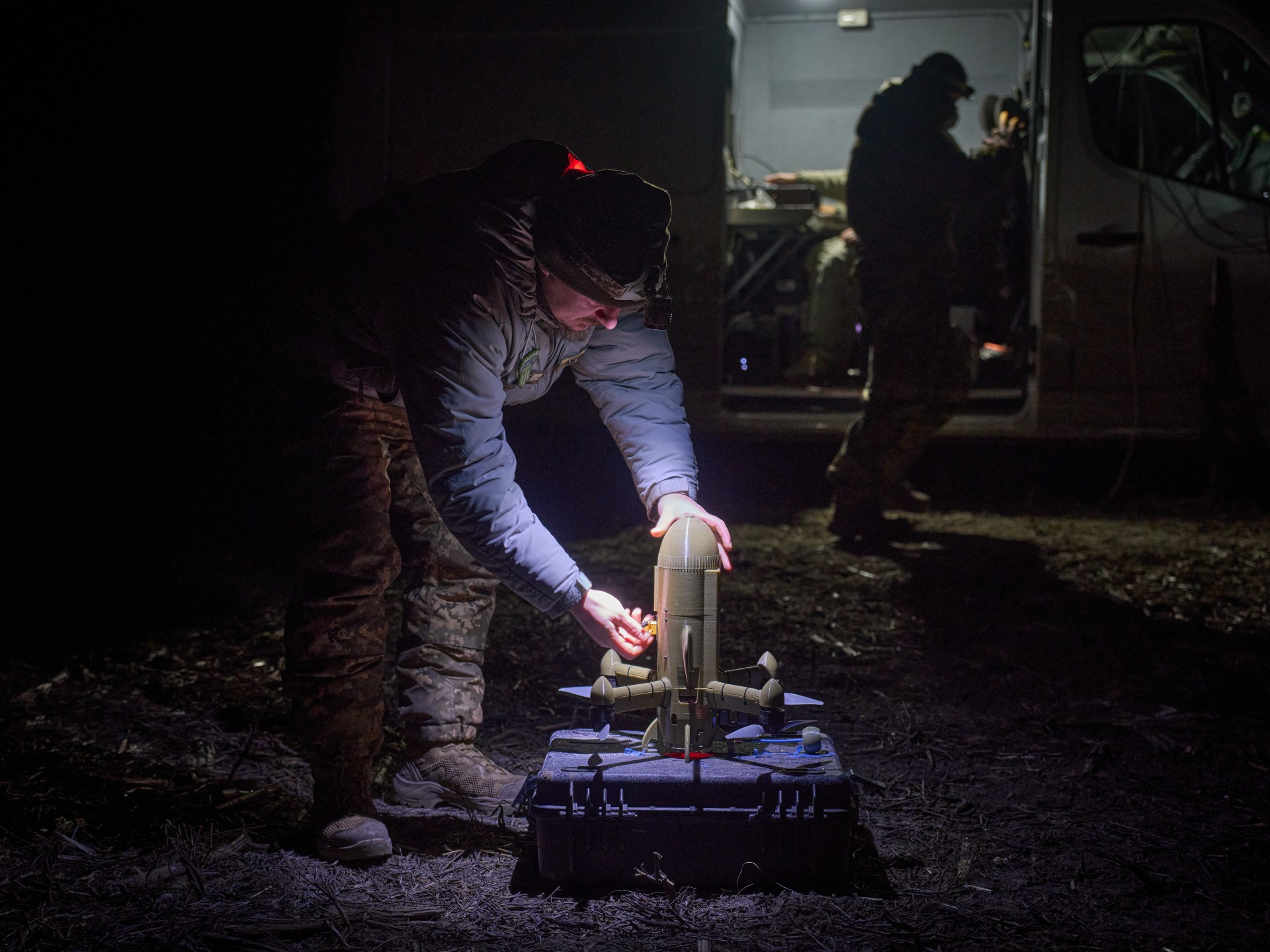
Field technicians swiftly assemble equipment, attaching antennas and sensors to light stands and unpacking monitors and controls from protective cases as they prepare these game-changing weapons for immediate deployment.
The Sting with its thermos-like appearance exemplifies Ukraine’s innovative interceptor fleet. According to a unit commander, these systems neutralise Russia’s evolving suicide drones, which now operate faster and at higher altitudes.
“Every destroyed target is something that did not hit our homes, our families, our power plants,” said the officer, known only by the call sign “Loi” in line with Ukrainian military protocol. “The enemy does not sleep, and neither do we.”
Night-time bombardments of Ukrainian cities and power facilities have compelled Kyiv to transform its air defence strategy by developing affordable drone interceptors costing as little as $1,000. These systems have progressed from prototype to mass production within months during 2025, marking a pivotal evolution in contemporary warfare.
Ukraine’s defensive success now depends on mass manufacturing, rapid adaptation and integration of cost-efficient systems into existing networks rather than relying on traditional weapons that are limited, expensive and cannot be readily replaced.
Interceptors such as the Sting, produced by the volunteer-driven start-up Wild Hornets, and the newly introduced Bullet can rapidly accelerate before colliding with enemy drones. Pilots operate these systems with viewing displays or first-person-view goggles.
The economic advantage is proving decisive. Andrii Lavrenovych, who serves on the strategic council of the expanding start-up General Cherry, which develops the Bullet, said the drones it neutralises cost $10,000 to $300,000 each.
“We are inflicting serious economic damage,” he said.
Russia predominantly deploys the Iranian-designed Shahed suicide drone and has developed numerous variants of this triangle-winged aircraft equipped with jammers, cameras and turbojet engines in an ongoing innovation race.
“In some areas, they are one step ahead. In others, we invent an innovative solution, and they suffer from it,” Lavrenovych said.




Post Comment