Will the Russia-Ukraine war end in 2026? | Russia-Ukraine war News
Kyiv, Ukraine – Russian soldiers are terrified of Ukrainians, says Vasily, a burly officer limping uneasily on the cobblestones of Kyiv’s Sophia Square, where Ukraine’s largest Christmas tree stands
“I’ve jumped into their trenches. They’re really afraid of us,” he told Al Jazeera.
Recommended Stories
list of 4 itemsend of list
However, their fear does not mean that Kyiv can dictate the end-of-war terms as Russia has more servicemen, a stronger economy and a much bigger war chest – while Ukraine remains outmanned and outgunned, he said.
“When I see the enemy at 800 metres, yell into the radio that I see a tank and give its coordinates, but they say, ‘Hold on’, I realise that we simply have nothing to strike it with,” Vasily said, referring to the dire shortage of artillery shells while he was on the front line, before losing his left foot to a landmine in 2023.
Vassily remained in service and asked to withhold his last name in accordance with wartime regulations.
‘One can’t hope for the full end’
A four-star general thinks, however, that the only realistic achievement could be a “pause” in the war that will enter its fifth year in February 2026.
“With such an aggressive neighbour [as Russia], one can’t hope for the full end of the war,” Ihor Romanenko, former deputy head of Ukraine’s general staff of armed forces, told Al Jazeera.
“There won’t be peace with Russia until we liberate the lands within Ukraine’s [post-Soviet] 1991 borders,” he said.
And if Moscow breaches the ceasefire pause, Kyiv would have to “stop the Russians on the front line” through a major bolstering of its military potential, he said.
Kyiv would need to introduce universal and “fair” mobilisation without any exemptions, further boost domestic arms manufacturing, prioritise wartime needs in its economic decisions, and introduce stricter martial law, he said.
This year, Ukraine’s military-industrial complex has provided up to 40 percent of what the armed forces need – a major boost from 15 to 20 percent in 2022.
Western allies provide the remaining 60 percent – and their further aid should be “decisive and fast”, Romanenko said.

“A window of opportunity” to sign a peace deal may emerge in the second half of 2026 – if Russia does not succeed in breaching the front line and advancing rapidly and realises that Kyiv can stomach the war of attrition, another analyst says.
“Everything will depend on the Kremlin’s and [Russian President Vladimir] Putin’s personal readiness to agree,” Volodymyr Fesenko, head of the Kyiv-based Penta think tank, told Al Jazeera.
If the war’s “dead-end” development becomes clear to Moscow next year, then there is hope to reach a peace deal by late 2025, he said.
And even if Putin agrees, it would take months to iron out and “connect” the warring sides’ versions of a peace deal, Fesenko said.
Ukraine may have to bend to the White House’s demands to cede the Kyiv-controlled part of the Donetsk region, including several heavily fortified cities and towns, in exchange for Russia’s withdrawal from three Ukrainian regions in the east and north – otherwise, the war will go on into 2027, he said.

There are bigger global factors that influence the war’s possible end.
In 2026, the very definition of the collective West will change after Washington’s withdrawal from the “global policeman’s” role and the end of the “Western hegemony” over the rest of the world, according to Kyiv-based analyst Ihar Tyshkevich.
A truly “multi-polar” world is emerging as China boosts its global clout and domination in Asia, but still cannot fully challenge Washington’s domination, he told a news conference in Kyiv on Monday.
This process will also trigger the “erosion” of international law that will influence Ukraine’s position, he said.
For Ukraine, the worst-case development is a “Finnish scenario,” Tyshkevich said, referring to the 1939 Finnish-Soviet war, when Moscow tried to reconquer its tsarist-era province.
Even though Soviet forces suffered heavy losses that prompted Nazi Germany’s invasion of the USSR in 1941, Moscow cut off a tenth of Finland’s territory and forced Helsinki to recognise it.
In Ukraine’s case, the “Finnish scenario” will mean Kyiv’s recognition of Moscow-occupied regions as part of Russia.
Tyshkevych called another possible scenario “Georgian” in reference to the 2008 war between Russia and Georgia, when Moscow defeated smaller Georgian forces and “recognised” two breakaway regions – South Ossetia and Abkhazia – as “independent.”

For Ukraine, the Georgian scenario means no control over occupied areas, but Kyiv’s refusal to recognise them as Russia’s.
A third, “interim” scenario means the war is frozen and talks go on, he said.
There is only one scenario of the war’s end, according to Nikolay Mitrokhin, a researcher with Germany’s Bremen University.
Ukraine would be “pushed out” of the remaining one-fifth of the southeastern Donetsk region – or would have to leave it voluntarily and recognise the loss of 90 percent of the neighbouring Zaporizhia region and 15 percent of Dnipropetrovsk that Russia currently controls, he said.
‘Donetsk was the source of our problems’
As Western pressure in the way of sanctions on Russia is “weak”, because too many nations are interested in bypassing them and trading with Moscow, the Kremlin has enough resources to continue the war for at least another two years, he said.
In turn, Ukraine has the resources to resist, but its “corrupt and cowardly” government is not capable of mobilising enough manpower, he said.
As a result, Ukrainian forces slowly retreat in key directions as Western mediators cannot convince Russia to stop, he said.
“There are, however, chances that Trump and his administration will either force Zelenskyy to leave Donetsk or to hold a wartime [presidential] vote and really change the team that rules Ukraine,” Mitrokhin told Al Jazeera.
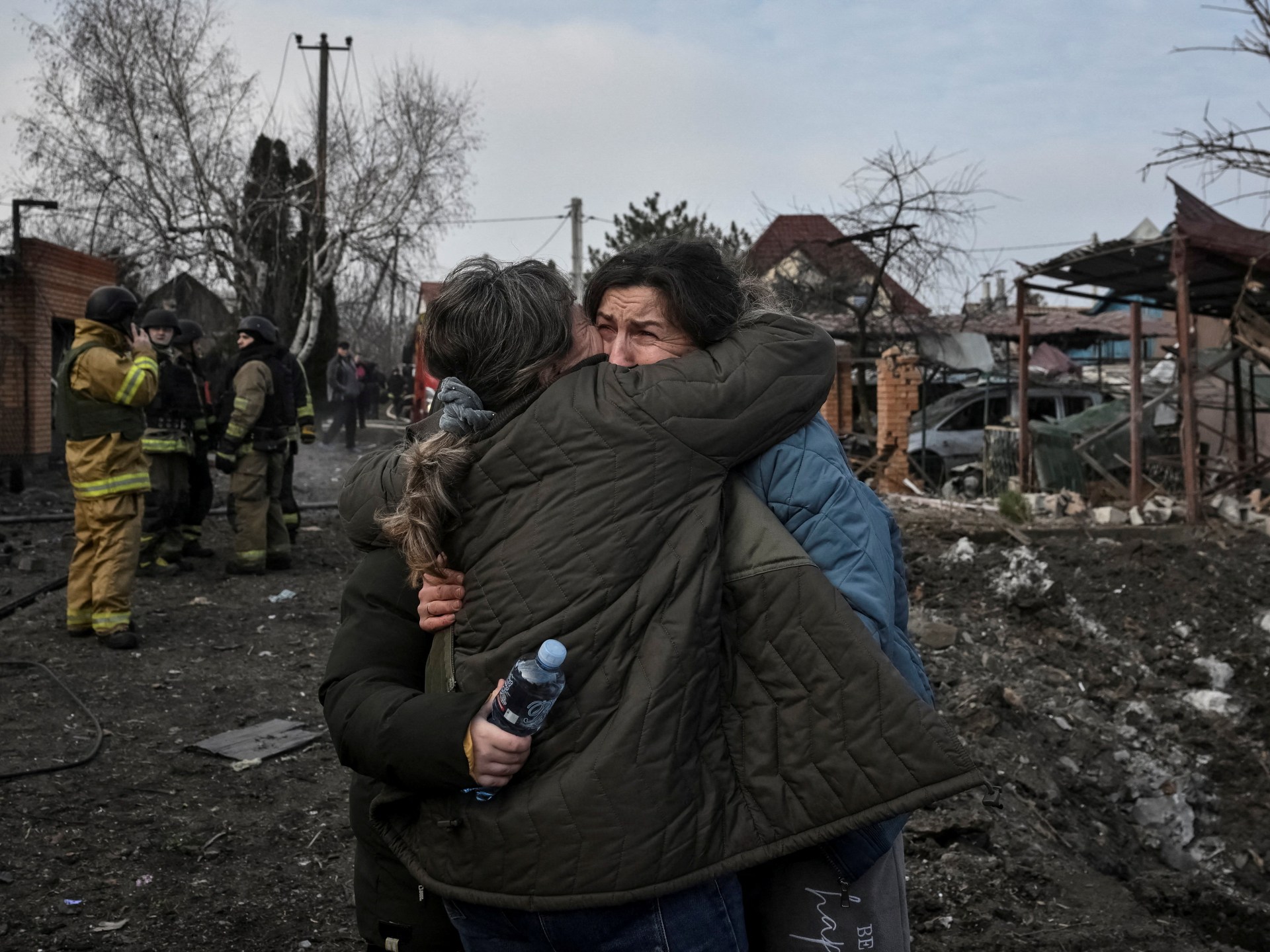
Meanwhile, many average Ukrainians are growing wearier of the war, Russian shelling, blackouts and an economic downturn.
“Donetsk was the source of our problems. Let Russia have it and pay tens of billions to restore it,” Taras Tymoshchuk, a 63-year-old former economist, told Al Jazeera, referring to a Moscow-backed separatist uprising in Donetsk and neighbouring Luhansk in 2014. “I want to wake up because the birds are singing, not because I hear Russian drones and missiles.”

Post Comment