Three messages reset conditions in eastern Yemen | Conflict
Political and military signals have intensified in Yemen’s already complex theatre. In an unusually short period of time, three successive statements were issued within a single context, beginning with an official Yemeni request from President Rashad al-Alimi, the head of Yemen’s Presidential Leadership Council, the governing body of the internationally recognised government. This was followed by an operational response from the Saudi-led coalition, and then a political message by the Saudi minister of defence that defines the moves on the ground and the directions they take.
What happened cannot be interpreted as an isolated move, nor as part of a routine truce. The sequence suggests an arrangement that uses Yemeni legitimacy as the political framework for a Saudi move aimed at restraining the expansion of an ally advancing eastward, while at the same time reducing the Houthis’ chances of exploiting any rift within the opposing camp. This is why the weight of the three statements exceeded their words, as they moved the crisis from an open tug-of-war to a clear path based on an official request, then a field response, then a political message that sets the limits of movement and defines its direction.
Why the east and why now?
The names of Yemen’s governorates may seem like marginal details to a non-Arab reader, but Hadramout and al-Mahra are exceptions. Hadramout represents economic depth for Yemen with its oil and gas resources and related infrastructure, and also has a vital border crossing with Saudi Arabia, making it part of the equation of both border security and trade. Al-Mahra, due to its border location with Oman and Saudi Arabia, controls ports, crossings and movement routes that affect regional security and the local economy. This location makes any tension in the east a quintessential border issue, not merely a local crisis, and any large-scale instability there will not remain confined within Yemen, as it impacts the country’s economy, raises border sensitivity within the region, and stirs concerns about the stability of trade routes.
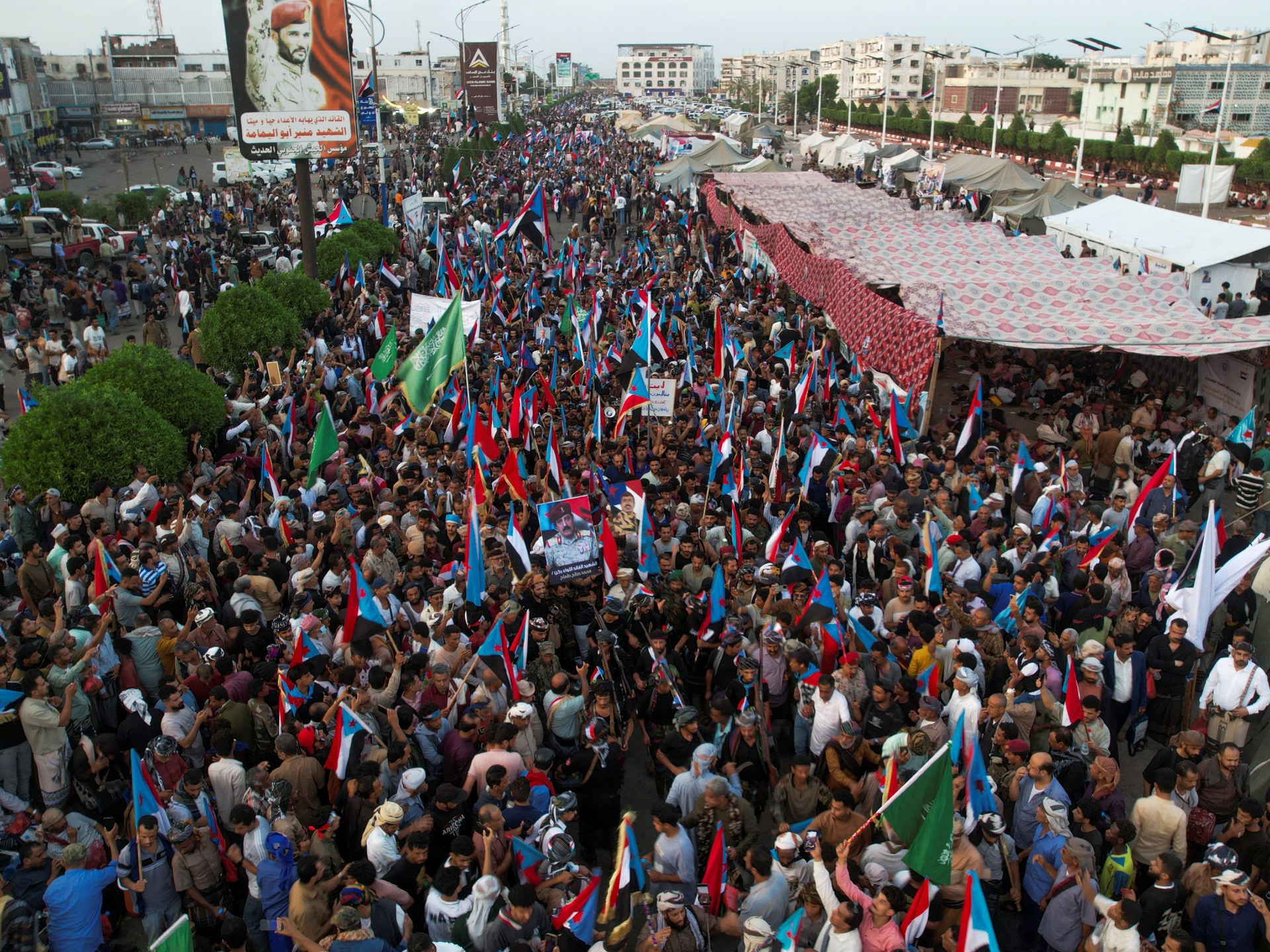
For this reason, Riyadh views the east as an area it seeks to neutralise from chaos as much as possible. With the expansion of the United Arab Emirates-backed Southern Transitional Council (STC) and its forces towards Hadramout and al-Mahra, the issue has shifted from a limited field movement to a test of the limits of the coalition itself, and to a direct question about who has the right to manage security and resources in areas that cannot bear a prolonged conflict.
The first step came through a statement attributed to a government source about a request by the chairman of the Presidential Leadership Council to take military measures to protect civilians in Hadramout and support the armed forces in imposing calm. The importance of this wording is that it moves the matter from being disputes between forces within the same camp (the STC is a member of the Presidential Leadership Council) to a level of escalation that threatens civilian safety and stability, thus requiring action from the supporting partner.
This request gives the coalition a clearer political justification for intervention, as it moves in response to a request from the head of an internationally recognised governing body. Internally, the request sends a message no less important, as the presidency does not want to become a mere facade covering up imposed facts, and it seeks to affirm the idea that controlling the field happens through the state, even if it seeks regional support to achieve that.
The second statement came through the coalition with an urgent call for the STC to withdraw from Hadramout and al-Mahra, hand over camps to the “Nation’s Shield” forces, and enable local authorities to carry out their duties, with a warning against directly dealing with any military movements that contravene de-escalation efforts. This content does not merely aim to reduce escalation, but rather outlines executive steps: withdrawal, then handover, then reinstating the local authority.
The mention of the “Homeland Shield” forces in the statement is striking because the coalition is not merely calling for vacating positions, but is also proposing an alternative party to take them over. This reduces the likelihood of a security vacuum and gives Riyadh a practical tool to manage the eastern file away from the logic of multiple forces. As for the phrase “direct engagement,” it is the most explicit warning, as it increases the cost of any attempt to test the coalition’s boundaries or impose a new reality by force.
The third statement by Saudi Defence Minister Prince Khalid bin Salman Al Saud, addressed primarily to the Yemeni people, affirmed that the kingdom’s intervention came in response to a request from the legitimate government and in support of restoring the state and preserving Yemen’s security. It stressed that the “Southern issue” is a fair political cause that cannot be ignored, and that it was incorporated into the political solution track through the Riyadh Conference and Riyadh Agreement, ensuring southern participation in governance. He then called on the STC to ”heed to reason” and respond to Saudi and Emirati mediation efforts to end the escalation and hand over the camps peacefully.
This framing works in two directions; it grants the STC political recognition of the Southern cause, while setting strict boundaries for its pursuit, as Riyadh – according to the statement – distinguishes between the justice of the cause and the use of force to change control maps in resource and border areas. At the same time, it leaves the STC with a practical exit through peaceful handover instead of an open confrontation.
What does this mean for the Southern Transitional Council?
This sequence puts the STC to a direct test. The request came from the head of the legitimate authority of which the STC is part, the operational statement from the coalition set a ceiling to its movements, and the political framing from the Saudi defence minister provided a way out via peaceful handover. In this context, an organised response would allow the STC to present any withdrawal as an engagement in de-escalation, while retaining its political discourse and influence in its traditional areas of control. Procrastination or direct defiance, however, raises risks, as it could lead to greater political and diplomatic pressure and portray it as the party obstructing the de-escalation process in a highly sensitive area. Moreover, the three messages redraw the boundaries of expansion within the same camp, as arrangements for influence in certain centres or areas differ from attempts to reshape influence in eastern Yemen by force.
Houthis are watching
The Houthis, an armed group with their own government backed by Iran, which control Yemen’s capital Sanaa and northwestern Yemen, are monitoring any rift among their opponents and seek to exploit it. This is why the rapid coordination between the Yemeni presidency and the coalition sends a signal to Sanaa rulers that the opposing camp is capable of managing its disputes in sensitive areas, and that betting on internal fighting as a path to the east may not be guaranteed. Additionally, establishing security arrangements around resource areas reduces the chances of politically benefitting from their chaos and complicates any future push towards them.
The phrase “Saudi–Emirati mediation” in the coalition’s statements and those by the Saudi defence minister appears highly sensitive because Abu Dhabi’s relationship with the STC is not merely one of political communication, but one of sponsorship, funding, and support that grants it freedom of movement and a constant backer. When the UAE appears as a mediator alongside Saudi Arabia, it sends two opposite messages at the same time: it gives the STC the feeling that it’s protected, while placing Abu Dhabi in a tight corner because mediation entails a practical commitment to halt escalation, not just a declaration of intent.
This turns the mediation into a test of the alignment of calculations within the coalition itself, and a direct measure of Abu Dhabi’s readiness to respect its partner Riyadh’s approach in an issue that Saudi Arabia considers a threat to its border security and strategic interests. But the question remains: will Abu Dhabi succeed in pushing the STC towards de-escalation, or will the political cover remain in place while developments on the ground move in a different direction?
Where are we heading?
It is more likely that Saudi Arabia is pushing towards a short-term settlement that includes a phased withdrawal, an organised handover of camps, and security arrangements that prevent any single party from imposing its control in the directorates of Hadramout and al-Mahra. This path maintains a minimum level of stability and reduces the chances of clashes within the camp opposing the Houthis. If it falters, limited deterrent tools will emerge aimed at enforcing the declared ceiling, while keeping the mediation channel open to avoid a full-scale explosion.
The three statements have raised the cost of turning eastern Yemen into an open arena of dispute, but they have not closed the scene.
In my view, what will determine the direction is not the statements alone, but the behaviour of the parties in the following days: will the STC choose a settlement that saves face, or will it bet on time? And will the “security alternative” arrangements succeed in reducing friction, or will they generate new local sensitivities?
And one final question concerning the Houthis: will they see this containment as a deterrent that reduces opportunities to invest in disputes, or will they see it as a chance to test the limits of movement?
The answers will become clear soon, because events are still moving quickly, and because eastern Yemen has become either a benchmark for stability or a gateway to broader chaos.



Post Comment