Is the Eastern Mediterranean becoming Israel’s new front against Turkiye? | Conflict News
Two meetings, held almost simultaneously towards the end of December, offered a stark illustration of the competing strategic visions now shaping the Eastern Mediterranean and the Levant.
In Damascus, Turkiye’s foreign, defence and intelligence chiefs met Syrian officials on December 22 as Ankara continued to prioritise the consolidation of state authority and stabilisation after the fall of Bashar al-Assad’s government in Syria.
Recommended Stories
list of 3 itemsend of list
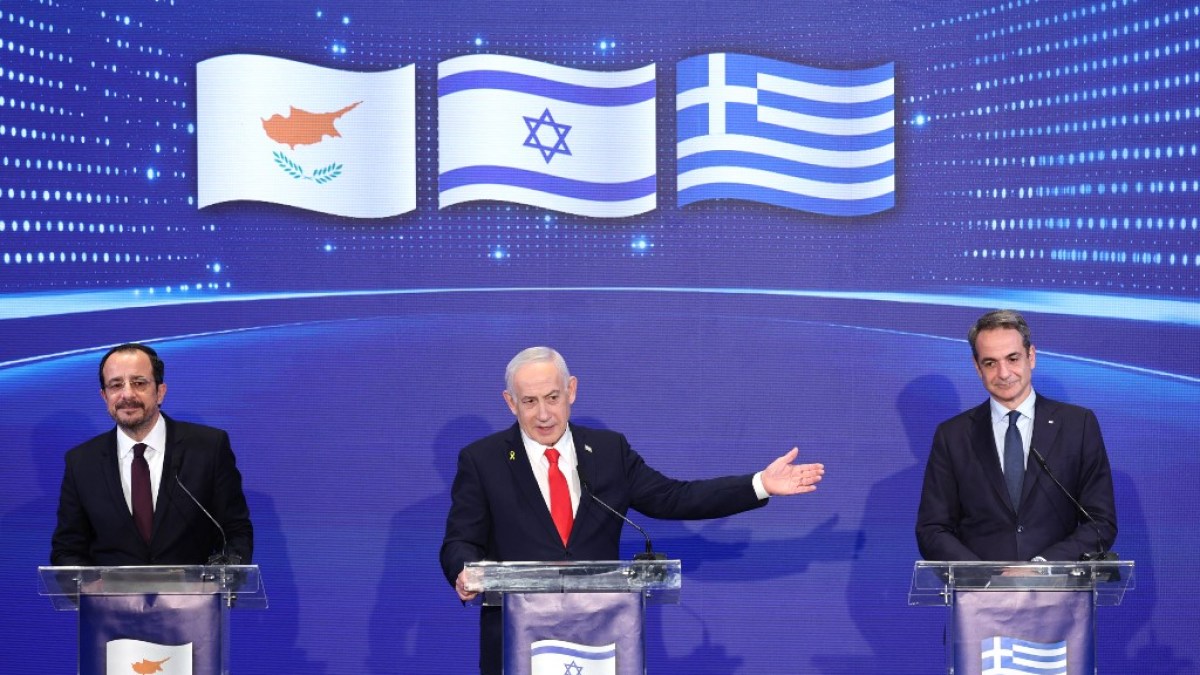
On the same day, Israel hosted Greece and Cyprus for the latest iteration of their trilateral framework. Two days before that meeting, Israel launched another air attack on Syria – one of more than 600 strikes in 2025 – a reminder to Ankara and Damascus that Israel is willing to disrupt Syria’s recovery from war.
While officially framed around energy cooperation and regional connectivity, the trilateral agenda between Israel, Greece and Cyprus has steadily expanded to encompass security coordination and military alignment, signalling a shift from economic competition to strategic containment.
For Cem Gurdeniz, a retired admiral and one of the architects of Turkiye’s “Blue Homeland” maritime doctrine that calls for Ankara to safeguard its interests across the surrounding seas – the Aegean, Eastern Mediterranean and the Black Sea – the meeting was an attempt “to exclude and encircle Turkiye”.
Gurdeniz describes Israel’s approach as an indirect containment strategy aimed not at confrontation but at altering Ankara’s behaviour. “The objective is not war, but behavioural change – narrowing Turkiye’s strategic space to induce withdrawal without conflict,” he told Al Jazeera, warning against treating the standoff as routine energy competition.

For Israel, the trilateral framework reflects unease with Turkiye’s approach in Syria, which prioritises territorial integrity and the restoration of central authority – an outcome that runs counter to Israel’s preference for a fragmented regional security landscape.
Greece and Cyprus, meanwhile, view the partnership as a means to advance maritime boundary claims and energy corridors that would marginalise Turkiye’s role in the Eastern Mediterranean.
Security and military cooperation now form a central pillar of the trilateral agenda, according to Muzaffer Senel, a visiting scholar of European studies at Marmara University.
“All three actors have sought to create faits accomplis through unilateral initiatives in the region in what they jointly perceive as a common rival: Turkiye,” Senel told Al Jazeera in reference to possible security and energy arrangements between the three countries that could threaten Ankara’s interests.
Israel’s gambit
The decision to hold the trilateral meeting in Israel was not incidental. It reflected the shrinking diplomatic space available to the Israeli leadership as the genocidal war on Gaza deepens Israel’s international isolation.
With Prime Minister Benjamin Netanyahu facing an arrest warrant from the International Criminal Court (ICC) for war crimes and crimes against humanity, his ability to travel abroad has become increasingly constrained, particularly to countries that are signatories to the court, such as Greece and Cyprus.
The Greek government, while not rejecting the ICC’s warrant for Netanyahu – which also includes one for Israel’s former defence minister, Yoav Gallant – has said that “these decisions do not help”. Cyprus has also noted that the ICC warrants are binding. Neither has publicly said that they will not execute the warrants.
Hosting the Greek and Cypriot leaders in Israel was therefore not simply a logistical choice, but a symptom of how legal and diplomatic pressures are reshaping Israel’s outlook and pushing it towards security-centric alliances.
At the same time, the meeting served to recast Turkiye as a regional problem through coded Ottoman references and narratives of expansionist ambition, aimed at eroding Ankara’s interests in the Eastern Mediterranean.
Standing alongside Greek Prime Minister Kyriakos Mitsotakis and Cypriot President Nikos Christodoulides, Netanyahu – a longtime advocate of a Greater Israel – warned that “those who fantasise they can re-establish their empires and their dominion over our lands” should “forget it”, a remark widely interpreted as a reference to Turkiye.
As a peninsular state, Turkiye has more than 8,300km (5,100 miles) of coastline. Greece argues its Aegean islands, many of which lie just off the Turkish coast, generate their own exclusive economic zones (EEZ), extending maritime claims up to 200 nautical miles (about 370km).

Ankara rejects this, saying islands cannot create full EEZs and that borders should be drawn from the mainland.
Cyprus is another flashpoint. After a Greek Cypriot coup in 1974, Turkiye intervened as a guarantor power, splitting the island. Turkiye is the only country to recognise the Turkish Republic of Northern Cyprus. In 2004, the north backed a United Nations reunification plan, but the Greek-administered south rejected it, leaving the conflict unresolved.
In the Eastern Mediterranean, these regional wedge issues have given Israel an opportunity to insert itself and further inflame tensions.
Greece, in particular, has sought to leverage Israel’s close ties with Washington to secure diplomatic backing in longstanding maritime boundary disputes.
“Greece seeks to involve the US through Israel in order to gain diplomatic backing for resolving Eastern Mediterranean maritime boundary issues,” said Senel. Those disputes – involving gas exploration rights also claimed by Turkiye – have long fuelled regional tensions and now form part of a broader effort to constrain Ankara’s strategic room for manoeuvre.
While no formal collective defence agreement has been signed, high-level cooperation among the three states is moving beyond ad hoc coordination towards a more institutionalised security framework. The inclusion of the United States as a “like-minded partner” under a so-called 3+1 format, Senel noted, “clearly conveys a strategic message directed at Turkiye”.
Although the trilateral mechanism stops short of a formal military alliance, its trajectory points towards deeper security and defence cooperation, reinforcing Ankara’s perception of an emerging containment axis in the eastern Mediterranean.
Emerging anti-Turkiye axis
Relations between Greece, Cyprus and Israel have not been hindered by Israel’s genocidal war on Gaza, which began in October 2023.
Unlike several other European Union states that have described Israel’s campaign in Gaza as genocide or ethnic cleansing and called for sanctions over violations of international law, Greece and Cyprus have remained largely silent while expanding cooperation with Israel.
“In the current context, where the Greek Cypriots will assume the presidency of the Council of the EU, and at a time when the EU is ignoring Turkiye’s geostrategic position and importance, finding diplomatic pathways to alleviate the tensions is a hard task,” said Zeynep Alemdar, foreign policy programme director at the Centre for Economics and Foreign Policy Studies in Istanbul.
“EU officials do not understand the mutual benefits of including Turkiye in the energy and defence calculations of the region,” Alemdar told Al Jazeera.
In December, Greek parliamentarians approved the purchase of 36 PULS rocket artillery systems from Israel for approximately $760m.
The two countries are also advancing towards a major defence agreement estimated at $3.5bn, under which Israeli defence firms would construct a multi-layered air defence system for Greece.
In September 2025, Cyprus also received an Israeli-made air defence system costing tens of millions of dollars, with further deliveries expected.
“Turkiye will surely try to dilute this coalition through diplomacy with its Middle Eastern allies, yet Israel’s disruption will continue. Israel’s and Turkiye’s interests in the region will bring about more confrontations,” noted Alemdar.
Turkish President Recep Tayyip Erdogan said that Turkiye “will not allow violations of its rights in the Aegean and the Mediterranean”, without naming the three countries or referring directly to their meeting.
Rear Admiral Zeki Akturk, the press and public relations adviser and spokesperson for the Ministry of Defence, sought to downplay the trilateral meeting, noting that it “does not pose a military threat to Turkiye”.
Turkiye, for its part, has also embarked on its largest naval procurement process, with a price tag estimated at about $8bn and 31 ships in the process of being built in 2025 alone to defend its interests in the Eastern Mediterranean.
The process has largely been driven by skirmishes between Greece and Turkiye dating back to 2020, when both parties used naval assets to lay claim to conflicting economic zones, and when Ankara realised it needed to invest more in its navy to avoid being squeezed out of the Eastern Mediterranean.
Turkiye’s regional approach
Analysts are also warning that Turkiye’s calibrated response to the trilateral meeting risks underestimating a broader pattern of Israeli provocations across multiple theatres.
From Syria to the Eastern Mediterranean – and, more recently, Somalia, following Israel’s recognition of the breakaway Somaliland region – Israel has demonstrated a willingness to exploit political fractures in ways that undermine state consolidation.
In Syria, this approach has been particularly visible and feeds into Israel’s policies in the Eastern Mediterranean. The Israeli bombing of the presidential palace and the Ministry of Defence in Damascus in July last year was widely seen as an attempt to weaken the Syrian government at a moment of renewed diplomatic engagement.
Turkiye’s Foreign Minister Hakan Fidan warned in December that the Kurdish-led Syrian Democratic Forces (SDF) were “in coordination with Israel” to obstruct Syria’s stabilisation.
A recent Al Jazeera Arabic investigation obtained hours of leaked audio recordings of senior military officers from the regime of the ousted leader al-Assad, discussing plans to destabilise Syria and suggesting coordination with Israel.
Taken together, Israeli actions in Syria increasingly resemble a template for indirect pressure – not aimed at direct confrontation with Turkiye, but at constraining Ankara’s influence by entrenching instability along its southern flank.
In seeking to grind down Turkiye in Syria while advancing its naval strategy in the Eastern Mediterranean, “the result is a dual-pressure model that exhausts and distracts Turkiye, turning each move into a potential crisis and steadily eroding its initiative”, said the retired Turkish admiral Cem Gurdeniz.
Israeli recognition of Somaliland likely reinforces Turkiye’s concern that Israel is willing to legitimise breakaway coastal entities when doing so undercuts stabilisation efforts aligned with Turkiye’s maritime interests.
This approach also finds support within Israel’s ideological ecosystem. The right-wing political theorist Yoram Hazony, a close ally of Netanyahu, has openly argued for the fragmentation of regional states such as Iraq and Syria into smaller entities organised along sectarian or communal lines – a vision that aligns with policies privileging division over consolidation.
“Turkiye should stop treating this as episodic friction and treat it as Israel’s deliberate attempt to shape the post-Assad order in Syria while tightening a Mediterranean alignment that sidelines Ankara,” Andreas Krieg, associate professor of security studies at King’s College London, told Al Jazeera.
“The response needs to be practical, coercive in the political sense, and geared to results rather than signalling,” he added.
Turkiye has a track record of acting proactively when it believes its national interests are at stake. In Libya, Ankara’s military support for the internationally recognised government in 2020 prevented its collapse. Similarly, Ankara’s backing of Azerbaijan in its war with Armenia helped tip the balance, enabling Baku to recapture territory occupied by Armenian forces.
Israeli threats to destabilise Syria, Somalia and Yemen could provide Ankara with an opening with countries it has had rocky relations (since improved) with in recent years, mainly Saudi Arabia and Egypt, which increasingly are also threatened by Israeli influence in the region and have most recently condemned Israeli recognition of Somaliland.
Ankara should not only expand relations with such key Arab states, Krieg said, it also needs to take practical steps that make “alternative formats commercially and strategically attractive”.
“Turkiye will not dismantle that [Eastern Mediterranean] axis with rhetoric,” he added.
“Ankara should expose and disrupt Israeli influence operations rather than arguing about motives,” he warned, adding that “the point is to make it politically expensive for Israel to posture as a stabiliser while acting as a patron of breakaway structures,” said Krieg.
“The strategic risk for Turkiye is gradualism; [Ankara’s] objective should be explicit: prevent a permanent Israeli security carve-out in southern Syria and prevent an Eastern Mediterranean order in which Ankara is boxed in,” Krieg concluded.


Post Comment