Yemeni gov’t says southern areas ‘recaptured’ from separatist STC | Conflict News
Rashad al-Alimi says government forces have retaken Hadramout and al-Mahra provinces from Southern Transitional Council.
Yemen’s internationally recognised government says it has recaptured southern parts of the country from the separatist Southern Transitional Council (STC), whose future remains uncertain amid internal divisions and the exile of its leader.
Rashad al-Alimi, chief of the Saudi Arabia-backed Presidential Leadership Council, said in a televised statement on Saturday that all contested cities had been brought under the control of government forces.
Recommended Stories
list of 3 itemsend of list
“As the president of the country and the high commander of the armed forces, I want to assure you of the recapture of Hadramout and al-Mahra,” al-Alimi said.
Reporting from the Saudi capital Riyadh, Al Jazeera’s Hashem Ahelbarra said the announcement was effectively a message of “reassurance” from the Yemeni government “that its troops are now in control of all the military bases” taken by the STC in recent weeks.
“He also said that there’s going to be a conference about the future of South Yemen here in Riyadh, where all the leaders of the southern parts of Yemen will convene about the potential for a new roadmap that will put an end to the violence and instability we’ve seen,” Ahelbarra said.
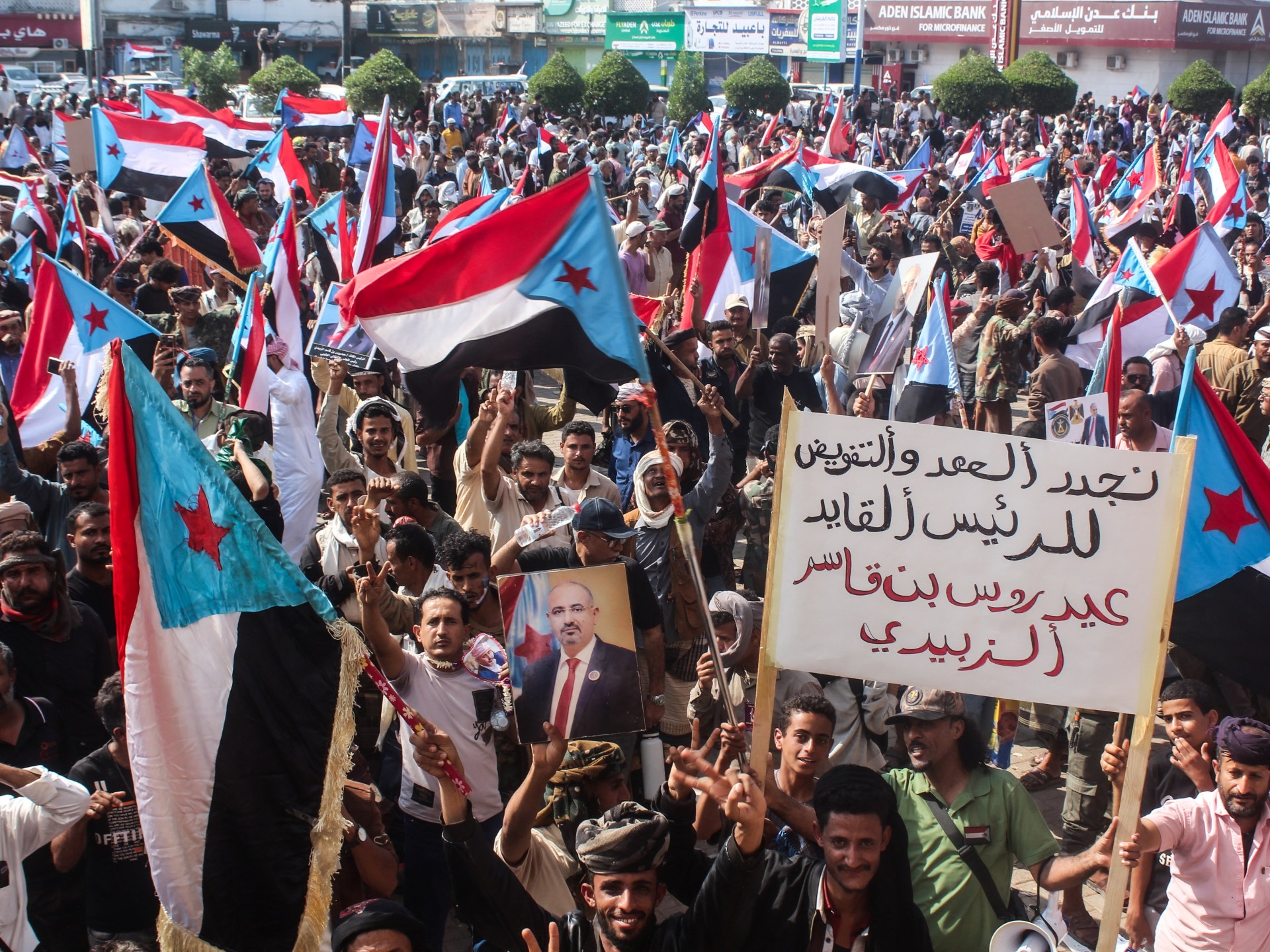
Al-Alimi’s address came shortly after thousands of Yemenis took to the streets in Aden to show support for the STC amid conflicting reports about the group’s purported plans to disband following deadly confrontations with Saudi-backed forces.
STC supporters chanted slogans against Saudi Arabia and the Yemeni government in demonstrations in Aden’s Khor Maksar district, one of the group’s strongholds. The crowd waved the flag of the former South Yemen, which was an independent state between 1967 and 1990.
“Today, the people of the south gathered from all provinces in the capital, Aden, to reiterate what they have been saying consistently for years and throughout the last month: we want an independent state,” protester Yacoub al-Safyani told the AFP news agency.
The public show of solidarity came after a successful Saudi-backed offensive to drive the STC out of parts of southern and eastern Yemen that it had seized towards the end of last year.
The confrontations exposed heightened tensions between Saudi Arabia and the United Arab Emirates, a top ally that the Saudi authorities have accused of backing the STC.
The group had taken over the provinces of Hadramout, on the border with Saudi Arabia, and al-Mahra, a land mass representing about half the country.
After weeks of Saudi-led efforts to de-escalate, Yemeni government forces, backed by the Gulf country, launched an attack on the STC, forcing the separatists out of Hadramout, the presidential palace in Aden and military camps in al-Mahra.
On Friday, an STC delegation that travelled to Riyadh for talks had announced the dissolution of the group in an apparent admission of defeat.
Secretary-General Abdulrahman Jalal al-Sebaihi said the group would shut down all of its bodies and offices inside and outside of Yemen, citing internal disagreements and mounting regional pressure.
However, Anwar al-Tamimi, an STC spokesman, contested the decision, writing on X that only the full council could take such steps under its president – highlighting internal divisions within the separatist movement.
During Saturday’s protest in Aden, STC supporters held up posters of the group’s leader Aidarous al-Zubaidi, who was smuggled from Aden to the UAE this week after failing to turn up to the talks in the Saudi capital.
Saudi-backed forces have accused the UAE of helping him escape on a flight that was tracked to a military airport in Abu Dhabi.
Authorities in Aden that are aligned with Yemen’s Saudi-backed government on Friday had ordered a ban on demonstrations in the southern city, citing security concerns, according to an official directive seen by Reuters.


Post Comment