Japan, Philippines sign new defence pacts amid surging China tensions | South China Sea News
One of the deals allows the tax-free provision of ammunition, fuel, food and other supplies when their forces stage joint training.

Published On 15 Jan 2026
The Philippines and Japan signed two defence pacts Thursday, including a deal allowing their forces to exchange supplies and services, the latest in a series of agreements aimed at countering China’s regional assertiveness.
Tokyo and Manila have significantly deepened military ties in recent years, joining a security partnership with Washington, and Japan supplying patrol boats and radio gear to the Philippines.
Recommended Stories
list of 3 itemsend of list
The Philippines and China have engaged in frequent clashes in the contested South China Sea, which Beijing claims in nearly its entirety despite an international court ruling that its assertion has no legal basis.
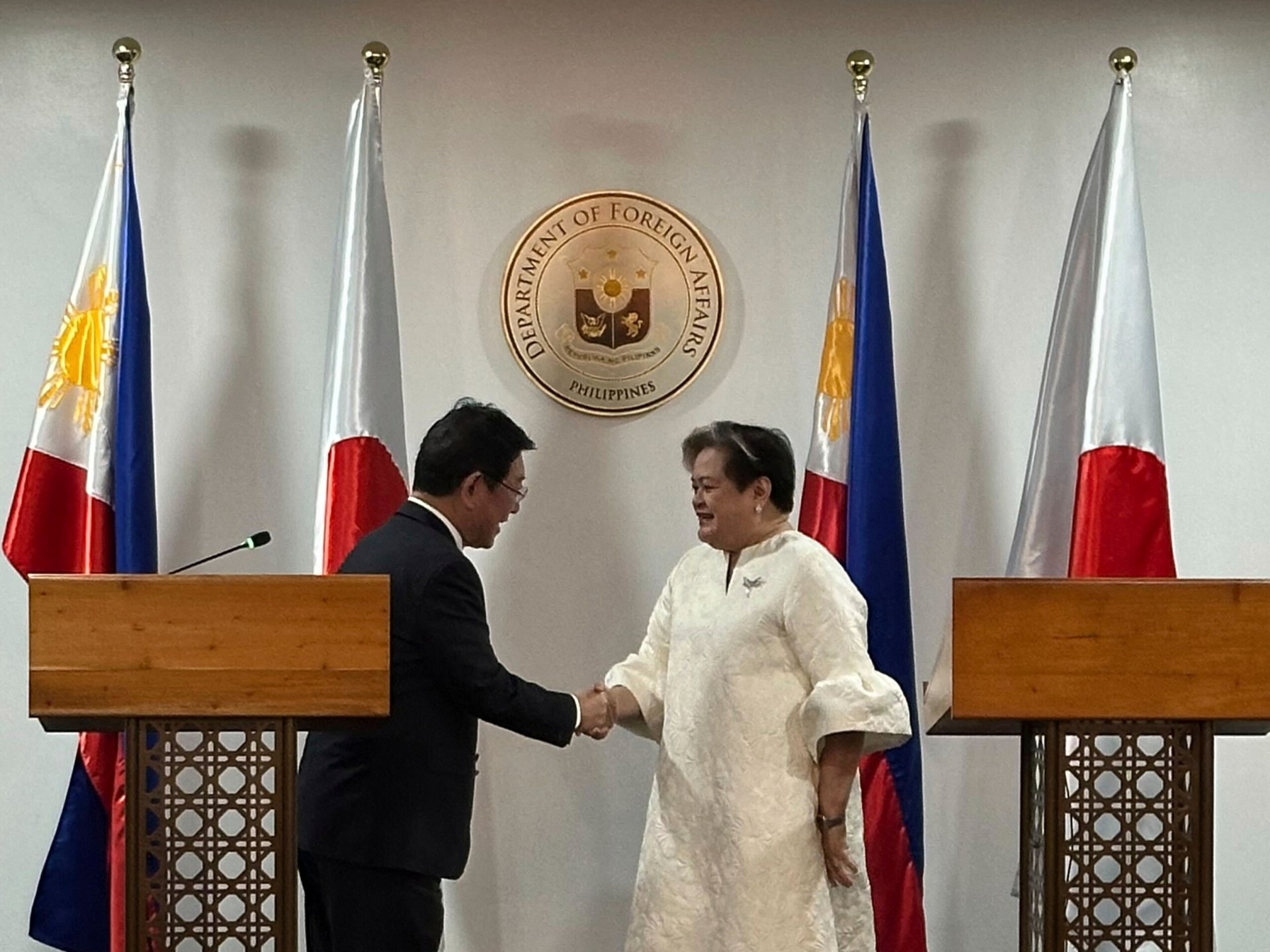
Japanese Foreign Minister Toshimitsu Motegi signed the Acquisition and Cross-Servicing Agreement with Philippine Foreign Secretary Theresa Lazaro in Manila. The deal allows the tax-free provision of ammunition, fuel, food and other necessities when their forces stage joint training.
Motegi and Lazaro also announced a $6m Official Security Assistance package from Tokyo to fund the building of facilities to house rigid-hulled inflatable boats donated by Japan to boost Manila’s naval capabilities.
Speaking of the resupply deal at a joint briefing in Manila, Lazaro said it would “enhance our mutual military interoperability and readiness” while building off a previously signed visiting forces agreement.
“We both recognised the value of promoting the rule of law, including the freedom of navigation and overflight, especially in the South China Sea,” Lazaro added.
Motegi said he and Lazaro “concurred on continuing to oppose unilateral attempts to change the status quo by force or coercion in the East and South China seas”, in a clear rebuke of Beijing’s increasing assertiveness but without naming China.
In mid-2024, both countries signed the Reciprocal Access Agreement, which allows the deployment of forces of either country to the other’s territory for joint and larger combat exercises, including live-fire drills. That agreement took effect in September.
In the meantime, China and Japan have long been at odds over historical and territorial issues, but relations deteriorated sharply after Japanese Prime Minister Sanae Takaichi suggested late last year that Tokyo could intervene militarily if China attacked Taiwan.
The Japanese leader’s remarks infuriated Beijing, which has long pledged to unify Taiwan with the Chinese mainland, using force if necessary, and has prompted various economic punitive measures.
In his annual New Year’s address, Chinese President Xi Jinping called the “reunification” of China and Taiwan “unstoppable”. He made the remarks days after China’s military wrapped up live-fire drills that simulated a blockade of the island.

Post Comment