Maccabi football fans and the ousting of a UK police chief – why it matters | Israel-Palestine conflict News
The resignation of the UK’s West Midlands police chief, who banned Maccabi Tel Aviv fans from attending a football match in Birmingham last year, has triggered concerns that pressure from pro-Israel groups is being allowed to override policing decisions in the United Kingdom.
Police decisions are supposed to be independent of the government or political influence in the UK. But the departure of Craig Guildford, chief constable of West Midlands Police, was the result of political pressure from pro-Israel lobby groups amid heightened sensitivities around the issues of Israel and Palestine, legal and political commentators say.
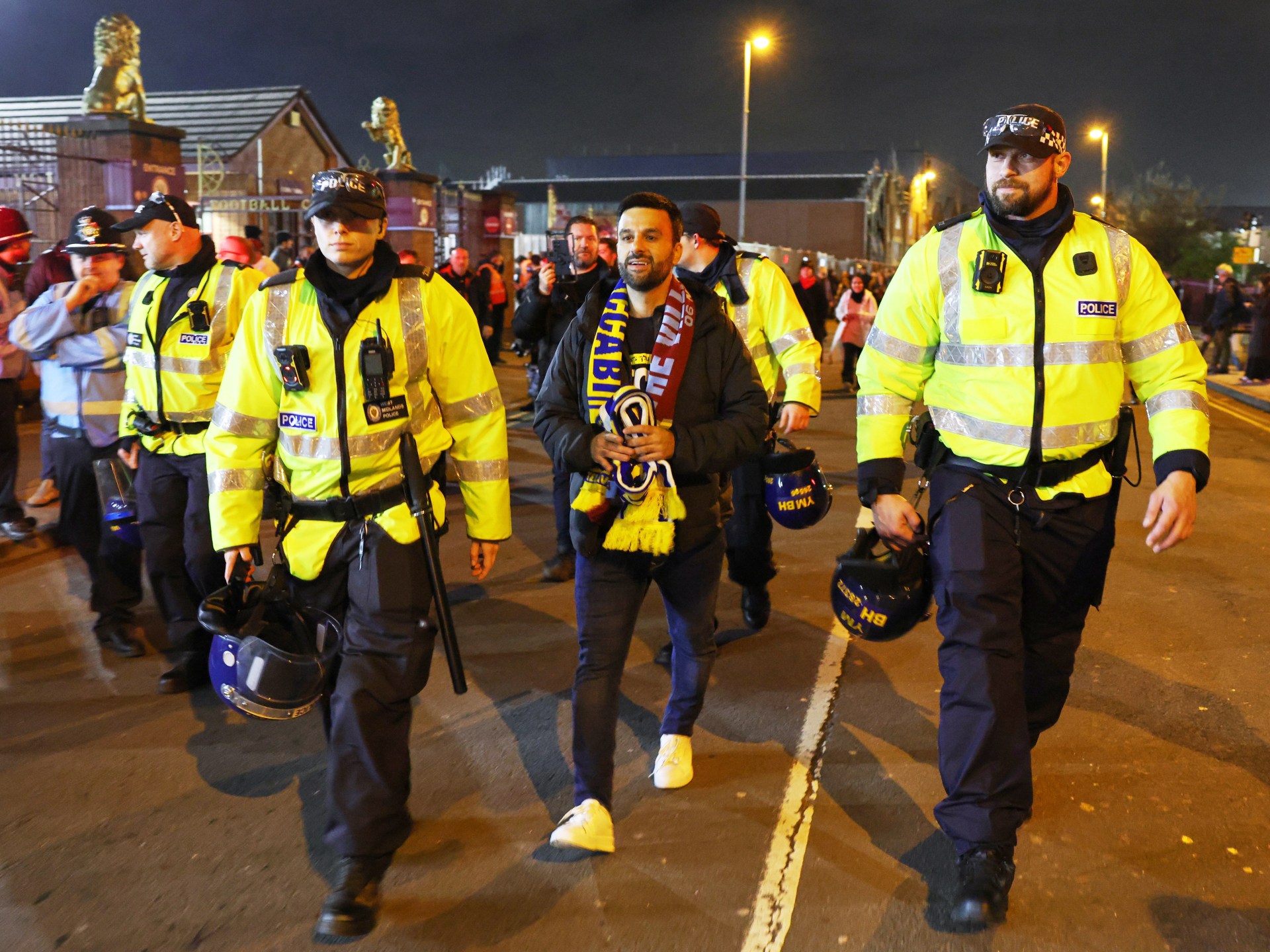
In November last year, West Midlands Police recommended that Maccabi Tel Aviv football fans should be banned from attending a Europa League match against Aston Villa in Birmingham on public order and security grounds.
West Midlands Police said it had classified the match as high risk based on “current intelligence and previous incidents, including violent clashes and hate crime offences that occurred during the 2024 UEFA Europa League match between Ajax and Maccabi Tel Aviv in Amsterdam”.
“Based on our professional judgement, we believe this measure will help mitigate risks to public safety,” the police force said at the time.
The decision was ultimately approved by Birmingham City Council’s Safety Advisory Group (SAG), a multi-agency body that brings together police, local authorities and emergency services to assess safety risks at major events.
There was a public outcry, and numerous media opinion pieces called the ban “anti-Semitic”.
That pressure has since intensified. Last week, UK Home Secretary Shabana Mahmood publicly stated that she had lost confidence in Guildford following criticism by a police watchdog of how the ban was handled. Guildford resigned on Friday.
But observers say Guildford’s departure is a sign that policing decisions which intersect with the issue of Israel and Palestine are no longer insulated from political consequences.
The reason for this, said Chris Nineham, vice-chair of the British group Stop the War Coalition, is that “most politicians are too scared to challenge the pro-Israel mainstream consensus”.
He believes the fallout from the ban will have lasting consequences for future policing decisions. “I think it will reinforce the tendency for police forces to go along with the establishment bias against Palestine supporters, which is a product of the British ruling class’s support for Israel and is reinforced by Israel’s impressive lobbying operation,” Nineham told Al Jazeera.
‘A very dangerous precedent’
Frances Webber, a retired barrister who writes on politics, human rights and the rule of law, said the significance of Guildford’s resignation extends far beyond football or crowd control.
In the UK, “police forces are operationally independent of government, and any case against Guildford should have been pursued judicially, not politically”, she explained.
The visible role of central government in the fallout from this policing decision, she argued, “sets a very dangerous precedent, not just for police and local authorities but for democracy”.
Supporters of the ban on Maccabi fans attending the match in Birmingham argue it was rooted in a risk assessment shaped by events abroad and local context.
In 2024, Dutch authorities reported serious disorder involving Maccabi Tel Aviv supporters at a match in Amsterdam, with violence both before and after the fixture. In intelligence shared ahead of the Birmingham match, British police said their Dutch counterparts informed them that significant numbers of visiting fans had been involved in organised confrontations and disturbances.
Birmingham is one of the UK’s most diverse cities, with around 30 percent of its residents Muslim and more than 40 percent identifying as Asian or from minority ethnic backgrounds, according to the 2021 Census.
Officers were therefore concerned that the arrival of large numbers of high-risk, visiting supporters could spark tensions and even retaliatory disorder.
Nineham argues, therefore, that while procedural mistakes have since been identified by a police watchdog, the underlying policing decision about the match in Birmingham was sound. “The undeniably violent element within the Maccabi fans would have been a risk to the local population,” he said.
Webber also points to reports that visiting Maccabi fans in Amsterdam had openly celebrated the killing of children in Gaza, and officers would have had to consider this when assessing the risks surrounding the Birmingham football fixture.

An imbalance in scrutiny?
So why was the ban called into question at all?
Last week, a police watchdog report by Sir Andy Cooke, chief inspector at His Majesty’s Inspectorate of Constabulary, found that “confirmation bias” had influenced how West Midlands Police assessed and presented intelligence it had received about Maccabi fans to the SAG.
It reported that Dutch police had questioned the intelligence UK police claimed to have received from them. According to a report in the UK newspaper The Guardian this week, Dutch police said key claims about the violence in Amsterdam relied on by West Midlands Police to reach its decision to ban Maccabi fans did not align with its own experience.
The report also criticised the police’s reliance on artificial intelligence (AI), in particular, erroneous AI-generated material such as a reference to a football match between Maccabi Tel Aviv and West Ham that never took place. Guildford later apologised after initially telling MPs that AI had not been used, before clarifying that the error stemmed from an AI-assisted search tool.
Since Cooke’s interim report was published, much of the British media has framed Guildford’s resignation as justified, citing the findings in the report.
However, the report found no evidence that the ban was motivated by anti-Semitism, despite repeated claims to that effect.
Critics of the report, including Jewish Voice for Labour, however, have argued that there was an imbalance when it came to weighing concerns from different members of the community.
In a letter to the West Midlands Police and Crime Commissioner, the group said the chief inspector of constabulary met with what his report described as “significant people” including representatives of the Israeli Embassy, members of Birmingham’s Jewish community, and Lord John Mann, the government’s independent adviser on anti-Semitism, but did not meet with any groups representing Birmingham’s Muslim community.
The group said that this disparity showed that Muslim safety concerns had been marginalised during the process.
‘A pro-Israel consensus’
“It is worrying how the line that this ban was anti-Semitic and that only a tiny minority of Maccabi fans are a problem has been able to take hold, despite the clear evidence to the contrary,” Nineham said, adding that most politicians have appeared unwilling to challenge a pro-Israel consensus once it was formed.
The fallout that resulted in Guildford’s departure, he believes, was ultimately shaped less by the report’s findings than by concern within the political establishment about the precedent the ban might set.
“Guildford was forced out because the political establishment didn’t want the decision he made to become a precedent… The message to the police is: don’t make decisions based on a real risk assessment, toe the pro-Israel line,” Nineham noted.
He said he believes the episode will serve to reinforce a wider tendency within policing and other institutions to avoid decisions perceived as unfavourable to Israel, deepening what he describes as an establishment bias against Palestine supporters.
Indeed, the implications of Guildford’s departure extend far beyond this single case, warns Webber, with leaders in the police force being placed in an “impossible situation”, expected to weigh foreign-policy sensitivities alongside public safety – something she said is absolutely not their role.
Guildford’s exit may satisfy political demands for accountability. But it has also sent a clear message: when policing decisions intersect with Israel and Palestine, independence comes at a price, and careers can be the cost.



Post Comment