US trade with Southeast Asia and Taiwan surging despite Trump tariffs | Trade War News
When United States President Donald Trump returned to office 12 months ago, he promised to slash the country’s trade deficit, which had swelled to about $918.4bn, or 3.1 percent of gross domestic product (GDP), for goods and services in 2024.
Invoking the International Emergency Economic Powers Act (IEEPA), he launched “reciprocal tariffs” on US trade partners to “rectify trade practices”, which the White House blamed for hollowing out US manufacturing, starting on April 2.
Recommended Stories
list of 4 itemsend of list
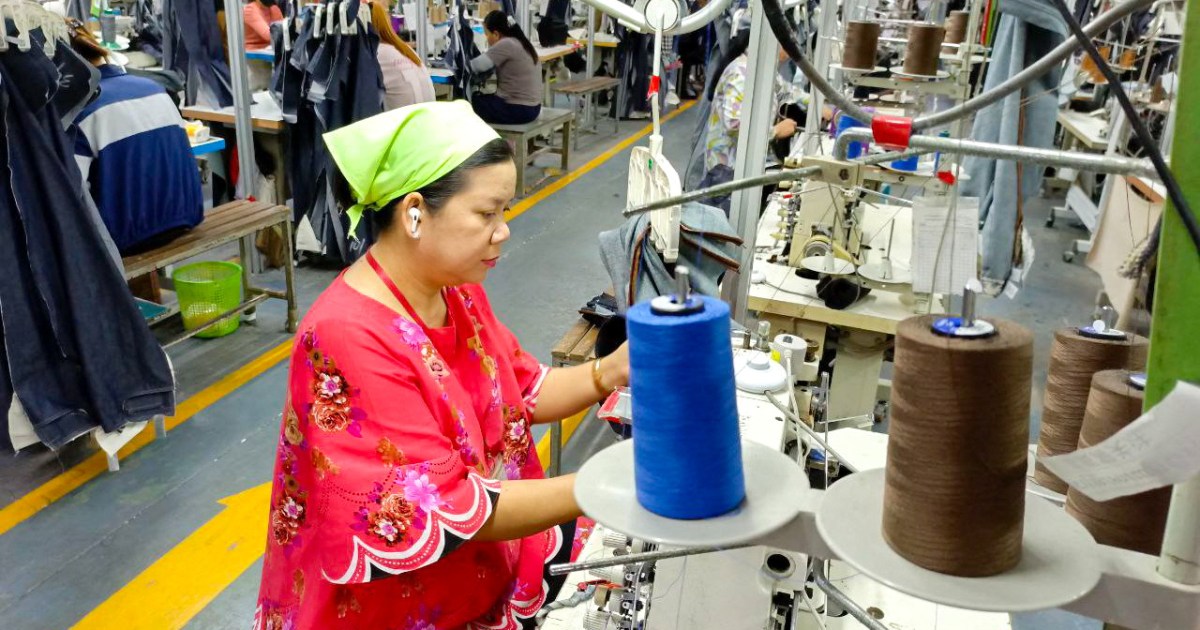
But preliminary trade data indicate that while the global US trade deficit fell in 2025 as Trump intended, the tariffs have not had their intended effect in Southeast and East Asia. Rather than reduce US dependence on the two regions, both major manufacturing hubs, the tariffs have simply rearranged supply chains.
“If you squeeze a balloon in one direction and people still want the product, then they will get the product, whatever it is, from a different location,” said Deborah Elms, head of trade policy at the Hinrich Foundation in Singapore.
“Trade moves to where trade opportunities can be found,” she told Al Jazeera. “We have shuffled the way that we do trade, but we haven’t ended trade.”
Drop in Chinese exports to US
One of Trump’s top targets was China, the world’s factory and a major source of exports to the US.
Months of tit-for-tariffs imposed by Washington and Beijing ended with an average US duty of 47.5 percent on Chinese goods as of November 2025, according to the US-based Peterson Institute for International Economics.
The final duties could change following a future meeting between Trump and Chinese President Xi Jinping, scheduled for April, but it has already led to a sharp drop in trade.
Amid the turmoil of 2025, the value of Chinese exports to the US fell 20 percent, according to Chinese customs data.
The US Census Bureau, which publishes US trade data, reported that the trade deficit for goods also fell dramatically. The value of imported goods from China fell from $438.7bn in 2024 to $266.3bn in 2025, according to US Census data.
The overall US trade deficit for goods fell from $245.5bn in 2024 to $175.4bn in 2025, according to the same data.
US trade data tell a different story for Southeast Asia, however, whose manufacturers are a key part of the “Chinese Plus One” supply chain.
Southeast Asia’s gain
The region was a major target of Trump’s “Liberation Day” tariffs, with preliminary duties set at 17 to 49 percent for Cambodia, Indonesia, Malaysia, the Philippines, Thailand and Vietnam. Tariffs were later negotiated to 19 to 20 percent through bilateral trade deals that allowed some sector-specific exemptions.
While higher than before, they are still less than the US tariffs imposed on China.
The US trade in goods with Thailand, Indonesia and the Philippines all rose in 2025, even as these countries faced “reciprocal tariff” rates of 19 percent, according to census data. The US trade deficit for goods rose 11 percent with Indonesia, 23 percent with Thailand, and an astonishing 38 percent with the Philippines – albeit from a relatively modest $4.9bn to $6.8bn.
Trade in goods with Cambodia and Malaysia remained unchanged between 2024 and 2025, despite tariffs of 19 percent, according to census data.
The most substantial change in terms of the dollar amount in Southeast Asia was seen in Vietnam, where the US trade deficit for goods rose more than $20bn – from $123.4bn in 2024 to $145.7bn in 2025 – despite a 20 percent tariff, according to the same data.
Is China just rerouting its goods?
Some of this shift can be explained by Chinese goods being rerouted through Southeast Asia to the US – a practice known as transshipment – but Zichun Huang, a China economist at the United Kingdom’s Capital Economics, told Al Jazeera that supply chains continue to move around.
“Rerouting of exports to the US via neighbouring countries has played a role. But it has not been the main driver,” she said by email.
“Instead, there’s been a more fundamental reconfiguration of supply chains: ASEAN is importing more machinery and intermediate goods from China, which are being used in the production of exports sent to the US,” she continued, using the acronym for the Association of Southeast Asian Nations.
Chinese exporters are also expanding their customer base beyond the US, as reflected in China’s record $1.19 trillion global trade surplus in 2025, posted last week by Beijing’s General Administration of Customs.
The White House last year threatened to impose a 40 percent tariff on “transshipments”, but the term has become increasingly hard to define as supply chains spread across Southeast Asia, with goods crossing borders multiple times during the manufacturing process, according to Nick Marro, principal economist for Asia at the Economist Intelligence Unit.
“Probably one reason why we haven’t seen the US move on this is the difficulty in defining a transshipment,” he told Al Jazeera. At the same time, he said, the US is distracted with trade and foreign policy concerns in other parts of the world.
Taiwan trade booms, with AI as key driver
Trump has threatened new tariffs on European countries that oppose the US’s moves to take control of Greenland, as well as countries that continue to do business with Iran following Tehran’s crackdown on mass antigovernment protests.
Trump has meanwhile shown that he can have competing and even contradictory aims for the US economy, according to experts like Elms. While the US president may want the US trade deficit to shrink, he also wants to fuel the AI boom and US-based manufacturing.
Nowhere is this clearer than in Trump’s dealings with Taiwan, which the US president has previously accused of stealing the chip industry from the US.
Trade with Taiwan is booming, even as it has fallen elsewhere in East Asia, according to US government data. The US deficit with Taiwan ballooned more than 50 percent from $73.7bn in 2024 to $111.8bn in 2025, thanks to tariff carveouts for Taiwan’s semiconductors and derivative parts.
Trump’s “reciprocal tariffs” on Taiwanese goods – agreed to last week as 15 percent – only affected about 30 percent of exports, according to Kristy Tsun-Tzu Hsu, director of the Taiwan ASEAN Studies Centre at the Chung-Hua Institution for Economic Research in Taipei.
Still, the surge in exports caught many observers off-guard, she told Al Jazeera.
“This is very different from what everybody expected, because Taiwan and other countries expected weak exports last year, but because of this inventory [stockpiling] and the AI boom, there is very strong demand for semiconductors.”
Hsu said the same demand explained the surge in imports from Vietnam, which has risen through the ranks to become one of the US’s top chip suppliers. She expected the surge to continue into 2026 for both places.
Elms said Trump was unlikely to move against Taiwan on the issue of chips, despite the ballooning US trade deficit.
She acknowledged the US president’s “desire to have the trade deficits shrink”.
But she added, “Trump loves the stock market boom as a result of AI.”
“I think for Trump, if you said to him, would you rather have a lower trade deficit overall or a higher booming stock market? He would vote for the stock market every time,” she said.
What’s next?
Whether the tariffs will remain in place is uncertain as Trump’s “reciprocal tariffs” face a legal challenge at the US Supreme Court. Experts told Al Jazeera that even if the court strikes them down, the tariffs could still take months if not years to unwind.
Priyanka Kishore, director and principal economist at Asia Decoded in Singapore, told Al Jazeera that the midterm elections in the US in November could dent Trump’s enthusiasm for tariffs as the country’s prices rise.
“At this point in time, there’s a lot of uncertainty. There are two very strong schools of thought. One is that he has a lot of other avenues to go through,” said Priyanka Kishore, director and principal economist at Asia Decoded in Singapore. “And the other is that the general sentiment is turning against him. He does not have the popular support that he used to have.”


Post Comment