The US attack on Venezuela and the collapse of international law | Donald Trump
The United States attack on Venezuela on January 3 should be understood not simply as an unlawful use of force, but as part of a broader shift towards nihilistic geopolitics in which international law is openly subordinated to imperial management of global security. What is at stake is not only Venezuela’s sovereignty, but the collapse of any remaining confidence in the capacity of the United Nations system, and particularly the permanent members of the Security Council, to restrain aggression, prevent genocide, or uphold the core legal norms they claim to defend.
The military intervention, its political aftermath, and the accompanying rhetoric of US leadership together expose a system in which legality is invoked selectively, veto power substitutes for accountability, and coercion replaces consent. Venezuela thus becomes both a case study and a warning: not of the failure of international law as such, but of its deliberate marginalisation by those states entrusted with managing global security.
From the standpoint of international law, this action constitutes a crude, brazen, unlawful and unprovoked recourse to aggressive force, in clear violation of the core norm of the UN Charter, Article 2(4), which reads: “All Members of the United Nations shall refrain in their international relations from the threat or use of force against the territorial integrity or political independence of any state.” The only qualification to this prohibition is set out in Article 51: “Nothing in the present Charter shall impair the inherent right of individual or collective self-defence if an armed attack occurs against a Member of the United Nations.” This flagrant violation of Venezuelan territorial sovereignty and political independence was preceded by years of US sanctions, weeks of explicit threats, and recent lethal attacks on vessels allegedly transporting drugs, as well as seizures of tankers carrying Venezuelan oil.
This unilateral action was further aggravated by the capture of Venezuela’s head of state, Nicolas Maduro, and his wife, Cilia Flores, by US Special Forces, reportedly guided by the CIA, to face charges of “narco-terrorism” in a US federal court, in apparent violation of sovereign immunity. This imperial posture, openly disregarding the immunity of foreign leaders, was underscored by President Trump’s declared intention to direct Venezuelan policymaking for an indefinite period, ostensibly until the country was “stabilised” sufficiently to restore oil production under the auspices of major US corporations, including Chevron, Exxon Mobil and ConocoPhillips. When asked who was in charge of Venezuela’s governance, Trump responded impatiently, “We are in charge.”
There is more politically at stake in this drastic reversal of the US Good Neighbour Policy, associated with Latin American diplomacy since 1933 and the presidency of Franklin D Roosevelt, than initially meets even the most discerning eye. Of course, this tradition of cooperative relations was repeatedly undermined after the Castro revolution in Cuba and Salvador Allende’s electoral victory in Chile.
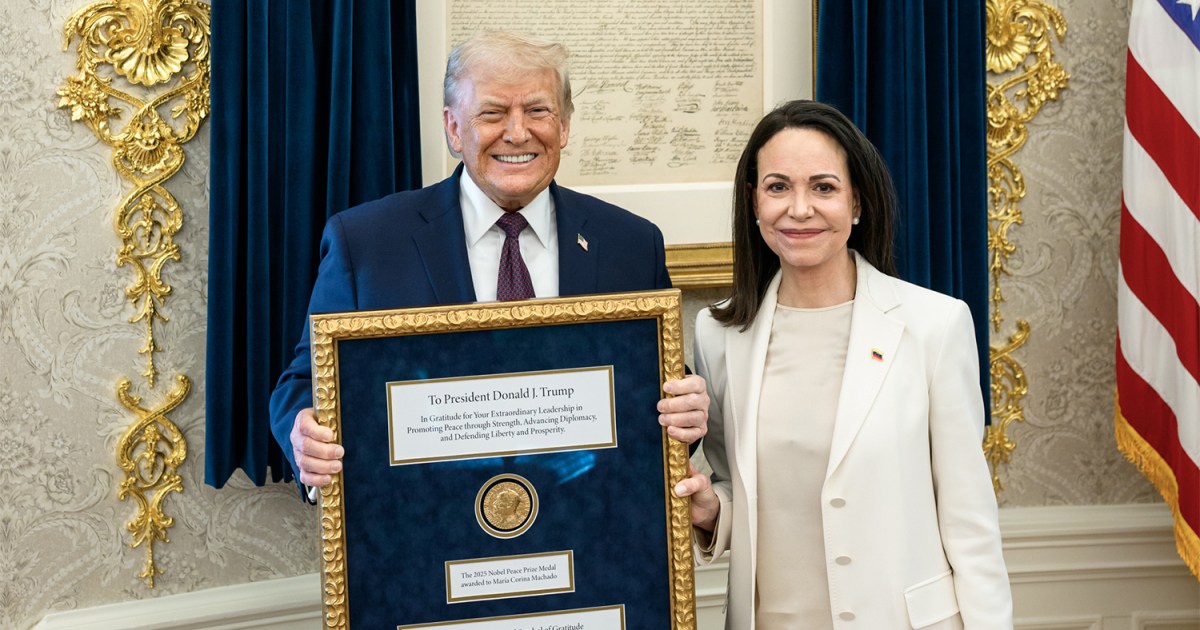
Most informed observers assumed that the attack on Venezuela aimed at achieving regime change, installing Maria Corina Machado, an ardent advocate of US intervention, longtime leader of the anti-Maduro opposition, and 2025 Nobel Peace Prize laureate, whose acceptance speech lavishly praised Trump as the more deserving candidate. The most unexpected development of the intervention has been the bypassing of Machado, and the installation instead of Vice President Delcy Rodriguez as Venezuela’s new president. Washington claimed confidence that Rodriguez would cooperate with US interests, particularly in relation to Venezuelan oil and other resources, and restore stability on terms compatible with US priorities. Trump even declared that had Machado declined the Nobel Prize on the grounds that he deserved it, she would have become Venezuela’s president.
A more plausible explanation is that Machado lacked sufficient domestic support to stabilise the country, whereas Rodriguez appeared willing to accommodate US economic demands, particularly those relating to control over Venezuela’s resource wealth, while enjoying broader popular support. The pre-attack “pro-democracy” narrative promoted by US state propaganda gained limited credibility from this continuity of leadership, rather than a symbolic march into Caracas alongside Machado to preside over her inauguration as Venezuela’s new puppet leader. Yet after meeting Trump on January 9, executives of major US oil corporations, widely assumed to be the principal beneficiaries of the intervention, expressed reservations about resuming operations, citing concerns over instability following the US takeover.
Clarifying relations between international law and global security
This military operation in Venezuela, together with its political aftermath, clearly violates international law governing the use of force, as authoritatively codified in the UN Charter. Yet even this apparently straightforward assessment contains ambiguity. The charter’s institutional design privileges the five victorious powers of the second world war, granting them permanent membership of the Security Council and an unrestricted veto. In effect, responsibility for managing global security was deliberately entrusted to these states, which also became the first nuclear weapons powers, enabling any one of them to block Security Council action even when supported by a 14–1 majority.
The Security Council is the only political organ of the UN authorised to issue binding decisions, aside from the International Court of Justice (ICJ). The ICJ, however, operates under voluntary jurisdiction, as states may withhold consent to what is known as “compulsory jurisdiction”. As a result, the management of global security has in practice been left to the discretion of the Permanent Five, usually dominated by the US or paralysed by vetoes.
In this sense, the Venezuelan operation should be understood less as signalling the collapse of international law than as an expression of nihilistic geopolitical management. If so, the appropriate remedy is not simply to strengthen international law, but to strip geopolitical actors of their self-assigned managerial role in global security. Russia’s aggression against Ukraine in 2022 can be viewed similarly: a geopolitical failure, shaped by irresponsible NATO provocations, culminating in Russia’s own provoked yet egregious breach of Article 2(4).
The Venezuelan operation further erodes any residual confidence in the capacity of the Permanent Five, and especially Trump’s United States, to manage peace, security or genocide prevention. It therefore reinforces the need to consider alternative frameworks, either by curtailing the veto or by shifting security governance beyond the UN to counter-hegemonic mechanisms, including BRICS, China’s Belt and Road Initiative, and emerging South–South development frameworks.
It must nevertheless be emphasised that international law remains indispensable and effective in most areas of cross-border interaction. In domains such as diplomatic immunity, maritime and aviation safety, tourism and communications, negotiated legal standards are generally respected and disputes resolved peacefully. International law functions where reciprocity prevails, but has never constrained great-power ambition in the domain of global security, where asymmetries of hard power dominate.
The 2025 US national security strategy: Nihilistic geopolitics
To understand Venezuela’s place within Trump’s worldview, it is essential to examine the National Security Strategy of the United States, released in November 2025. Trump’s cover letter is suffused with narcissism and contempt for internationalism, including international law, multilateral institutions, and the UN. He proclaims: “America is strong and respected again — and because of that, we are making peace all over the world.” Such rhetoric, pathological in any ordinary individual, is alarming when issued by a leader who controls the use of nuclear weapons. Trump concludes by promising to make America “safer, richer, freer, greater, and more powerful than ever before”.
The NSS repeatedly invokes “pre-eminence” as the central objective of US foreign policy, to be pursued by any means necessary. The Venezuelan intervention appears as a sequel to US complicity in Israel’s genocide in Gaza, and a possible prelude to further projects, including control over Greenland and renewed military threats against Iran. Yet the document’s primary focus is Latin America, framed through a revival of the Monroe Doctrine, now reinforced by the explicitly named “Trump Corollary,” colloquially dubbed the “Donroe Doctrine”.
This hemispheric turn abandons the post–Cold War ambition of global US leadership pursued by Obama and Biden, which consumed vast resources in failed state-building ventures in Libya, Iraq and Afghanistan. Instead, it prioritises resource extraction, securing oil, rare earths and minerals with immense benefits for US corporations, while marginalising NATO and abandoning multilateralism, underlying the recent US withdrawal from participation in 66 separate institutional entities, including the climate change treaty. Venezuela, with its vast oil reserves, strategic location and authoritarian populist government, provided an ideal testing ground — and conveniently diverted attention from Trump’s personal entanglements with Jeffrey Epstein.
In practical terms, the intervention resembles a coup rather than regime change, accompanied by an explicit demand that the new leadership take orders from Washington as the price of political survival. Trump and his Cuban exile secretary of state, Marco Rubio, openly linked Venezuela to future regime-change efforts in Colombia and Cuba, with Trump issuing a crude threat to Colombian President Gustavo Petro and US forces reportedly killing 32 Cuban members of Maduro’s Presidential Guard.
Implications
It remains uncertain whether Delcy Rodriguez’s government will negotiate an arrangement that preserves formal sovereignty while surrendering substantive control. Such an outcome would signal an embrace of digital-age gunboat diplomacy, reversing the UN principle of Permanent Sovereignty over Natural Resources, and reinstating a hierarchical hemispheric order. This vision even contemplates the subordination of Canadian sovereignty to Washington’s political and economic preferences.
International reactions to the assault on Venezuela have been muted, reflecting fear, confusion or perceived futility. Meanwhile, geopolitical rivalry intensifies, particularly with Russia and China, raising the spectre of a new Cold War or nuclear conflict. The NSS makes clear that US preeminence requires excluding all extra-hemispheric powers from the region, by its repeated referencing of “our Hemisphere”.
The Venezuelan episode thus exemplifies a broader strategy: the rejection of international law, the marginalisation of the UN, and the unilateral assertion of US dominance in the Western Hemisphere, along with potential intervention almost anywhere on the planet, but with immediate relevance to Greenland and Iran.
The views expressed in this article are the author’s own and do not necessarily reflect Al Jazeera’s editorial stance.



Post Comment