Can Europe break with Trump? A tale of energy, defence, economic dependence | Donald Trump News
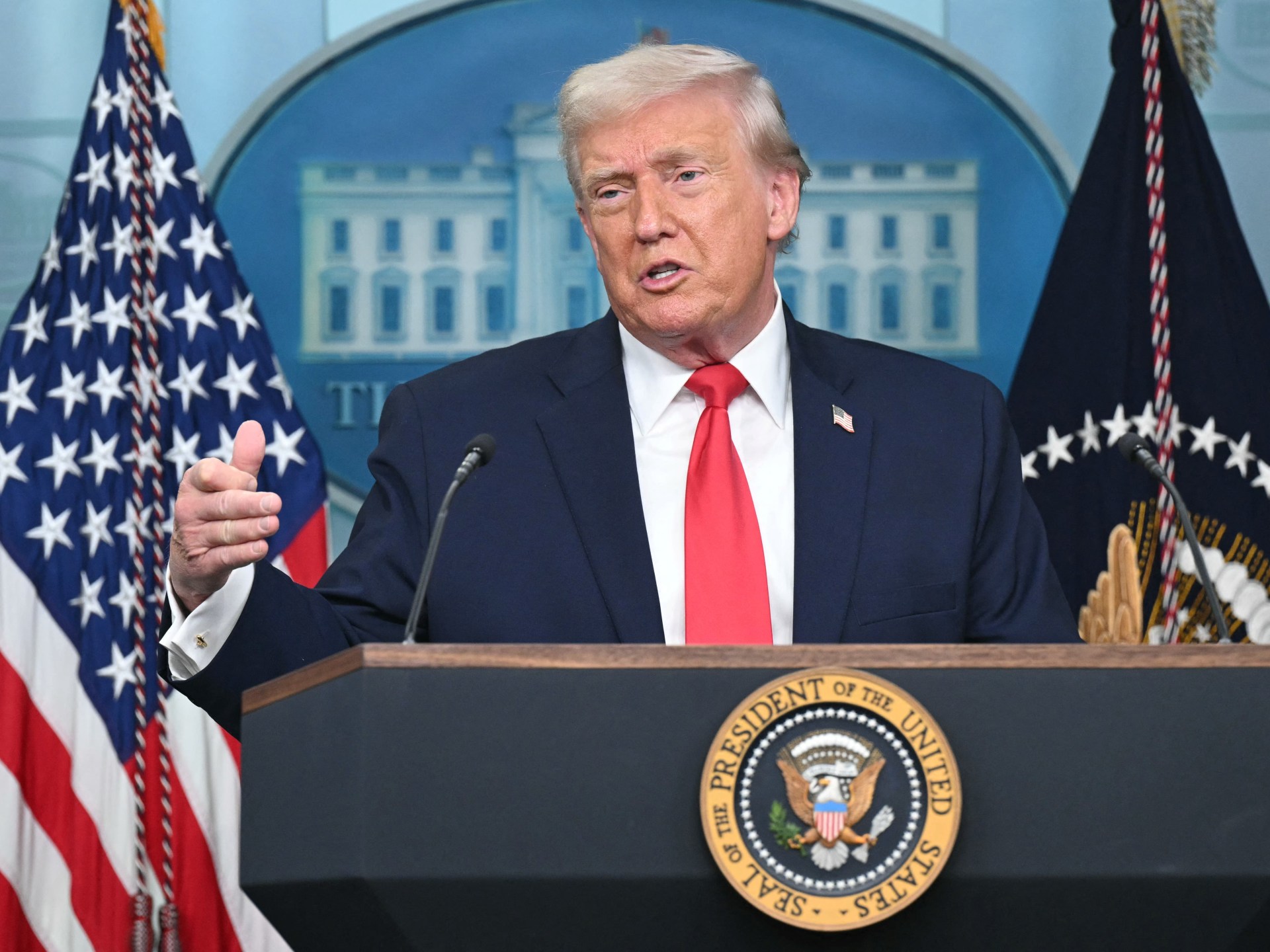
Transatlantic tensions over Greenland have ratcheted up between the United States and European nations as President Donald Trump doubles down on his ambitions to acquire the self-governing island, which is part of the Kingdom of Denmark.
In a social media post following a phone call with NATO Secretary-General Mark Rutte on Tuesday, Trump said there is “no going back” on Washington’s plans. Trump added that he would meet “the various parties” in Davos, Switzerland, during this week’s annual summit of the World Economic Forum (WEF).
Last weekend, Trump threatened to increase trade tariffs for European countries which oppose his attempt to acquire Greenland. Since the tariff threats, the European Union has been contemplating its response, with some members calling for the implementation of the bloc’s never-before-used “trade bazooka” option of retaliatory tariffs and restrictions.
Given Europe’s decades-long dependence on Washington, which has only deepened in recent years, could the EU take action against the US, and could that risk a serious transatlantic rift?
What has Trump said about Greenland this week?
Trump made a series of posts on his Truth Social platform on Tuesday, reiterating his ambition to acquire Greenland and stating that he would meet European leaders in Davos to discuss the issue.
In one post, Trump wrote that he had a “very good telephone call” with Rutte about Greenland. “I agreed to a meeting of the various parties in Davos, Switzerland. As I expressed to everyone, very plainly, Greenland is imperative for National and World Security. There can be no going back – On that, everyone agrees!” he added.
In a separate post, Trump shared a screenshot showing messages, presumably from Rutte, in which he wrote, “I am committed to finding a way forward on Greenland.”
In another post, he shared screenshots of messages from French President Emmanuel Macron, who wrote, “I do not understand what you are doing in Greenland.” In the messages, Macron also offered to set up a Group of Seven meeting in Paris on Thursday.
Trump also posted mockup images created using artificial intelligence (AI) tools on Tuesday, showing himself holding the US flag in Greenland with a sign stating “US territory”. Vice President JD Vance and Secretary of State Marco Rubio are depicted in the image, standing behind him.
Another image Trump shared shows him in an Oval Office meeting with European leaders. It includes a map on an easel showing the US flag spanning Canada, Greenland and Venezuela.
Why does Trump want Greenland?
The sparsely populated Arctic island of 56,000 people – mostly Indigenous Inuit – is geographically in North America but politically part of Denmark, making it part of Europe. Greenland withdrew from the European Community (EC/EU) in 1985 after it gained home rule, but maintains a special association with the EU as an Overseas Country and Territory (OCT), which grants limited internal market access and EU citizenship to Greenland’s residents through Denmark.
Trump has long coveted Greenland because of its strategic location and plentiful mineral deposits, including highly sought-after rare-earth metals required for the manufacture of a wide range of technology from smartphones to fighter planes. The island has therefore drawn increasing interest from leading powers as climate change opens up new shipping lanes in the Arctic.
Currently, Greenland’s economy relies mainly on fishing; locals oppose large-scale mining, and there is no oil or gas extraction.
The island’s geographical position between the Arctic and North Atlantic oceans provides the shortest air and sea routes between North America and Europe, making it crucial for US military operations and early-warning systems, especially around the Greenland-Iceland-United Kingdom gap, according to the Trump administration.
What trade tariffs is Trump threatening?
On January 17, Trump said, starting February 1, Denmark, Norway, Sweden, France, Germany, the UK, the Netherlands and Finland would be charged a 10 percent tariff on their exports to the US.
On June 1, the tariff would be increased to 25 percent, he said. “This Tariff will be due and payable until such time as a Deal is reached for the Complete and Total purchase of Greenland,” Trump wrote on Truth Social.
A day after Trump posted this threat to social media, the 27 EU members convened for an emergency meeting.
In a joint statement, the eight countries targeted by Trump with new tariffs said they “stand in full solidarity” with Denmark and the people of Greenland, a semi-autonomous Danish territory.
“Building on the process begun last week, we stand ready to engage in a dialogue based on the principles of sovereignty and territorial integrity that we stand firmly behind,” the statement said.
“Tariff threats undermine transatlantic relations and risk a dangerous downward spiral. We will continue to stand united and coordinated in our response. We are committed to upholding our sovereignty.”
What action could Europe take against Trump over Greenland?
European leaders are contemplating several responses to Trump’s threat, ranging from diplomacy to retaliatory tariffs to the extreme, last-ditch “trade bazooka” – the Anti-Coercion Instrument (ACI) – which could target specific goods and services the US has a trade surplus in with the EU.
However, the never-before-used ACI, which was adopted by the EU in 2023 following restrictions placed on Lithuanian exports by China, would likely take months to implement. It requires the agreement of a minimum of 15 EU countries, representing at least 65 percent of the bloc’s population. It also requires a months-long investigation process.
How much does Europe depend on the US?
Europe has a growing dependence on Washington in various sectors.
Defence
In recent years, Europe has become increasingly dependent on the US for military and intelligence support, especially since the start of Russia’s war in Ukraine in February 2022.
Even before that, the US was providing Ukraine with significant intelligence support, which has not been detailed publicly. However, reports and officials highlight two crucial roles it has played – first, satellite and signals intelligence help Ukraine anticipate and prepare for Russian attacks, and second, it helps locate enemy troops and bases so Ukrainians can target them with missiles, including long-range systems which can reach inside Russian territory.
European NATO states received 64 percent of their arms imports from the US between 2020 and 2024, up from 52 percent during 2015-19, according to a report by the Stockholm International Peace Research Institute (SIPRI) published in March 2025.
The US contributed about 16 percent of NATO’s common budgets, the joint largest contribution, matched only by Germany’s, according to a NATO breakdown published last year.
“Militarily, nearly half of Europe’s recent procurement comes from the US, especially in critical backbone capabilities such as combat aircraft, missiles, air defence, software-driven systems and sustainment,” Christine Nissen, chief analyst at the Copenhagen-based Think Tank Europa, told Al Jazeera.
“These dependencies are deeply locked in through platforms, upgrades, spare parts, data and interoperability.”
Economy
Europe is also highly dependent on the US for the provision of technology services and economic infrastructure, such as cloud services, semiconductors, digital platforms, satellite services, cybersecurity, energy technologies and parts of the financial system, Nissen said.
“In many of these domains, Europe relies on US firms, standards and regulatory reach, which amplifies Washington’s leverage in a confrontation.”
Investors in European countries hold more than $10 trillion of US Treasury bonds.
Bonds are investments through which investors lend money to a government or a company for a set time in exchange for regular interest payments and the original capital back at maturity to whoever is holding the bond at the time. Bonds can be bought and sold on financial markets, so the issuer of the bond may ultimately pay back a different investor from the one who first bought it.
Bonds usually offer lower returns than stock market shares but are seen as low-risk, especially government bonds.
US Treasury bonds are particularly popular as they are viewed as “safe-haven” assets. If US-Europe relations turn hostile, however, that safe haven would become highly politicised as there could be a perceived danger that the US might not repay the initial capital brought to buy the bonds.
Furthermore, if there is a rift in transatlantic relations, investors could panic and start selling off US Treasury bonds en masse. When lots of people sell at the same time, the price of bonds drops. This would mean that the value of the bonds EU members own would decline, and they would lose money on their huge pile of US bonds.
While this would be bad for the US economically, it would also mean that European holders of the bonds would no longer be able to fully rely on this stash of “safe” assets and might have difficulty finding other places big and stable enough to move that money to.
“The [economic] dependency is mutual but asymmetric. For the US, Europe is mainly a major market and industrial partner, a commercial dependence. For Europe, the reliance is operational, technological and security-critical,” Nissen said.
“That asymmetry gives Washington durable structural influence, regardless of who occupies the White House.”
Energy
Following Russia’s invasion of Ukraine in February 2022, Europe has imposed sanctions on Russian oil and has gradually reduced its energy dependence on Russia.
Europe’s imports of Russian gas fell by 75 percent between 2021 and 2025, according to a report by the US-based Institute for Energy Economics and Financial Analysis (IEEFA), published on Monday.
Instead, Europe increased energy imports from the US, especially liquefied natural gas (LNG).
Europe’s imports of US LNG jumped from 21 billion cubic metres (bcm) in 2021 to 81bcm in 2025 – almost a fourfold increase. “This means that EU countries sourced 57 percent of their LNG imports from the US in 2025,” the IEEFA report states.
The report also states that if the EU takes all the US LNG it has signed up for, and does not cut its gas use, by 2030, the US could be supplying almost 75 to 80 percent of its imports.
What happens if Europe-US relations break down?
Europe has a lot to lose.
“A serious rupture with the US would likely reduce Europe’s access to critical military support, technology, intelligence, energy flows and parts of the financial and digital ecosystem,” Nissen said.
That dependence is why Europe has usually tried hard so far not to clash with the US, she said.
“In the short term, Europe cannot meaningfully decouple without real capability and economic costs,” Nissen said.
Therefore, she added, Europe is unlikely to abruptly break from the US, but rather gradually shift away from it by building new trading partnerships and developing its production capabilities for essential goods and services.
“Over the past weeks, Europe has started to move more explicitly toward diversification as a strategic hedge: reducing single-supplier exposure, widening partnerships and strengthening internal resilience,” Nissen said.
“At the same time, there is a much stronger political focus on building European capabilities – in defence production, critical technologies, energy infrastructure and industrial capacity. The logic is not decoupling from the US, but lowering vulnerability and increasing European room for manoeuvre over time.”



Post Comment