Ecuador announces 30 percent tariff on Colombia over drug trafficking | International Trade News
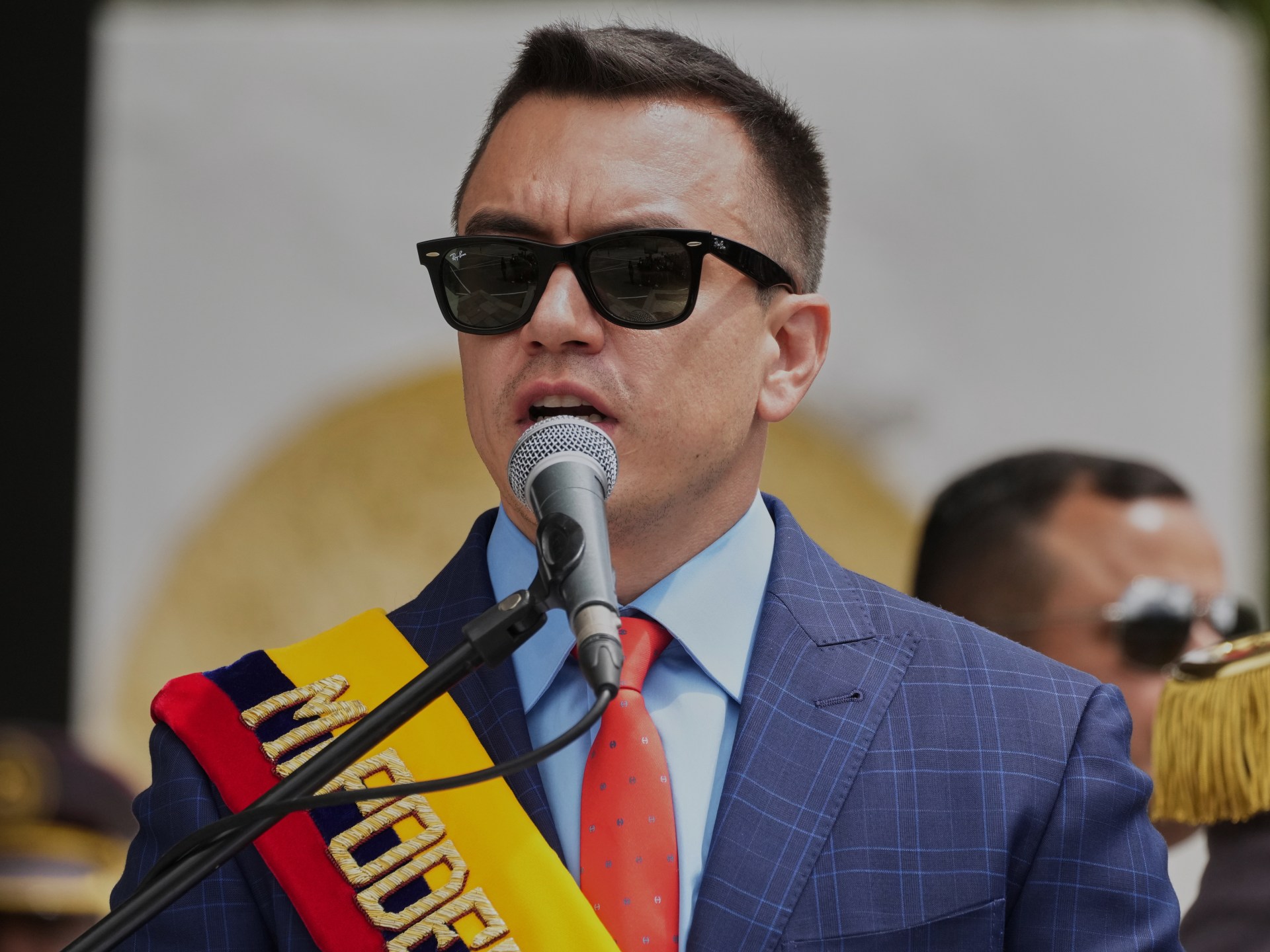
Ecuador’s President Daniel Noboa has revealed that, next month, his country will start to impose a 30 percent “security tariff” on its neighbour Colombia for failing to contain illegal mining and the trafficking of cocaine.
Wednesday’s announcement echoes similar measures taken by United States President Donald Trump, who has criticised Colombia’s left-wing government for not pursuing a more aggressive approach to drug trafficking.
Recommended Stories
list of 3 itemsend of list
In a social media post, Noboa unveiled the new tariff on Colombian imports. He warned that the new tax would remain in place until the country showed “a real commitment to jointly confronting drug-trafficking and illegal mining at the border”.
“We have made genuine efforts to cooperate with Colombia, even while facing a trade deficit exceeding $1bn annually,” Noboa wrote.
“But while we have insisted on dialogue, our military continues to confront criminal groups linked to drug trafficking at the border without any cooperation from Colombia. Therefore, given the lack of reciprocity and decisive action, Ecuador will apply a 30 percent security tariff on imports from Colombia starting February 1.”

Close ties to Trump
Noboa, 38, is a right-wing leader who has expressed affinity for Trump and his policies.
When Trump was re-elected in 2024, Noboa hailed the victory with a social media post saying that the “future looks bright for the Continent”.
And since his own re-election in 2025, Noboa has backed Trump’s attempts to increase US influence across Latin America, most notably championing a failed referendum in November that would have allowed the construction of US military bases in Ecuador.
Noboa’s administration has argued that close cooperation with the US is necessary to combat violent crime in the country. But the tight relations have also bolstered Trump’s efforts to expand US authority throughout the Western Hemisphere.
Twice over the past year, Noboa has hosted Trump’s Homeland Security Secretary Kristi Noem: once in July and a second time before the November ballot referendum.
“Ecuador has been an excellent partner to the U.S. in our work to stop illegal immigration, drug trafficking, and smugglers on land and on the seas,” Noem wrote at the time.
Trump has made tariffs a hallmark of his second term in office, calling the term “the most beautiful word” in the dictionary. Since returning to the White House in January 2025, he has enacted a sweeping tariff campaign, which includes a baseline tariff of 10 percent on nearly all trading partners and additional individualised tariffs for certain countries.
Trump has argued that tariffs protect domestic industries while feeding government coffers. He has also used the economic penalty as a means of forcing trading partners to submit to policy demands.
Last year, for instance, Trump threatened the US’s neighbours, Mexico and Canada, with tariff hikes if they failed to adequately combat drug smuggling and cross-border immigration.
His administration has similarly imposed a tariff on China to incentivise the country to staunch the flow of fentanyl.
But critics have questioned the legality of Trump’s tariff campaign and its coercive nature. Economists have also warned that the tax hikes on imports could result in higher consumer prices domestically.

Fraying relations with Petro
For his part, Noboa appears to be using the threat of tariffs not only to force compliance with Ecuador’s crime crackdown but also to strike back at Colombia’s President Gustavo Petro.
A former rebel fighter, Petro was elected in 2022 as his country’s first left-wing president. But he has faced criticism, both domestically and abroad, about his efforts to combat drug trafficking.
Colombia remains the world’s largest producer of cocaine. In a 2024 report, the United Nations said the country had seen 10 consecutive years of rising production potential. Nearly 253,000 hectares (645,000 acres) in the country were dedicated to the cultivation of coca leaves, the raw ingredient in cocaine.
Complicating efforts is a six-decade-long internal conflict in Colombia. The slow-simmering conflict has long pitted government forces, right-wing paramilitaries, left-wing rebels and criminal networks against each other.
Since taking office, Petro has departed from the heavy-handed crackdowns of his right-wing predecessors, instead opting for a “Total Peace” plan that involves dialogue with armed rebels and criminal groups.
His administration has also overseen a shift away from the forced eradication of coca crops, largely grown by impoverished rural farmers. Instead, it has pursued a strategy of voluntary crop substitution, while attacking the laboratories and facilities that process the leaf into drugs.
Petro has claimed his strategy has resulted in the destruction of nearly 18,400 drug-making labs. In addition, last November, his administration claimed to have made Colombia’s largest drug bust in a decade, seizing 14 tonnes of cocaine.
But right-wing figures like Trump have called for “more aggressive action” from Colombia. The US president has gone so far as to threaten military action, saying Petro should “watch his a**”.

Differences over crime and politics
Noboa has been among Petro’s critics in the region. His election was buoyed, in part, by a pledge to tamp down on Ecuador’s burgeoning crime crisis.
Since the COVID-19 pandemic, Ecuador has shed its reputation as an “island of peace” in Latin America, as criminal activity spiked.
That trend coincided with a steep rise in murders. As of 2024, the think tank Insight Crime found that Ecuador had a homicide rate of 44.6 for every 100,000 people, the highest proportion of any South American country. A total of 7,062 homicides were reported that year.
Experts say the crime wave reflects, in part, Ecuador’s strategic position between Colombia and Peru, the world’s second-largest cocaine producer.
But the timing of Noboa’s tariffs has raised questions about the president’s motives — and whether he was strictly focused on crime, rather than politics.
On Tuesday, one day before the new tariffs were unveiled, Petro posted on social media a message in support of Ecuador’s former Vice President Jorge Glas, a left-wing figure.
In 2024, Noboa had authorised a controversial raid on Mexico’s embassy in Quito to arrest Glas on bribery charges. Glas currently resides in a maximum security prison, and Petro has accused the Ecuadorian government of using “psychological torture” against the former politician.
“Just as I demanded the release of political prisoners in Venezuela and Nicaragua, I believe Jorge Glass should be released,” Petro wrote on Tuesday.
The Glas case has been a source of ongoing tension between Petro and Noboa, leading some critics to speculate whether the tariffs were, in part, a response to Tuesday’s post.
Ecuador and Colombia are among each other’s top trading partners, and the new taxes are likely to spur questions about the future of regional trade agreements.

Post Comment